





“Push Pull Legs” Workout Challenge
What is Push-Pull-Legs (or PPL), why is it so popular and how can you use it? As a personal trainer, I get asked all the time, “Which workout split, routine or plan should I use?” I can confidently say that PPL is a proven workout plan used by everyone from the most accomplished bodybuilders to the mamas trying to stay strong enough to keep up with their littles. In short, PPL organizes exercises by movement pattern, grouping related muscle groups rather than isolating a single muscle group per workout. In this article, I’ll break down how PPL works, who it’s best for and how to build a Push Pull Legs workout plan that fits your goals and schedule.
Already completed this challenge? Leave a review!
The PPL Split Explained
A traditional Push-Pull-Legs (PPL) split divides strength training into 3 categories. These categories are based on different movement patterns and how the muscles work together during exercise. Push day focuses on exercises and movements that push resistance away from the body, while pull day is the opposite. Push exercises primarily work the chest, shoulders and triceps. On pull day, you can expect to hit your back, biceps and rear delts. Leg day focuses on the muscle groups found in the lower body, like the quadriceps, hamstrings, glutes and calves.
Push
Pushing exercises focus most of their effort on moving resistance away from the body and allow you to split the upper-body muscle groups into 2 distinct workouts effectively.
- Chest (pectorals): The majority of push days start with the chest because of the demand. The chest takes on a lot of work during pushing movements, and starting with larger, more demanding exercises allows you to perform them with the most energy and focus. The bench press, incline dumbbell press, dips and push-ups are your go-to movements for building chest strength and muscle.
- Shoulders (deltoids): Your shoulders are already involved in many chest pressing movements, so exercises that more directly target the deltoids can build on that work. The overhead press, dumbbell shoulder press and lateral raises are great options for targeting the shoulders and focusing on the front and lateral deltoids. Both contribute to overall shoulder strength and stability.
- Triceps: The triceps assist with nearly every pressing movement on push day! Putting in a little focus work to finish your push day with exercises that directly target the triceps, like triceps pushdowns, overhead triceps extensions and dips, will help your overall strength gains for your next push day.
Pull
Pulling exercises focus most of their effort on bringing resistance toward the body and allow you to effectively train the upper-body muscles that work opposite the push muscles.
- Back: Pull day starts with the back because it targets some of the largest muscle groups in the upper body and does a lot of work during compound lifts. Pull-ups, lat pulldowns, barbell rows, dumbbell rows and cable rows are great options for building back strength and muscle growth. These compound exercises can also engage the traps and rear delts while building overall upper-body strength.
- Biceps: Your biceps assist with nearly every pulling movement on pull day, making them an easy muscle group to finish with some focused work. Barbell curls, biceps curls and hammer curls are great isolation exercises for directly targeting the biceps after your larger back movements. Keeping these exercises controlled and focusing on a full range of motion can help build biceps strength and muscle.
- Rear Delts: The rear delts help support shoulder movement and stability and are involved in many pulling exercises. Face pulls, dumbbell rows and barbell rows can all involve the rear delts, with face pulls providing a more direct way to target this often-overlooked muscle group. A little focused rear-delt work can help round out your pull workout and support balanced upper-body strength.
Legs
Leg exercises focus on the muscles of the lower body, with leg day typically combining compound lifts and isolation exercises to target the major muscle groups from multiple angles.
- Quads: Your quads do a lot of the work during exercises that require you to extend the knee, making them a major focus of any leg day. Squats, front squats, leg press, lunges and leg extensions are great options for building quad strength and supporting overall lower-body strength.
- Hamstrings: The hamstrings work alongside the glutes during many lower-body movements and are responsible for bending the knee and helping extend the hip. Romanian deadlifts, leg curls and lying leg curls are great options for targeting the hamstrings, while compound movements like deadlifts can train the hamstrings alongside other lower-body muscle groups.
- Glutes and Calves: Your glutes are involved in many of the biggest compound movements on leg day, including squats, lunges and Romanian deadlifts. The calves can be trained more directly with calf raises, making them an easy addition to the end of your legs workout. Training both muscle groups helps create a more complete lower-body workout while supporting strength and stability.

Who a Push Pull Legs Split Is Ideal For
- For beginners seeking structure, PPL provides a simple, organized workout routine that takes the guesswork out of choosing which muscle groups to train each day.
- Intermediate lifters focused on finding balance can use PPL to find stability in their strength training, training volume and recovery across the week.
- Advanced lifters handling volume can use PPL to distribute higher training volume across multiple workouts while allowing for recovery in targeted muscle groups.
- Anyone training 3 to 6 days per week can adapt a PPL split to both a 3-day and 6-day schedule, making it a flexible workout split.
Download the Plan That Best Fits Your Schedule 👉
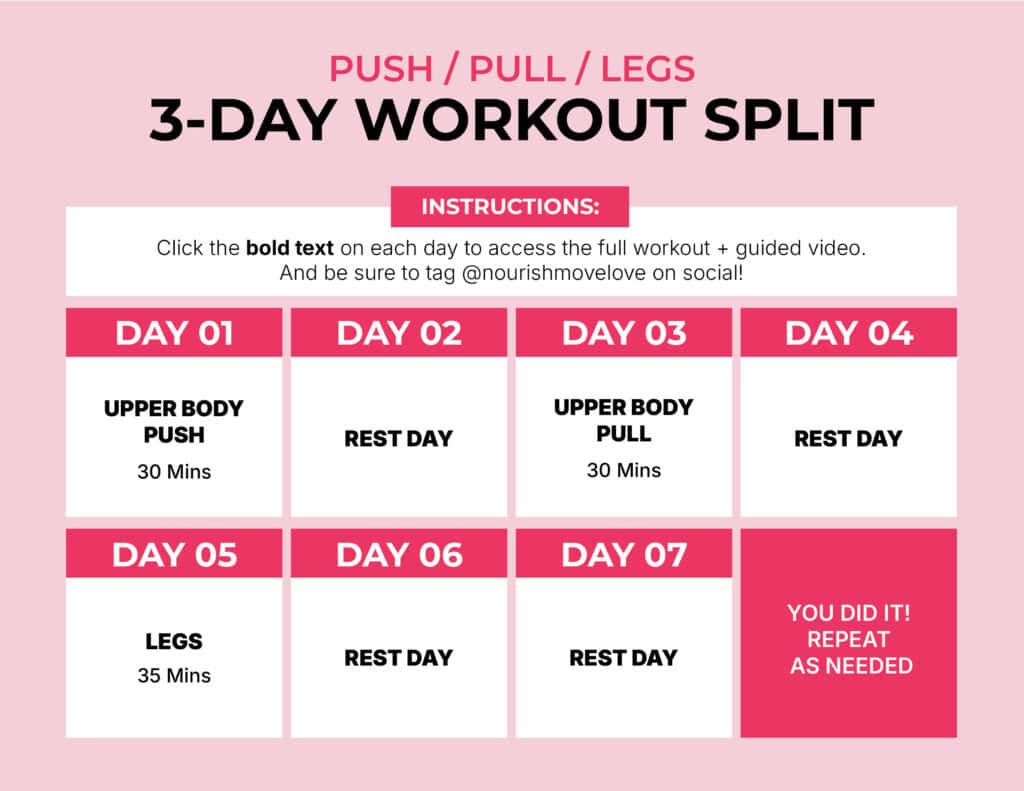
3-Day Version
Day 1: Upper Body Push
- Workout Time: 30 Minutes
- Equipment: Medium-to-heavy set of dumbbells. I’m using 15-25 lbs. Optional box/bench.
- YouTube Link: 30-Minute Push Day: Chest, Shoulders, Triceps
Day 2: Rest
Rest days are part of the Push Pull Legs workout plan, not a break from making progress. Use rest days in these programs to prioritize recovery, hydration and adequate nutrition while giving your muscles time to adapt to your strength training. Light walking, mobility work, yoga, Pilates, barre or gentle stretching are great options if you want to stay active without adding significant training volume. Here are some example workouts to try.
Day 3: Upper Body Pull
- Workout Time: 30 Minutes
- Equipment: Medium-to-heavy set of dumbbells. I’m using 15-30 lbs. Optional bench, pull-up bar and long loop resistance band if needed (discount code: NML).
- YouTube Link: 30-Minute Back and Bicep Pull Workout
Day 4: Rest
- Mobility and Recovery Exercises (10 Minutes)
- 15-Minute Mobility Workout
- 8 Best Foam Roller Exercises
Day 5: Legs
- Workout Time: 35 Minutes
- Equipment: Medium-to-heavy set of dumbbells. I’m using 20-30 lbs. Optional glute band.
- YouTube Link: 7 Best Compound Leg Exercises
Day 6: Rest
Day 7: Rest
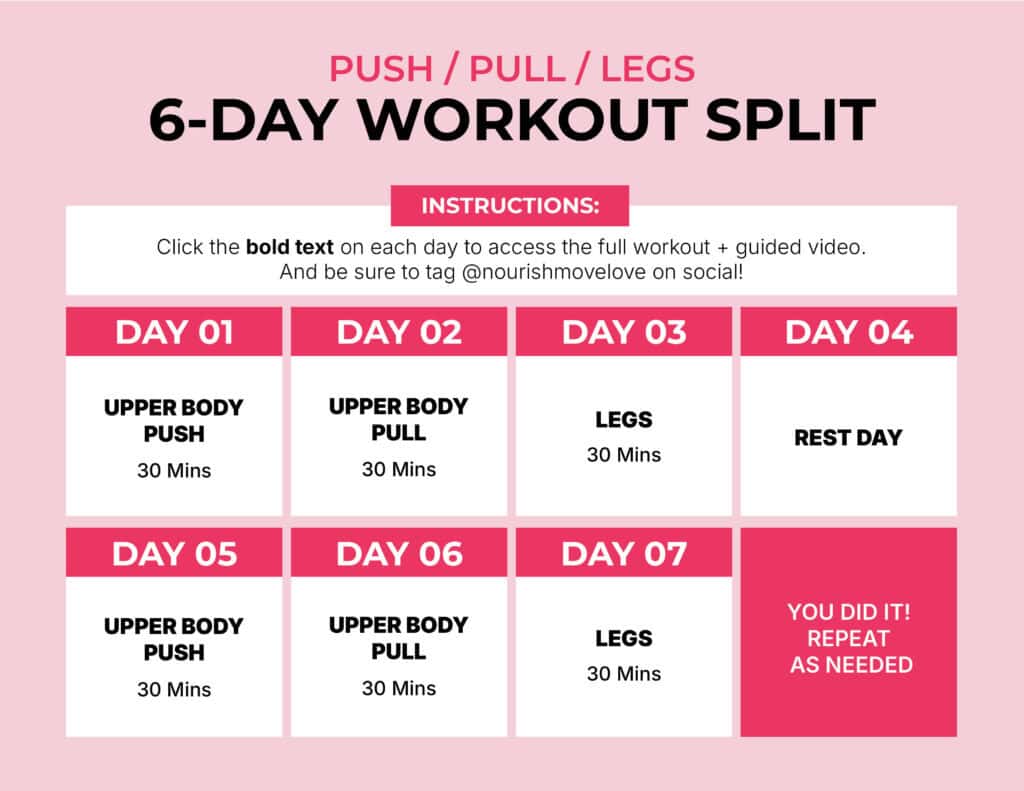
6-Day Version
Day 1: Upper Body Push
- Workout Time: 30 Minutes
- Equipment: Medium-to-heavy set of dumbbells. I’m using 15-25 lbs. Optional box/bench.
- YouTube Link: 30-Minute Push Day: Chest, Shoulders, Triceps
Day 2: Upper Body Pull
- Workout Time: 30 Minutes
- Equipment: Medium-to-heavy set of dumbbells. I’m using 15-30 lbs. Optional bench, pull-up bar and long loop resistance band if needed (discount code: NML).
- YouTube Link: 30-Minute Back and Bicep Pull Workout
Day 3: Legs
- Workout Time: 30 Minutes
- Equipment: Medium-to-heavy set of dumbbells. I’m using 15-30 lbs. Option to add a bench and a weight plate or book.
- YouTube Link: 30-Minute Quad and Glute Workouts
Day 4: Rest
- Mobility and Recovery Exercises (10 Minutes)
- 8 Best Foam Roller Exercises
- 10-Minute Full-Body Stretch Routine
Day 5: Upper Body Push
- Workout Time: 30 Minutes
- Equipment: Medium-to-heavy set of dumbbells. I’m using 5-20 lbs. Optional bench.
- YouTube Link: 30-Minute Chest, Shoulders + Triceps Workout
Day 6: Upper Body Pull
- Workout Time: 30 Minutes
- Equipment: Medium-to-heavy set of dumbbells. I’m using 15-30 lbs. Optional bench, pull-up bar and long loop resistance band if needed (discount code: NML).
- YouTube Link: 30-Minute Back and Bicep Workout
Day 7: Legs
- Workout Time: 30 Minutes
- Equipment: Medium-to-heavy set of dumbbells. I’m using 20-25 lbs.
- YouTube Link: 30-Minute Glute and Hamstring Overload Workout

Find This Workout Plan On YouTube
 YouTube Playlist
4-Day Workout Split Details
1. Gym Equipment Needed:
A Set of Dumbbells (Discount Code: NML5). Most of the daily workouts require a set of free weights. Each weight training workout will have a recommended dumbbell weight, usually between 15-30 pounds. You want a weight heavy enough that your last few reps are a struggle, but you are still able to complete the workout with good form.
Optional Exercise Equipment: Mini Loop and Long Loop Resistance Bands (Discount Code: NML), Pull-Up Bar and Bench/Box/Chair.
2. Time Requirement:
Strength workouts are around 30 minutes a day, 3-6 days per week. You can always take more rest days as needed.
3. Fitness Level:
Intermediate to advanced, with modifications offered for all fitness levels in the daily workout videos.
If you’re looking for a full-body workout plan for beginners, follow my Beginner Workout Plan.
4. Cost:
FREE! No sign-up needed; this is a FREE Workout Plan.
FAQs
Can beginners effectively use a push-pull-legs workout plan?
Definitely! Push-pull-legs workout plans can be very effective for beginners, especially when starting with a 3-day routine that allows plenty of time for recovery. A PPL split can help beginners learn foundational compound movements and isolation exercises while keeping each workout focused on specific muscle groups. I recommend prioritizing proper form and manageable training volume before worrying about lifting heavier weights or maximizing muscle growth.
How does PPL compare with full-body workouts?
A PPL split divides training into push, pull and leg days, while full-body workouts train most major muscle groups during each session. Full-body workouts can be a great option for beginners or anyone who can only strength-train 2-3 days per week, while PPL allows greater training volume for specific muscle groups in each workout. Neither workout split is inherently better, but both provide good options for you to fit into your schedule, help reach your goals and ensure you have the ability to recover consistently.
How do you progressively overload a PPL routine?
Progressive overload is not specific to any one workout routine and does not vary drastically from one to the next. It can be integrated into your PPL routine by gradually increasing the challenge placed on your muscles over time. Progressive overload supports strength and muscle growth by increasing the weight, reps, sets, or training volume of an exercise with proper form. I recommend starting with a weight you can control, then gradually increase the challenge as exercises like squats, rows, presses or Romanian deadlifts get easier.
How To Download and Use This 4-Day Workout Split
- Download the 3-Day Push/Pull/Legs Workout Split PDF by clicking here, and download the 6-Day Push/Pull/Legs Workout Split PDF by clicking here, or bookmark this webpage for reference.
- Save this workout calendar to your mobile device home screen for easy access.
- Open the workout calendar PDF in the Safari browser on your phone.
- Tap the bottom arrow in the center of your screen.
- Select ‘Add to Home Screen’.
- Hover over and then click on the bold text each day to access the full video on nourishmovelove.com. Or scroll to find the daily workouts on YouTube.
- You can also access all of the home workout videos on this workout challenge calendar on YouTube via this YouTube Playlist: Push Pull Legs Workout Split.
- Share your daily workouts with me by tagging @nourishmovelove on social and ‘Pin’ the daily workouts on Pinterest so you can do them again.
More Workouts
At HomePin This: Push Pull Legs Workout Plan (3-Day or 6-Day)

Leave A Review
Your review helps us keep creating free workouts.
Did you love this workout challenge or notice your strength improving? We would truly appreciate a review! Every single one helps us keep creating free fitness content that supports you in your health journey.
This post includes affiliate links. I do earn a commission for products purchased using these links (at no additional cost to you). Thank you for supporting Nourish Move Love, making the content you see on this blog possible.
no comments
Leave a Comment