





7 Best Strength Training Exercises for Women (30-Minute Workout)
This 30-minute full-body dumbbell strength workout for women features 7 of the best strength training exercises you can do at home. It combines 7 compound strength training exercises with 45 seconds of work and 15 seconds of rest, repeated for 3 sets. Strength training helps build muscle, support bone health and boost metabolism.
I’m a huge advocate for strength (or resistance training) for women because it’s one of the most effective and empowering forms of exercise you can do. Strength training means using resistance, like dumbbells, resistance bands or your own bodyweight, to challenge your muscles and build strength over time.
For women, regular strength training is especially important. Strength training helps build lean muscle, maintain bone density and support long-term health. I also love that strength training translates directly to everyday life, whether that means carrying groceries with ease, carrying kids or feeling stronger on a hike.
Strength training becomes even more important as you age. Muscle mass declines with age, and that loss can accelerate after menopause. Regular strength training helps preserve muscle while supporting bone health, joint health and healthy weight management and/or weight loss, and may help reduce osteoporosis risk. If you’re over 50 and looking for a place to start, my 12-week strength training plan for women over 50 is designed to help you build strength progressively.
And the best part? Strength training doesn’t have to be expensive or complicated. You can do an effective workout at home with nothing more than a pair of dumbbells or even just your bodyweight. This 30-minute workout combines compound strength moves that target your lower body, upper body and core in a single session, helping you build strength for everyday life.

Read A 5-Star Review ⭐⭐⭐⭐⭐
“I always use your workouts when I need something from home! As a physical therapist, I LOVE how you incorporate the multiplanar movements/single-sided weight for the core!!”
— Alyssa C.
Workout Details
Build full-body strength with these strength exercises for women, combining 7 of the best compound strength training exercises into a challenging and effective 30-minute workout.
This strength workout has been my go-to through all seasons of life, including pregnancy and postpartum. It’s also a great low-impact workout to try when you’re coming back from a break or illness. You decide how challenging it is based on the weights you pick up.
Add this full-body strength-building workout for women to your home training program 1-2 times a week to build muscle and increase endurance. This workout can be done at home with dumbbells, resistance bands or just your bodyweight.
Workout Equipment:
Medium to Heavy Set of Dumbbells. I recommend between 5-25 lbs, depending on your fitness level. I used 10, 15 and 20 lb dumbbells in today’s workout. The goal is to fatigue your muscles by the end of each set. You should struggle to complete the last 2-3 reps with correct form. That means you chose challenging weights.
Option to drop weights at any time and do this workout with just your body weight, or swap in resistance bands or a kettlebell for the goblet-style front squat if that’s what you have. You don’t need a barbell or bench press for this workout.
Workout Instructions:
Follow along with the guided Weight Training For Women Workout on YouTube, led by me — your certified personal trainer, Lindsey Bomgren.
Your Workout Looks Like This:
- Guided Warm-Up and Cool-Down
- 7 Strength Training Exercises
- Timed Intervals (45 seconds of work, 15 seconds rest; complete as many repetitions as you can in the timed interval)
- Repeat all 7 Exercises x3 Sets (taking a 1-minute break between sets)
For each timed interval, aim for roughly 8-12 repetitions using a weight that makes the last 2-3 reps challenging while maintaining good form. You’ll complete 3 total sets of each exercise.
Note: Today’s dumbbell workout routine is an updated version of a popular strength training workout. I re-filmed this workout to improve the audio and video quality and share some new moves. If you try both, I’d love to know which version is your favorite!
Why These 7 Exercises: The Basic Strength Training Movement Patterns
Most effective strength training routines are built around a handful of fundamental movement patterns: squat, hinge, lunge, push, pull and core. These patterns help you train all the major muscle groups while building strength for everyday movements.
Here’s how the 7 exercises in this workout fit into those basic strength training movement patterns:
- Squat: Front Squat and Overhead Shoulder Press
- Hinge: Deadlift and Upright Row
- Lunge: Reverse Lunge and Bicep Curl; Lateral Lunge and Single-Arm Back Row
- Push: Glute Bridge Hold and Chest Press
- Pull: Single-Arm Back Row and Upright Row
- Core: Every exercise challenges your core, especially the Side Plank and Push-Up
You’ll see these same patterns throughout strength training. Front squats are a squat variation, lateral lunges are a unilateral squat/lunge variation and upright rows are another variation of the pulling pattern. Learning these foundational movements makes it easier to build balanced workouts, whether you’re using dumbbells, resistance bands, free weights or bodyweight.
For more ways to incorporate these movement patterns into your routine, check out my guides to functional strength training and compound exercises.
Workout Outline
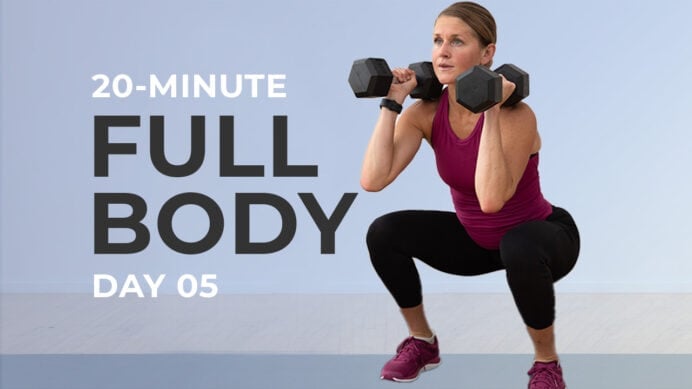
1. Front Squat and Overhead Shoulder Press
Targets: Glutes, quadriceps, hamstrings, shoulders (rotator cuff and anterior deltoid), and core.
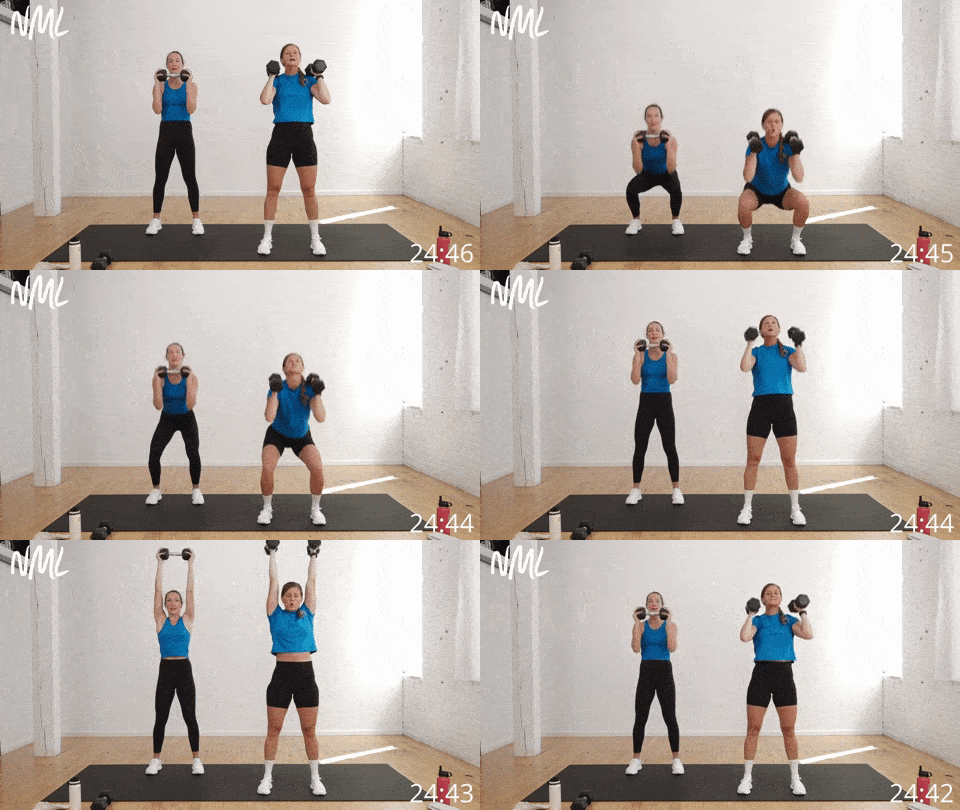
How to Do a Front Squat and Overhead Shoulder Press
- Stand with your feet shoulder-width apart and your toes pointing straight ahead or slightly angled out away from your body.
- Hold one dumbbell in each hand at your shoulders (palms facing in), and exhale to engage your core.
- Lower your hips down into a front squat, aiming to get your thighs parallel to the ground. Keep your weight in your heels, elbows and chest up.
- Drive through your heels to stand tall and perform an overhead shoulder press by pressing both dumbbells overhead, locking out your biceps by your ears.
- Lower the dumbbells back to your shoulders and repeat the squat-to-overhead press.
Modification: Hold one dumbbell horizontally at your chest, or perform the movement as a bodyweight exercise.
2. Alternating Reverse Lunge and Bicep Curl
Targets: Biceps, quads, hamstrings, glutes, and core.

How to Do an Alternating Reverse Lunge and Bicep Curl
- Stand with your feet hip-width apart. Hold a dumbbell in each hand at your sides, palms facing in towards each other (hammer grip).
- Step your right leg back into a reverse lunge, dropping your right knee down towards the ground as you lower your hips until both knees reach a 90-degree angle, front thigh is parallel to the floor.
- Hold the bottom of your lunge as you bend your elbows to curl the dumbbells up towards shoulder height, performing a hammer-grip bicep curl.
- Slowly lower the dumbbells back down to the starting position. As you lower the dumbbells, exhale, squeezing your left glute and keeping your weight in your left heel as you drive through the heel to stand tall, returning to your starting position.
- Repeat the lunge on the left side by stepping your left foot back into a reverse lunge, dropping your left knee down towards the ground until both knees reach 90-degree angles. Hold the lunge as you perform a hammer curl.
- Exhale, squeezing your right glute to push you up as you return to the starting position.
Modification: If lunges are uncomfortable, check out these alternative exercises.
3. Deadlift and Upright Row
Targets: Hamstrings, glutes, upper back, shoulders, and core.

How to Do a Deadlift and Upright Row
- Stand with your feet hip-width apart, holding a dumbbell in your left hand with your palm facing in towards your body.
- Stagger your feet so your right leg is slightly in front of your left foot. Kickstand your back left foot, left heel floating off the ground. Keep 80% of your weight in your front foot, 20% in your back toes.
- Maintain a staggered stance as you hinge at the hips. Push your hips back towards the wall behind you as you glide the dumbbell down the front of your leg, until you feel a stretch in the back of your leg. This is a deadlift.
- Press through your front heel to push your hips forward, pulling the dumbbell back up towards your hips as you stand tall.
- From a standing position, pull your left elbow up towards your left shoulder, gliding the dumbbell up your body. This is an upright row.
- Lower the dumbbell to the starting position and repeat.
Modification: Keep both feet planted and hinge only as far as you can while maintaining a flat lower back. If the upright row bothers your shoulders, skip it and perform a bent-over row instead.
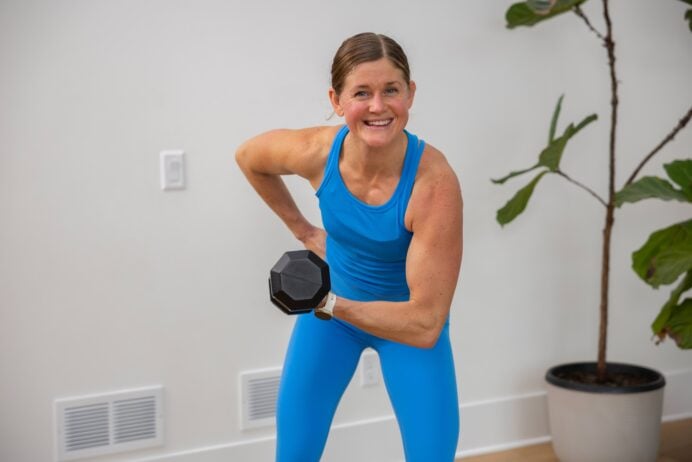
4. Lateral Lunge and Single-Arm Back Row
Targets: Gluteus medius (the outer part of your butt used for side-to-side movements), quads, hamstrings, hip adductors, hip abductors, hip flexors, calves, back, biceps and core.

How to Do a Lateral Lunge and Single-Arm Back Row
- Stand with your feet under your hips, holding a dumbbell in your left hand.
- Step your right leg out to the side as you push your hips back, bending your right knee while leaving your left leg straight. Think of performing a single-leg squat with your right leg while your left leg remains straight. Knees and toes are pointing forward.
- Hold at the bottom of the lateral lunge, then pull your left elbow back towards your left hip, performing a single-arm row. With control, lower the dumbbell back to the starting position.
- Drive off your right foot to reverse the movement, stepping back to center.
Modification: Shorten your lateral step or perform the row from a staggered stance. If lateral lunges bother your knees, swap them for step-ups onto a low box.
5. Push-Up and Side Plank Hold
Targets: Chest, shoulders, triceps, back, abs and core muscles.

How to Do a Push-Up and Side Plank Hold
- Start in a high plank position with your shoulders stacked over your wrists, weight evenly distributed amongst all 10 fingers. Pull your kneecaps up towards your belly, feet hip-width apart.
- Slowly lower your chest down towards the ground as your elbows fall back towards your hips.
- Once you’re at the bottom of the push-up, exhale as you push back up into high plank position.
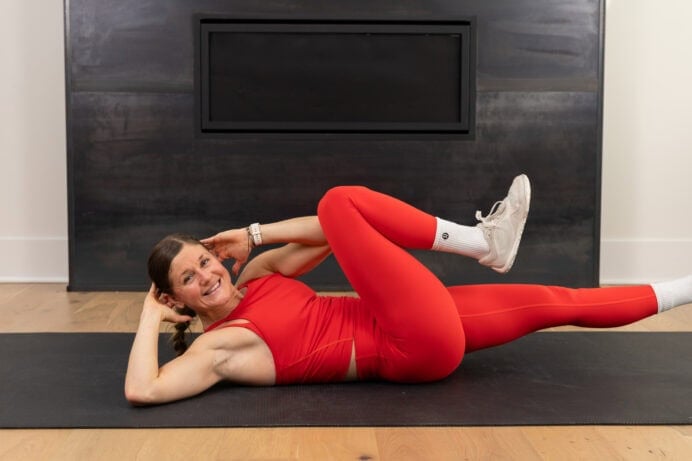
- Pull your right arm up and over your body, opening to your right as your arms expand into a “T” shape to perform a side plank. Hold for a 3-count before returning to high plank position.
- Repeat, performing another push-up, then opening to the left into a side plank on the left side.
Modification: If you experience wrist pain during push-ups, you can substitute incline push-ups by placing your hands on a chair or bench. You can also drop to your knees for modified push-ups and planks that still target core stability.
6. Glute Bridge and Tricep Extensions
Targets: Glutes, hamstrings, inner thighs, triceps (back of the arm) and core.

How to Do a Glute Bridge and Tricep Extension
- Lie flat on your back with your legs bent at 90 degrees and your heels flat on the ground.
- Holding one dumbbell in each hand, fully extend your arms so the dumbbells are directly overhead, palms facing one another.
- Bending at the elbows, slowly lower the dumbbells towards your head.
- As you push the dumbbells back overhead to return to the starting position, simultaneously drive through your heels, squeezing your butt to lift your hips up toward the ceiling. Keep your knees in line with your hips.
- Hold at the top for a moment, then lower your hips back down to a hover position as you lower the dumbbells back towards your head.
Modification: Before lifting your hips, press your lower back into the mat. If lying on your back is uncomfortable, perform the tricep extension seated or standing instead.
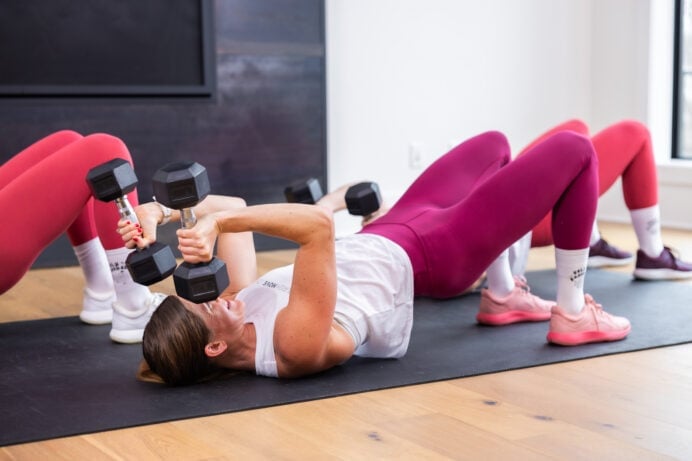
7. Glute Bridge Hold and Chest Press
Targets: Glutes, thighs, hips, hamstrings and chest muscles.

How to Do a Glute Bridge Hold and Chest Press
- Lie flat on the ground with your back straight and your legs bent at 90 degrees. Heels are flat on the ground.
- Holding one dumbbell in each hand, fully extend your arms so the dumbbells are directly overhead, palms facing away from your body.
- Drive through your heels, squeezing your butt to lift your hips toward the ceiling. Perform an isometric hold at the top of your glute bridge.
- Bending at the elbows, slowly lower the dumbbells towards your chest. Keep your chest puffed out and the weights in line with your nipples, bending your arms at 90 degrees.
- Exhale, pushing the dumbbells back overhead to return to the starting position.
Modification: Drop the bridge and perform the chest press lying flat, or perform a standing push, such as an incline push-up, instead. This chest press is the closest move to a bench press in this routine.
FAQs
What is the 3-3-3 rule for strength training?
The 3-3-3 rule is a beginner-friendly approach to strength training: 3 exercises, 3 sets of each exercise, 3 days a week. Definitions of the rule can vary from there, but the basic idea is to keep lifting weights simple and consistent.
This workout takes a slightly different approach, with 7 exercises performed for 3 sets each. Choose challenging weights and complete the recommended repetitions with good form. Follow the weekly strength-training plan for guidance on fitting this workout into your routine.
What are the 5 basic strength training exercises?
The 5 basic strength training movement patterns are the squat, hinge, lunge, push and pull, with core exercises often included as an additional move. Classic examples of strength training include a goblet squat for the squat, deadlift for the hinge, reverse lunge for the lunge, push-up or bench press for the push and bent-over row for the pull.
These exercises can be performed with free weights, resistance bands or your own bodyweight, depending on the movement. See the strength training movements section in this guide for a breakdown of each pattern and how they are used in this workout.
Is 20 minutes of strength training a day enough?
Yes, 20 minutes of strength training can be enough to build and maintain strength when you’re consistent and the workout is challenging. Focus on compound exercises that work multiple muscle groups, use weights that challenge you, and prioritize good form over speed.
A 20-minute workout should include a brief warm-up, several strength exercises and enough repetitions and sets to fatigue your muscles without sacrificing form. Strength training also helps you burn calories, so a short, challenging workout can support body composition goals and help you lose weight and burn fat when combined with a balanced diet.
Short on time? Try this 15-minute strength workout or this 20-minute quick full-body workout.
How many days a week should a woman strength train?
I recommend that beginners start weightlifting 2-3 days a week. This promotes strength and muscle gains while allowing your body time to recover between sessions. Women over 50 can also aim for 2-3 full-body strength training sessions per week, with adequate recovery between workouts. My 12-week strength training plan for women over 50 is a good place to start.
More advanced lifters might follow a 5-day training split, but be sure to avoid overtraining by incorporating rest and recovery. If you’re a runner interested in incorporating strength training, try a hybrid strength and run workout plan and find guidance here on whether to prioritize cardio over strength training.
How can women build muscle without getting bulky?
The reality is that hypertrophy or strength training will not make women bulky. “Bulking” is difficult and requires extra calories, genetics and a really intentional and consistent muscle-building routine. Women will not get bulky by focusing on strength training with moderate weights and higher repetitions.
Incorporate bodyweight exercises and dumbbell training, prioritize a balanced diet with adequate protein, and follow a consistent weekly workout plan for women to build lean muscle and support a defined, “toned” look.
Is it okay to strength train while pregnant?
Yes, strength training is generally safe during pregnancy, especially if you’ve been active and strength training prior to pregnancy. Strength training can help manage weight gain, reduce back pain and prepare the body for labor. I recommend following a pregnancy-friendly workout plan that includes appropriate modifications. Be sure to consult with your healthcare provider before starting or continuing any exercise program during pregnancy.
How can beginners start a strength training routine?
Beginners should focus on building a solid foundation. It’s important to maintain proper form during strength training exercises, so it may be best to start with bodyweight exercises and gradually introduce weights as you progress.
I recommend following a well-rounded strength training plan that targets every muscle group, along with cardio, mobility and other forms of movement like Pilates. Progressively increase the intensity of your workouts and incorporate rest days to support muscle recovery and growth. If you’re ready to work out at the gym, try this gym workout for women.
Free 2-Week Strength Program
More Workouts
Strength TrainingPin This: 7 Best Strength Training Exercises for Women
8 comments
More from
Strength Training Workouts


I was skeptical at first, as I’m used to my videos! Well…I’m sold! A solid 30 breathless, sweaty minutes! Thank you!!
Shaun! So glad you were willing to give this workout a try and liked it! It sure does give you a total body burn in 30 minutes! Thanks so much for sharing and I hope you Pin this one to your workout boards and come back for more! -Lindsey
Thank you SO much for sharing these simple moves/workouts Lindsay! I really like how simple you make them and how you incorporate movement into lifting weights.
Emily! I’m so glad you love these 7 exercises as much as I do! Thanks so much for your feedback and I hope you add this one to your ‘workout’ Pinterest board or weekly routine. Thanks Emily and have a great week, xo-Lindsey
Love this workout. I did it this evening. Quick and efficient! Love that sweater, too!
Laura! I’m so glad you love this workout as much as I do! And seriously I lived in that sweater during my second trimester, so cute + comfy! Thanks for sharing and awesome work! xo-Lindsey
I can’t wait to try this workout! I just found out I’m pregnant (yay!) and been reading a lot about exercising during pregnancy. Do you have any tips of what to focus on/avoid? I read that you should not do workouts on your stomach or back. Are these bridge workouts safe?
Sandi! Congrats on your pregnancy — that’s so exciting!!! Honestly, my best tip for exercising while pregnant is to listen to your body! If you’ve been active stick to your normal routine (it will help you feel more normal too) and just listen to your body, pull back and modify when needed. I didn’t really start adjusting my workout routine till around 20 weeks and I slowly started modifying and now in the third trimester I’m doing lots of modifying. But pregnancy is so different for everyone so just listen to your body (it will tell you what it likes and doesn’t), stay hydrated and just try and keep moving! I stopped doing exercises on my stomach after 12 weeks, but I still do some stuff on my back if it feels ok. The main thing with bridges on your back is more when you’re at the end of second/beginning of third trimester and you want baby to be head down and doing bridges can confuse babies positioning. Again your body will tell you what it likes and doesn’t like! Hope that helps and happy #fitpregnancy! xo-Lindsey