





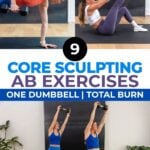
9 Dumbbell Exercises for Abs
These 9 dumbbell ab exercises target the upper and lower abs, obliques and deep core muscles for a core-strengthening workout you can do at home with a set of dumbbells. This dumbbell ab workout combines weighted ab exercises with movements that challenge the core through flexion, rotation and anti-rotation to build core stability and control.
While I’m a huge advocate of strength training, I used to think the most effective way to build strong, defined abs was through endless crunches and sit-ups. After rebuilding my core 3 times during and after pregnancy, I’ve learned that the abs, just like any other muscle group, benefit from progressive overload. Adding resistance, increasing reps or making an exercise more challenging over time helps continue to build strength.
I love using dumbbells for ab work because they add resistance to familiar movements while challenging the core to brace and stabilize. This workout includes exercises that target the abs from different angles, along with movements that train core stability. The goal is to build the core strength and control that supports everyday movements like lifting, twisting and bending.
Equipment and Instructions
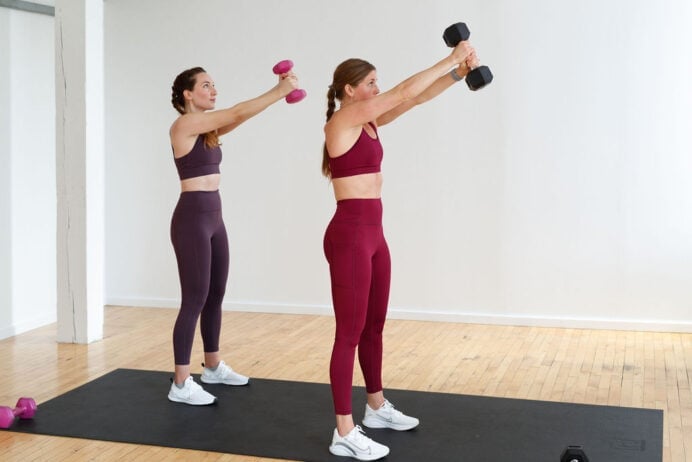
Equipment Needed: A medium-to-heavy set of dumbbells. I suggest anywhere from 5-25 lbs. If you’re a beginner, start with your bodyweight or a light dumbbell. More advanced exercisers can increase the weight or add a resistance band or kettlebell.
Implementing this workout into your routine: Add these dumbbell exercises for abs to your home workout routine 1-2 times per week to build core strength and stability.
Your workout looks like this:
- Beginner: Work for 30 seconds, rest for 15 seconds and complete each exercise for 1 set.
- Intermediate: Work for 40 seconds, rest for 20 seconds and complete each exercise for 2 sets.
- Advanced: Work for 45 seconds, rest for 15 seconds and complete each exercise for 3 sets.
If you prefer a fully guided workout video (complete with a warm-up and cool-down), try this 30-Minute Dumbbell Core Workout.
If you’re pregnant, postpartum, new to exercise or managing an injury or medical condition, consult your healthcare provider before starting a new workout routine. Modify any exercise as needed and stop if you experience pain or discomfort.
Workout Outline
1. Dumbbell Crunches
Targets: Upper abs and lower abs.
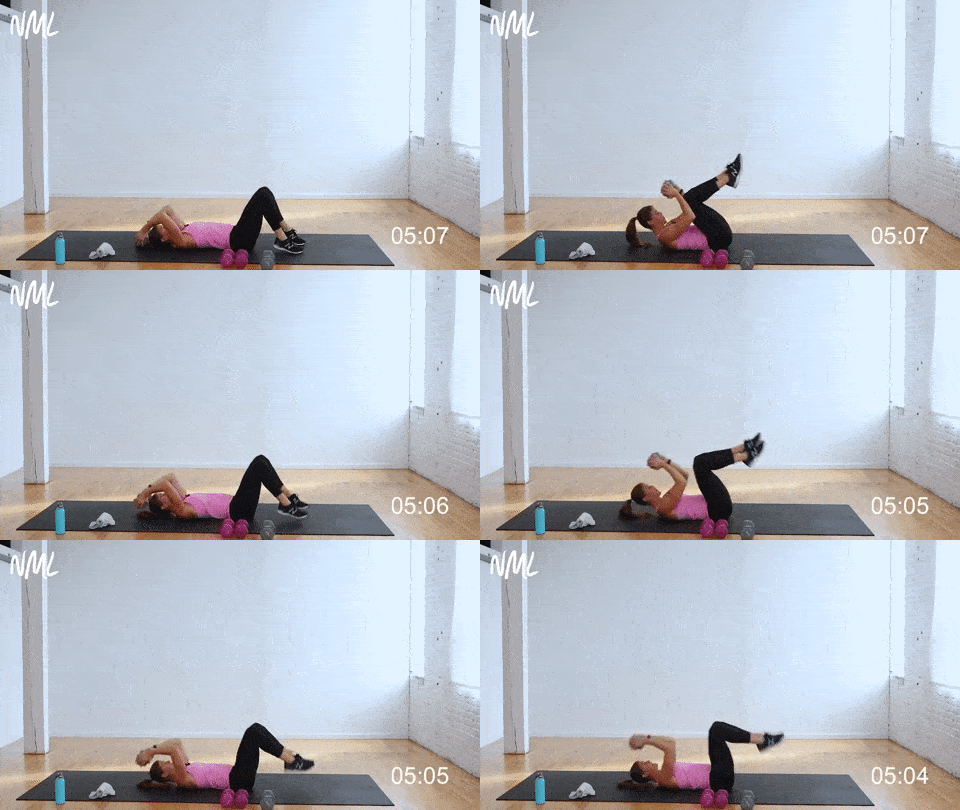
How to Do a Dumbbell Crunch
- Start by lying flat on your back, lower back pressing firmly into the mat. Bring your legs to a 90-degree bend, feet pressing firmly into the ground.
- Hold a dumbbell horizontally between your hands, elbows bent at 90 degrees and the dumbbell touching the floor.
- Perform a crunch by lifting your head, neck and shoulders off the ground as you pull the dumbbell in towards your knees. Simultaneously lift the feet off the floor, pulling the knees in to meet the elbows if you can.
- With control, lower the feet back toward the ground as you also lower the dumbbell back to the ground.
Modification(s): Keep your feet planted on the floor and perform a standard dumbbell-weighted crunch, lifting only the head, neck and shoulders off the mat.
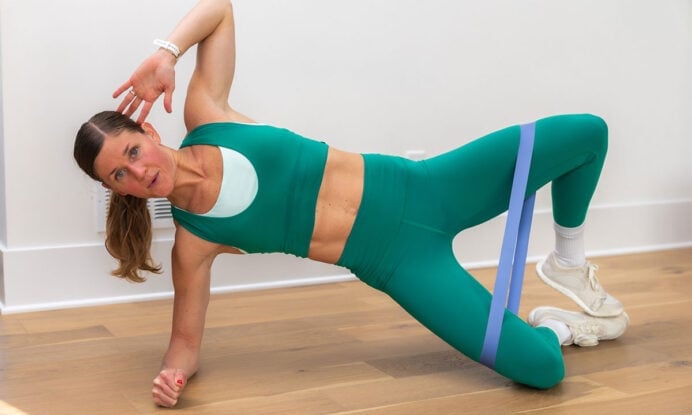
2. Side Planks
Targets: Internal and external obliques and transverse abdominis.
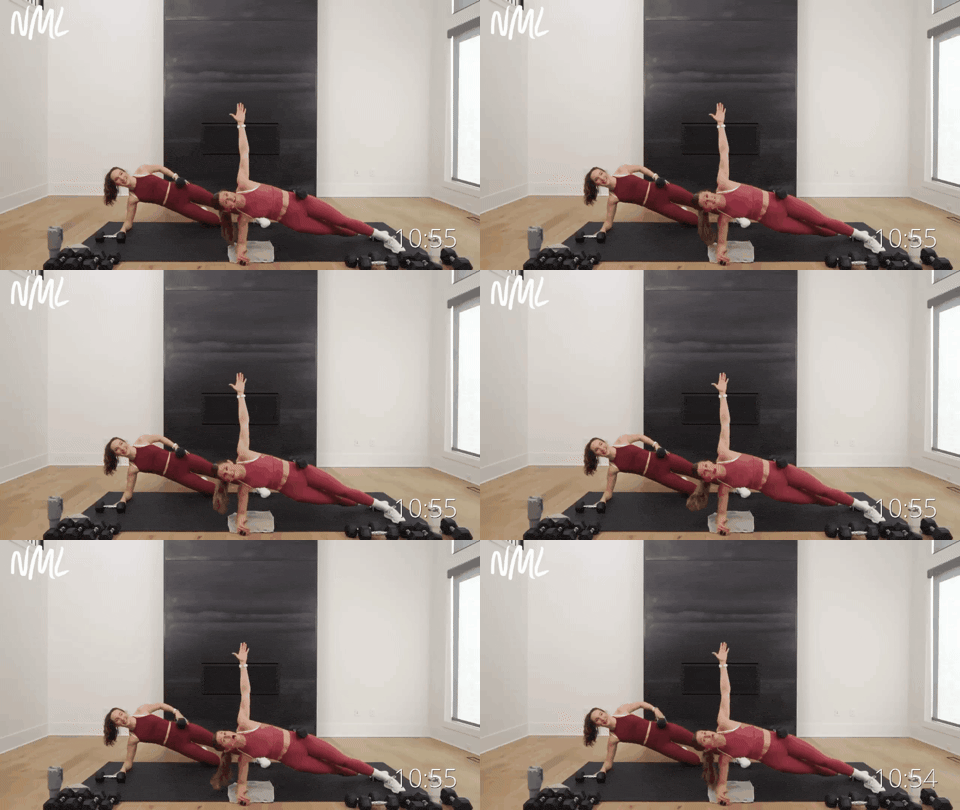
How to Do a Side Plank
- Start lying on your right side, with your right forearm on the mat and your right shoulder stacked over your right elbow. Option to place a dumbbell on your left hip to increase the difficulty.
- Press into your forearm and lift your hips. Balance on the outside edge of your right foot, stacking your left foot on top of your right foot.
- Extend your left hand overhead. Focus on keeping your hips high and even (stacked over each other).
Modification(s): Drop the bottom knee to the mat for additional support, keeping the hips lifted and the core engaged.
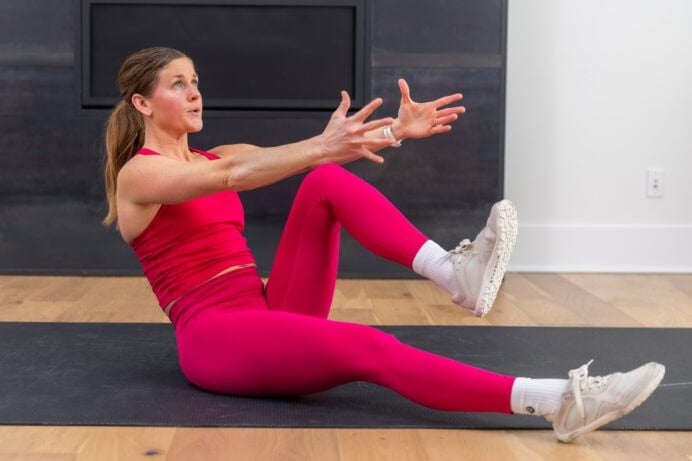
3. Russian Twists (Dumbbell Seated Twist)
Targets: Upper and lower abdominals, obliques, core and hip flexors.
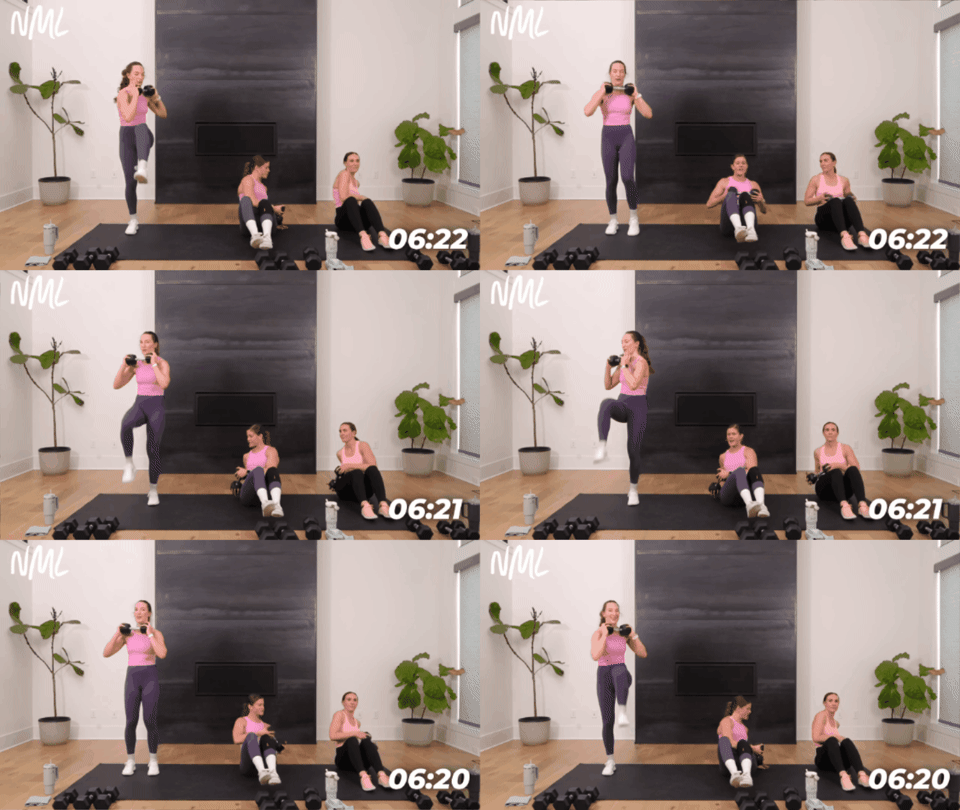
How to Do a Dumbbell Seated Twist (Russian Twist)
- Start in a seated position on the ground or on a yoga mat. Lean your torso back until you feel your core engage. Option to hold a dumbbell horizontally in both hands. To make it more difficult, float 1 or both feet off the ground.
- On an exhale, rotate your shoulders and torso to the right as you bring the dumbbell to tap the mat outside of your right hip. Inhale as you use your obliques and outer abs to return your chest to center.
- Then repeat on the opposite side, rotating your shoulders to the left as you bring the dumbbell to tap the mat outside of your left hip.
Modification(s): Keep both feet planted firmly on the mat throughout this dumbbell Russian twist. You can also try a standing dumbbell twist with a pair of dumbbells, rotating the torso from side to side while alternating a knee lift toward the opposite side.
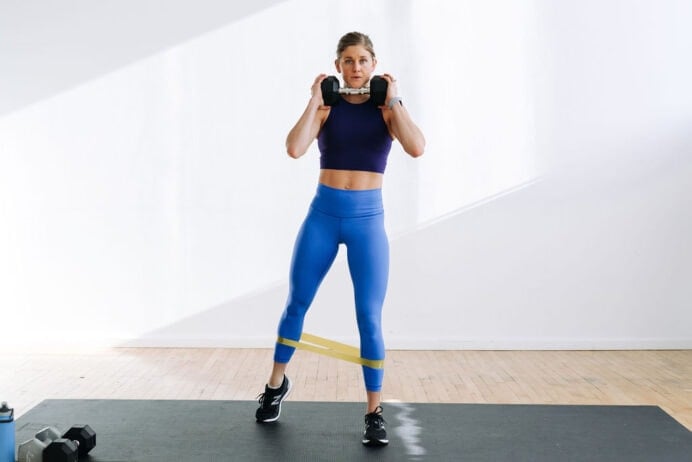
4. Side Bends (Standing Oblique Crunches)
Targets: Obliques, upper abs and lower back.
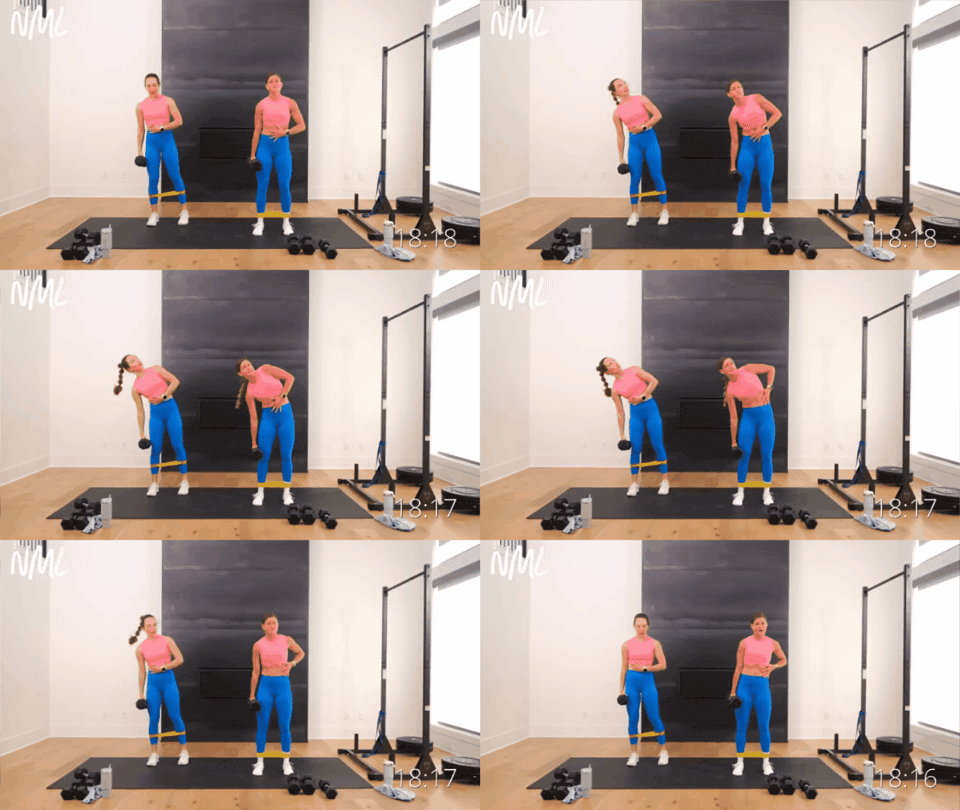
How to Do a Side Bend
- Stand with feet hip-width apart, knees slightly bent. Place a resistance band 6 inches above your ankle joints (around your calves/shins). Hold a dumbbell in your left hand at your side.
- Allow the weight in your left hand to pull you down, sliding the weight down your left thigh and bending through your left side. You should feel a stretch in the opposite (right) obliques.
- Squeeze through your right outer ab muscles to pull your torso upright, returning to the starting position.
Modification(s): Place the resistance band higher on the legs in this standing exercise, above the knees, to reduce the tension.
5. Single-Leg Toe-Touch Weighted Sit-Ups
Targets: Lower abs, upper abs, obliques, hips, shoulders and chest.
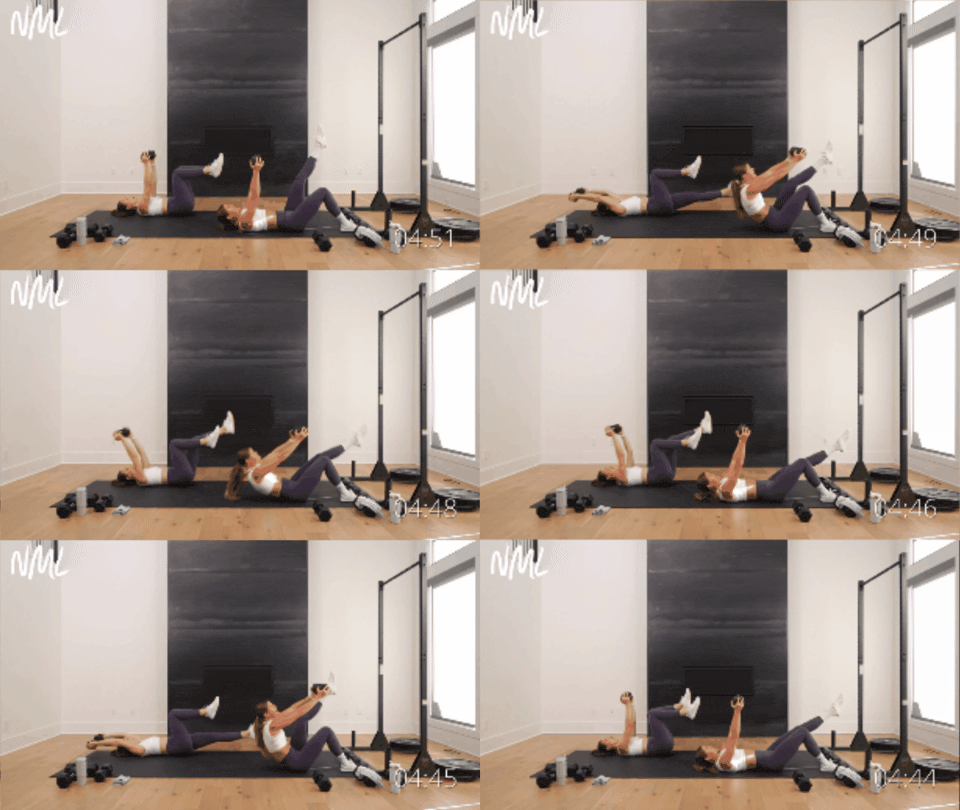
How to Do a Single-Leg Toe-Touch Weighted Sit-Up
- Start lying flat on your back, knees bent and feet planted on the floor. Straighten your left knee so your left toes are floating off the floor. Hold 1 dumbbell between both hands straight above your chest, wrists stacked over your shoulders.
- Pull your belly button towards your spine to engage your abdominal muscles.
- Exhale as you lift your upper body off the ground, sitting up to bring your torso towards your knees. At the same time, pull your left toes towards your midline, aiming to tap your left toes with the dumbbell.
- Inhale as you lower down, returning to the starting position.
Modification(s): Keep both feet planted on the mat throughout the movement to reduce the balance demands. You can also perform a dead bug variation, keeping your back flat on the mat as you lower a single leg and reach the dumbbell overhead.
6. Push-Up and Renegade Row (Plank Row)
Targets: Latissimus dorsi (or lats), upper back, chest, shoulders, triceps, arms and core.
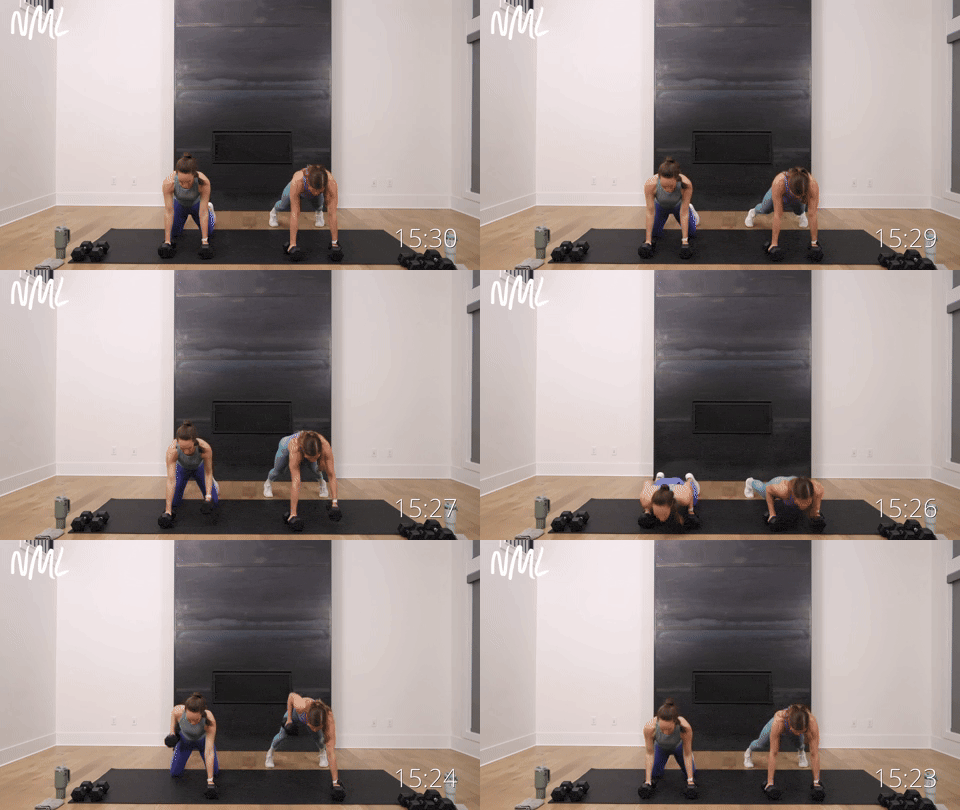
How to Do a Push-Up and Renegade Row
- Start in a high plank position, both hands on your dumbbells, shoulders stacked over wrists, core engaged.
- Slowly lower your chest down towards the ground as your elbows fall back towards your hips (keep elbows tight to the body).
- Once at the bottom of your push-up, exhale as you push back up into a high plank position (top of your push-up position).
- Then, hold a high plank position as you pull your right elbow towards your right hip, squeezing your back muscles to lift the dumbbell in your right hand, performing a plank and row.
- Slowly and with control, lower the dumbbell to the ground.
- Continue this pattern, alternating 1 push-up with 1 renegade row, switching the arm that performs the back row after each push-up.
Modification(s): If you can’t do a full push-up on your toes, you can substitute one of these push-up modifications. I also highly recommend working through my free 12-week push-up progression program. If push-ups hurt your wrists, substitute one of these exercises for wrist pain.
7. Dumbbell Chops (Wood Chops)
Targets: Internal obliques, external obliques, deep transversus abdominis muscles, hips, back and shoulders.
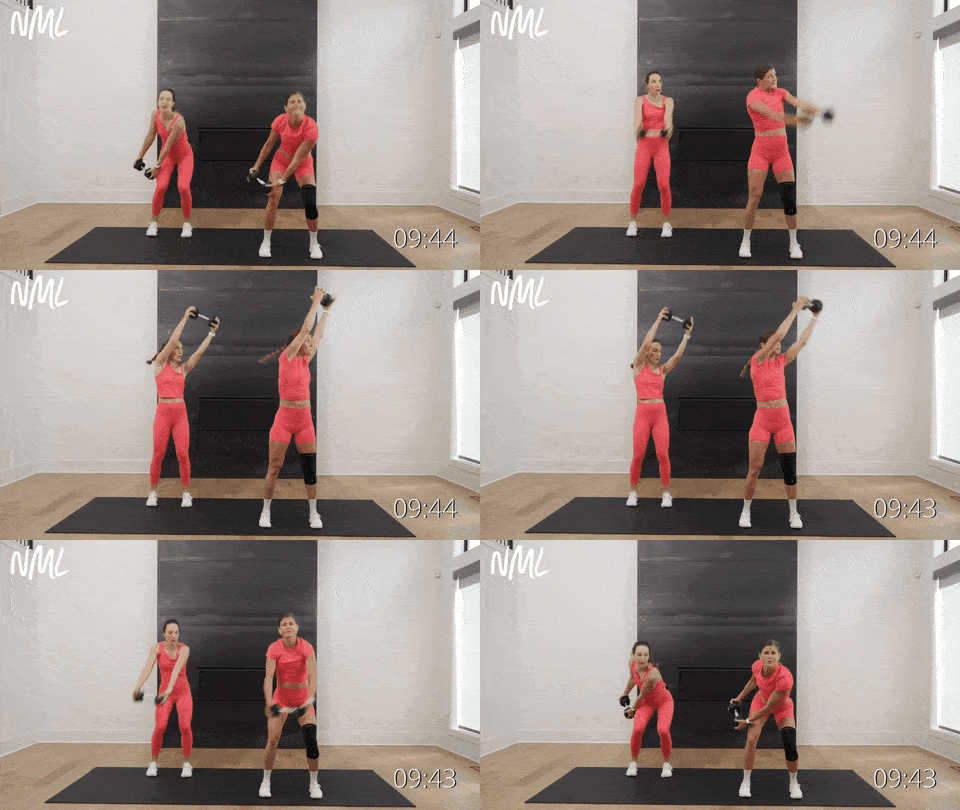
How to Do a Dumbbell Chop (Wood Chop)
- Start standing in an athletic stance, feet shoulder-width apart, with a soft bend in your knees and core engaged. Stagger your feet, so your left foot is slightly behind your right. Most of your weight is in your right foot.
- Hold 1 dumbbell horizontally between your hands.
- Bend your knees as you bring the dumbbell to the outside of your left knee.
- Then exhale as you use your legs, hips, glutes, abs and obliques to drive the dumbbell crossbody, extending your arms up overhead on the right side. Think about driving the weight from your left knee to your right shoulder.
- Lower the dumbbell with control back towards your left knee, returning to the starting position.
8. Weighted Dead Bugs
Targets: Deep core muscles (transverse abdominis), lower abs, hips, shoulders and back (posterior and anterior deltoids).
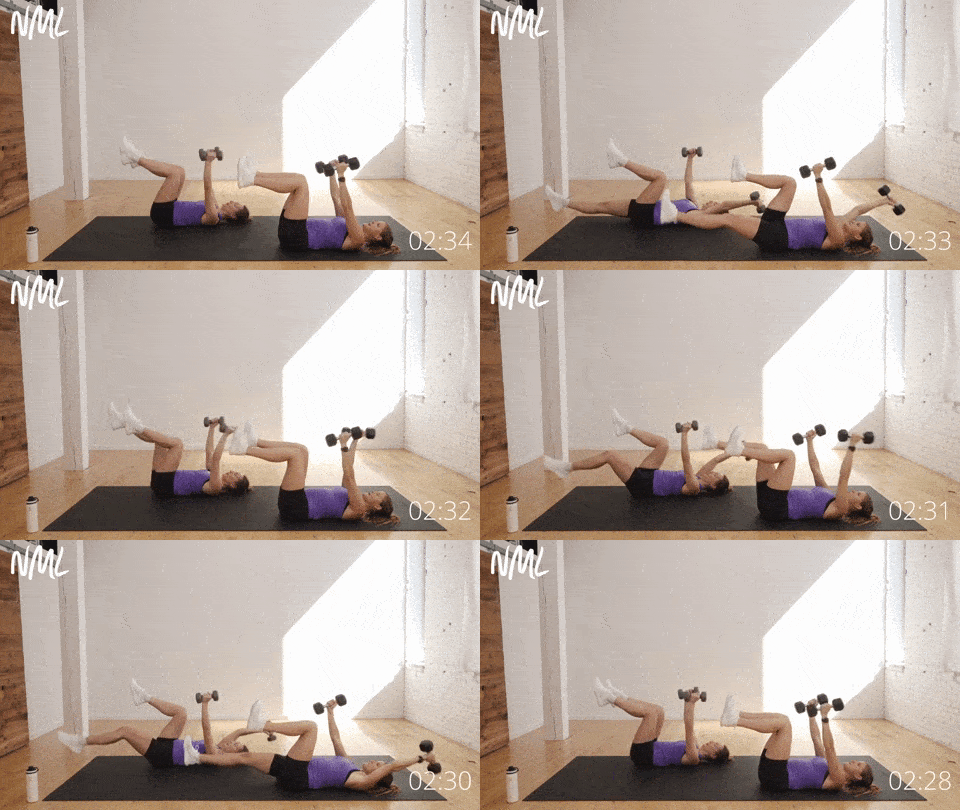
How to Do a Weighted Dead Bug
- Lie on your back flat on the floor, performing a slight pelvic tilt to press your lower back into the mat. Lift your knees to form a 90-degree angle (knees stacked on top of hips).
- Hold a dumbbell in each hand and extend your hands straight overhead toward the ceiling. Inhale, letting your belly expand.
- Exhale, engaging your core and simultaneously extending your left leg and right arm away from your body, lowering the dumbbell in your right arm towards the ground with control. Left arm and right leg remain in place. With control, inhale as you return to starting position.
- Then repeat on the opposite side, exhaling as you extend your right leg and left arm away from the body, lowering the dumbbell in your left arm towards the ground. With control, return to the starting position.
Modification(s): Perform the dead bug without dumbbells, keeping the same alternating arm and leg movement while focusing on maintaining a flat back.
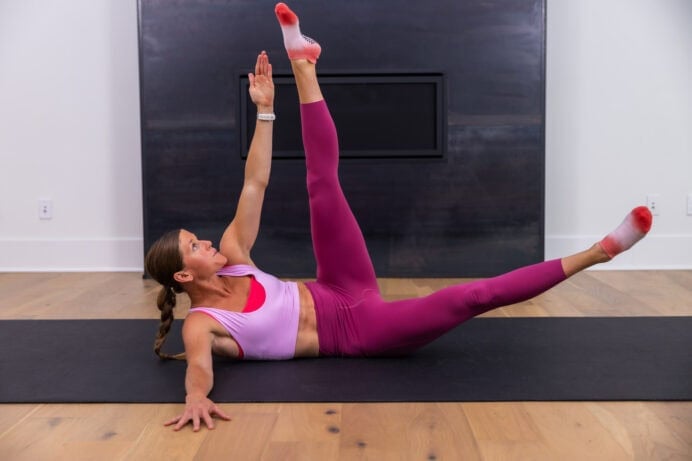
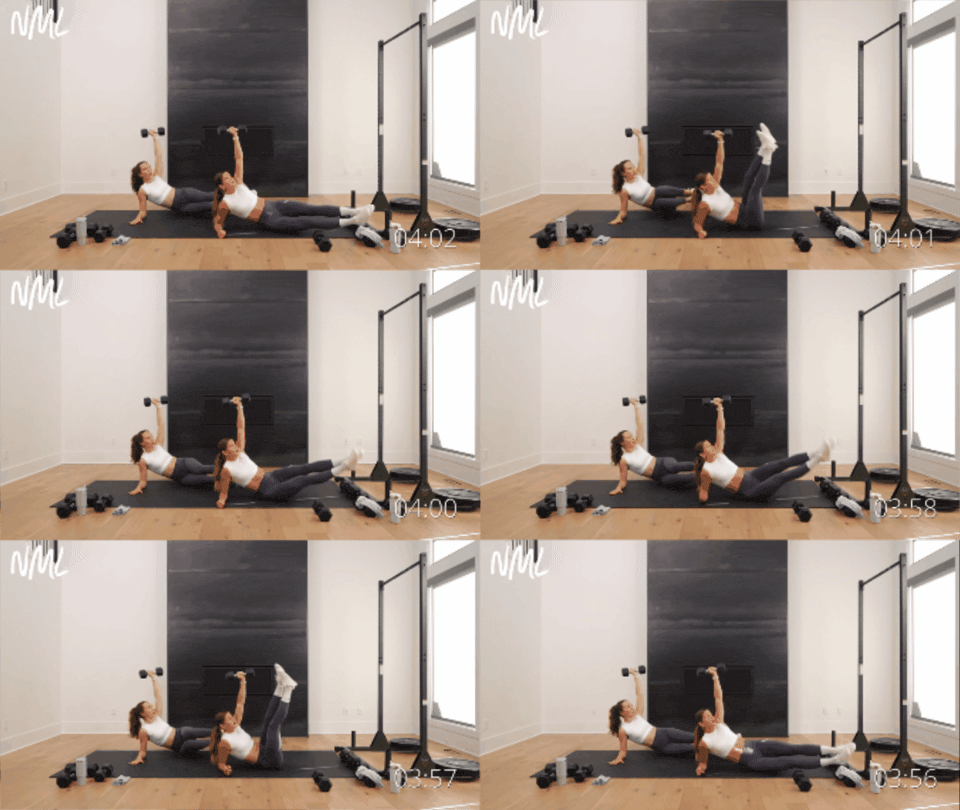
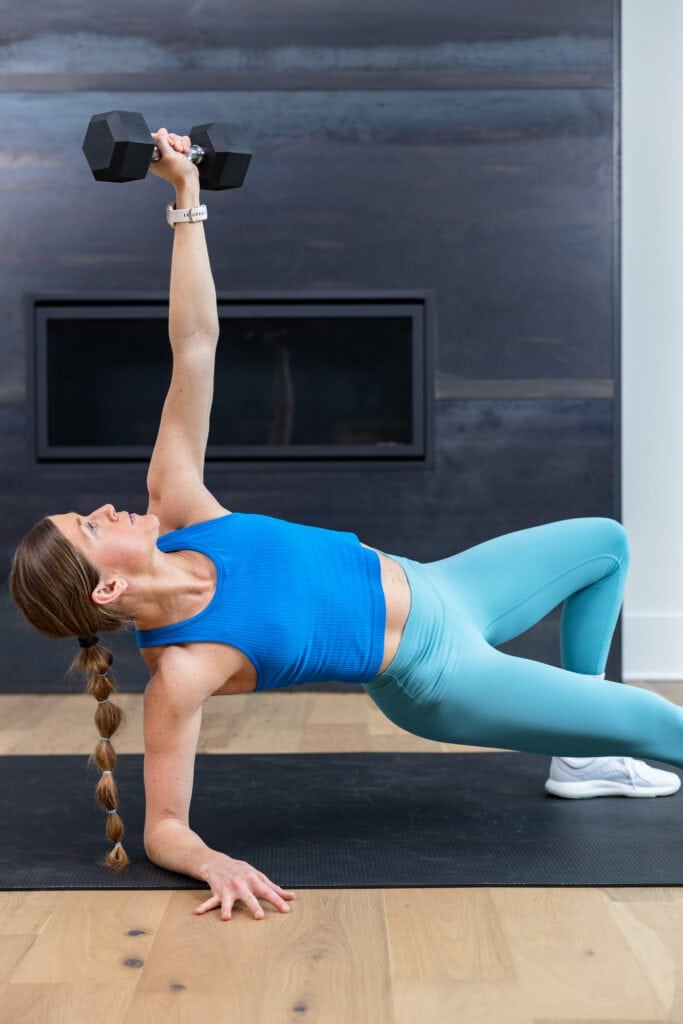
9. Oblique V-Ups
Targets: External oblique, internal oblique, lower abs, rectus abdominis and shoulder muscles.
How to Do an Oblique V-Up
- Lie on your right side on the mat. Keep your body in a straight line, with your left leg stacked on top of the right, slight bend in the knees. Hold a dumbbell in your left hand overhead, left wrist stacked over left shoulder.
- Place your right forearm on the mat, right shoulder stacked over right elbow. Think about lifting up and out of your right side to avoid collapsing down to the mat.
- Engage your core, especially the obliques, and lift both legs up towards your left hand. Aim to keep your legs as straight as possible.
- Briefly hold, then lower the legs, hovering them off the mat.
Modification(s): Bend the knees and draw them toward the chest rather than lifting the legs straight toward the dumbbell.
FAQs
How often should I do dumbbell ab workouts?
Aim to do free weight ab exercises 1-2 times per week as part of a balanced strength training routine. 10 minutes of focused ab training can help build core strength when you train with good form, control the tempo and gradually increase reps or weight. For additional core work, try my 30-Day Ab Challenge.
Do dumbbell ab exercises relieve back pain?
Weighted ab exercises can help improve spinal stability, posture and movement control, which may reduce strain on the lower back during everyday activities. It can also make it easier to perform strength exercises like deadlifts with less discomfort. Dumbbell ab exercises aren’t appropriate for every type of back pain, though. If an exercise causes you pain, stop and consult a qualified healthcare professional before continuing.
Can dumbbell exercises alone give me visible abs?
Abdominal exercises with dumbbells can strengthen and build the core muscles, but they can’t specifically target belly fat and your body fat percentage. Visible abs depend on things like body composition, genetics, nutrition, daily movement and overall training. A combination of strength training, cardio and a balanced diet can support overall body composition and muscle definition.
Why use dumbbells for core training?
Adding dumbbells to core exercises increases resistance, making the abdominal muscles work harder than they would with bodyweight alone. An ab workout with weights can challenge the abs while also requiring stability throughout the hips, hamstrings and trunk.
For beginners, start with lighter weights and focus on controlled movement and proper form. The dead bug is one of the best dumbbell ab exercises for beginners because it helps you learn proper form by teaching you how to brace your core, a foundational skill behind all ab training.
Free 7-Day Ab Challenge
More Workouts
Core StrengtheningPin This: 9 Dumbbell Ab Exercises

no comments
Leave a Comment