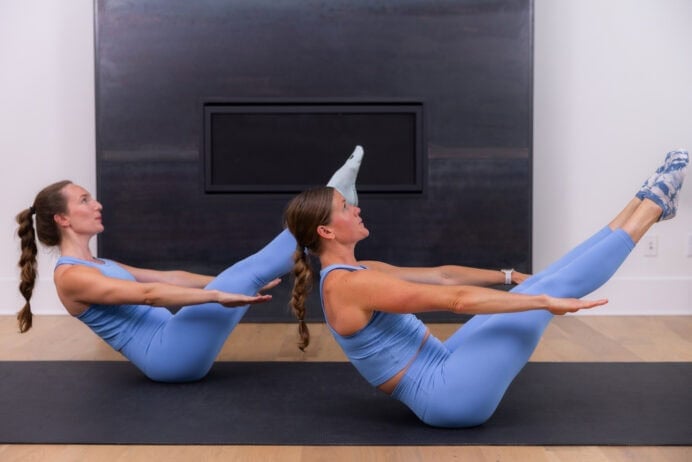



12 Unilateral Exercises for Full-Body Strength
This workout combines single-leg exercises, unilateral arm movements and full-body single-sided exercises. These movement patterns help correct muscle imbalances, reduce injury risk and build total-body strength by training each side of the body evenly. Because they demand deep core stabilization, you’ll also get a sneaky – and highly effective – ab workout in the process.
Workout Specifics
Improve balance, prevent injuries and increase overall strength and stability with this functional full-body unilateral training session.
Add full-body workouts at home to your muscle-building workout plan 1-2 times a week to increase total-body strength and endurance.
Workout Equipment
Medium to Heavy Pair of Dumbbells. I’m using 15 and 20 lb dumbbells in today’s workout. Option to add a box or bench.
Workout Instructions
Follow along with the guided Full Body Unilateral Workout on YouTube, led by me, your certified personal trainer (CPT), Lindsey Bomgren.
Your Workout Looks Like This:
- 4 Circuits
- 3 Unilateral Exercises Per Circuit (1 upper body, 1 lower body and 1 combination exercise)
- Timed Intervals (30 seconds of work, 15 seconds of rest. Perform as many reps as you can in the timed interval.)
- Repeat Each Circuit x2 Sets
Unilateral Exercises for Full-Body Strength
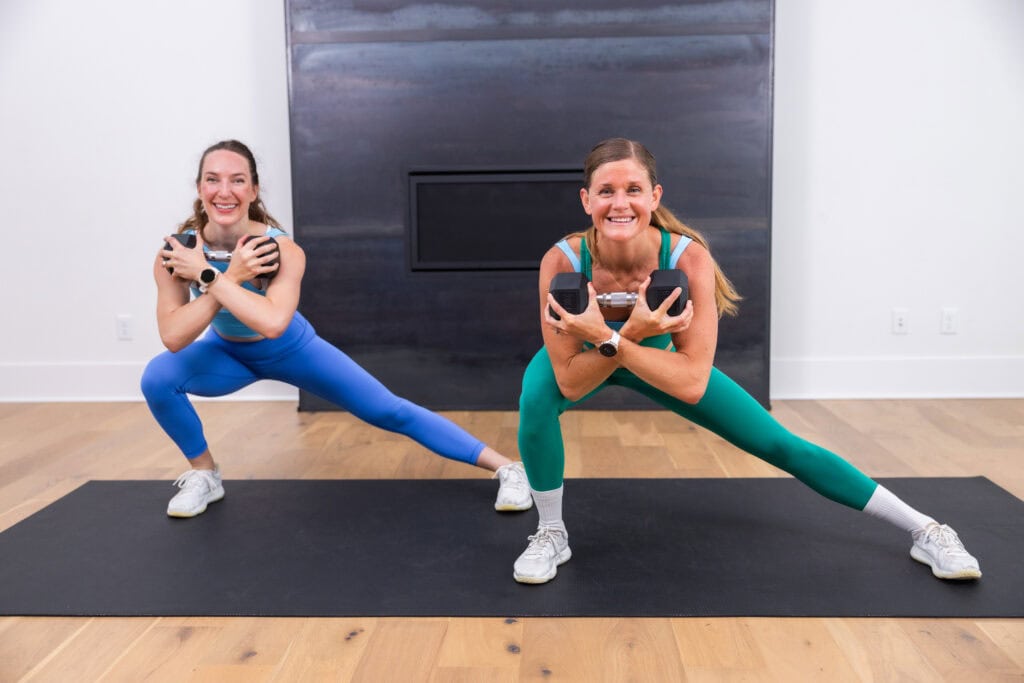
1. Staggered Good Morning and Lateral Lunge
Targets: Glutes, outer glutes (gluteus medius), inner thighs, hamstrings, hips, quadriceps, erector spinae, lower back and core muscles.
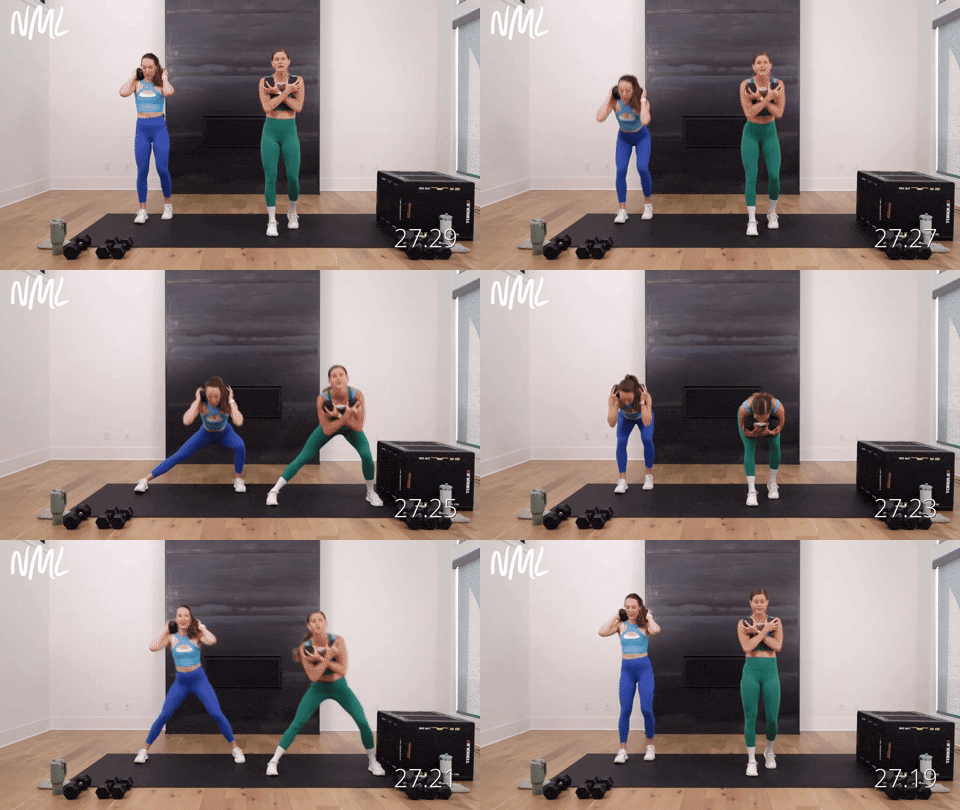
How to Do a Staggered Good Morning and Lateral Lunge
- Stand with your feet hip-width apart and your knees slightly bent. Hold 1 dumbbell horizontally at your chest or place it behind your head, resting on your upper back and shoulders. Hold each head of the dumbbell with 1 hand.
- Stagger your feet, so your left leg is slightly in front of your right foot. Kickstand your back right foot, right heel floating off the ground. Keep 80% of your weight in your front foot, 20% in your back right toe.
- Maintain a staggered stance as you hinge forward at the hips until your torso is parallel to the ground, or you feel a stretch in the hamstrings. This is a good morning exercise. Your core is engaged, and the spine is neutral, keeping your back flat.
- Press through your left heel to stand tall, returning to a standing position.
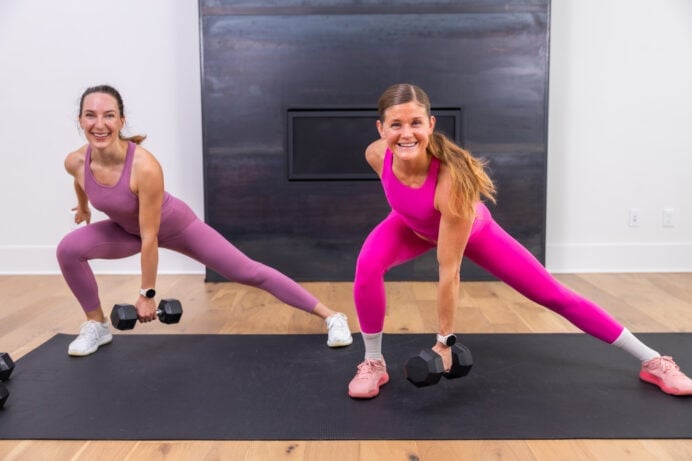
- Perform a lateral lunge by stepping your right leg out to the side as you push your hips back, bending your right knee while leaving your left leg straight. Think of performing a single-leg squat with your right leg while your left leg remains straight. Knees and toes are pointing forward.
- Drive off your right foot to reverse the movement, pushing back to the center and returning to a staggered stance.
2. Uneven Push-Up and Shoulder Tap
Targets: Chest, shoulders, triceps, back, abs, obliques and core muscles.
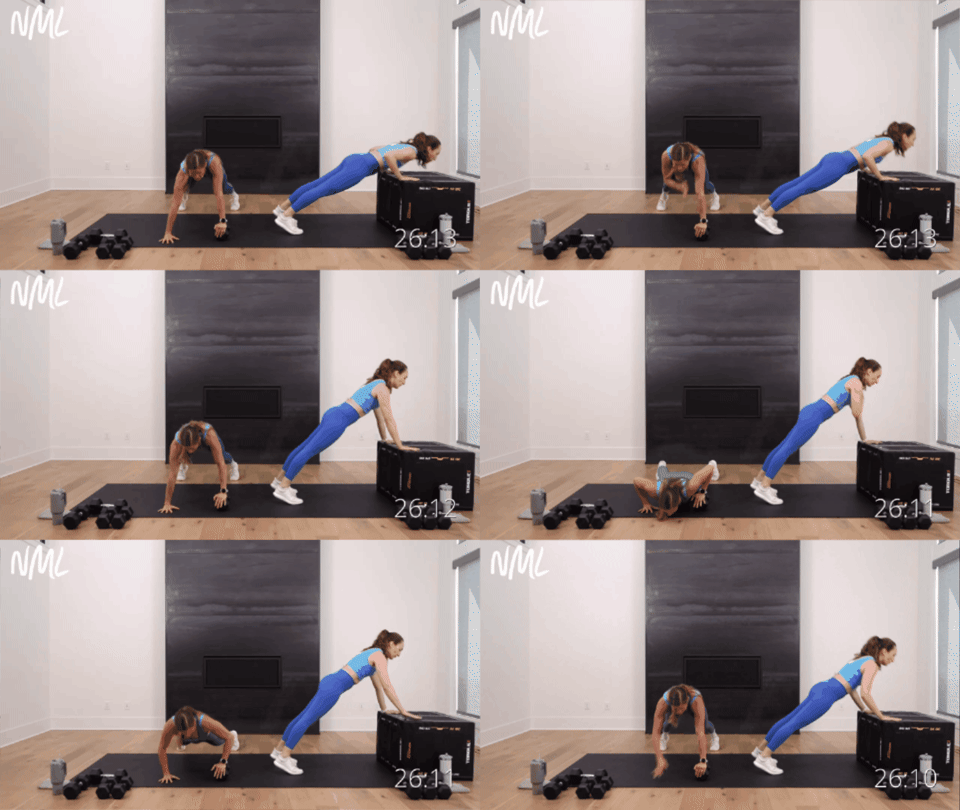
How to Do an Uneven Push-Up and Shoulder Tap
- Start in a high plank position with your shoulders stacked over your wrists. Place your left hand on the head of a stable dumbbell. Your feet are hip-width apart.
- Hold this high plank position, maintaining a straight line with your body, gaze slightly in front of you.
- Slowly lower your chest down towards the ground as your elbows fall back towards your body (not out to the sides).
- Once at the bottom of your push-up, exhale as you push back up into high plank position.
- Then, perform a single-sided shoulder tap by tapping the left shoulder with the right hand.
Modification: Option to take the push-ups from your knees. You may pop to your toes for the shoulder tap, or take the shoulder tap from the knees as well. Alternatively, perform incline push-ups by placing your hands on a chair or bench.
3. Staggered Stance Burpee and Single-Arm Press
Targets: Upper body (chest, arms, back, shoulders), lower body (legs, glutes, hips) and core.
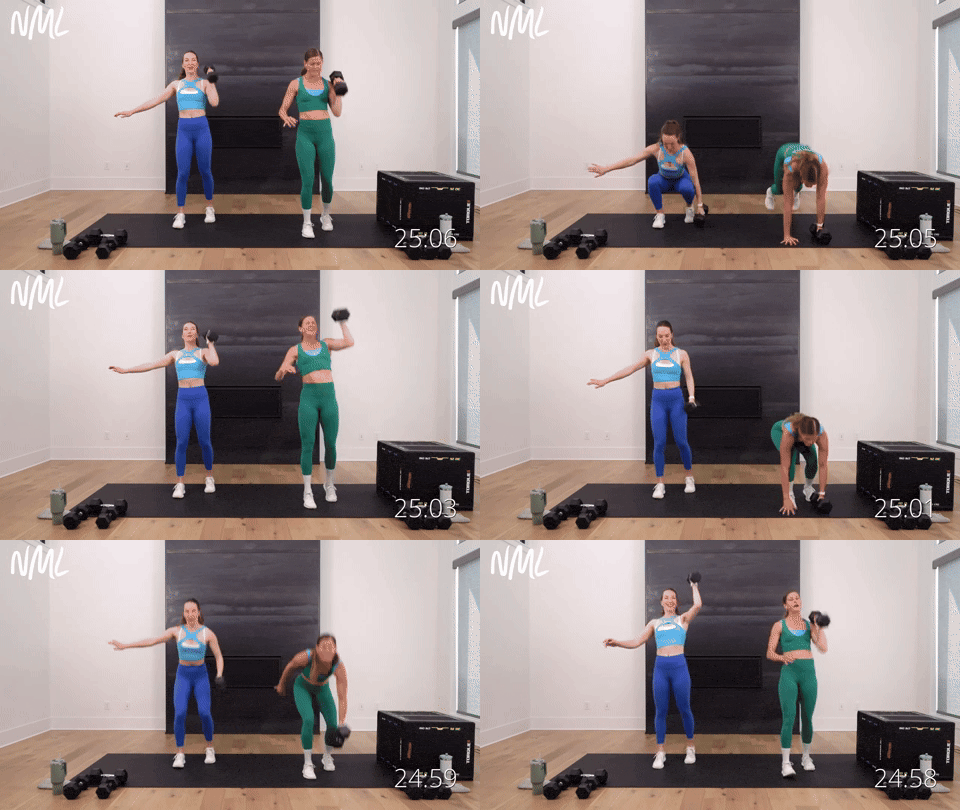
How to Do a Staggered Stance Burpee and Single-Arm Dumbbell Press
- Start standing with your feet shoulder-width apart, holding 1 dumbbell in your right hand at your side. Stagger your feet, so your left leg is slightly in front of your right foot.
- Bend your knees and drop your hips as you lower into a squat position, then place your left hand on the floor and your right hand on your dumbbell, directly in front of your feet.
- Shift your weight into your hands as you jump your feet back to softly land on the balls of your feet in a high plank position.
- Jump your feet up, landing outside your hands while finding the staggered stance again. Then drive through your left heel to stand tall, returning to the starting position.
- As you stand tall, curl the dumbbell in your right hand up to shoulder height. Then perform a single-arm overhead press by pressing the dumbbell overhead, locking out the right bicep near the right ear.
Modification: Perform a staggered squat and single-arm press rather than a burpee. You can also perform the burpee with your bodyweight.
4. Rear Foot Elevated Lunge
Targets: Legs, glutes, quads, hamstrings, hips and core.
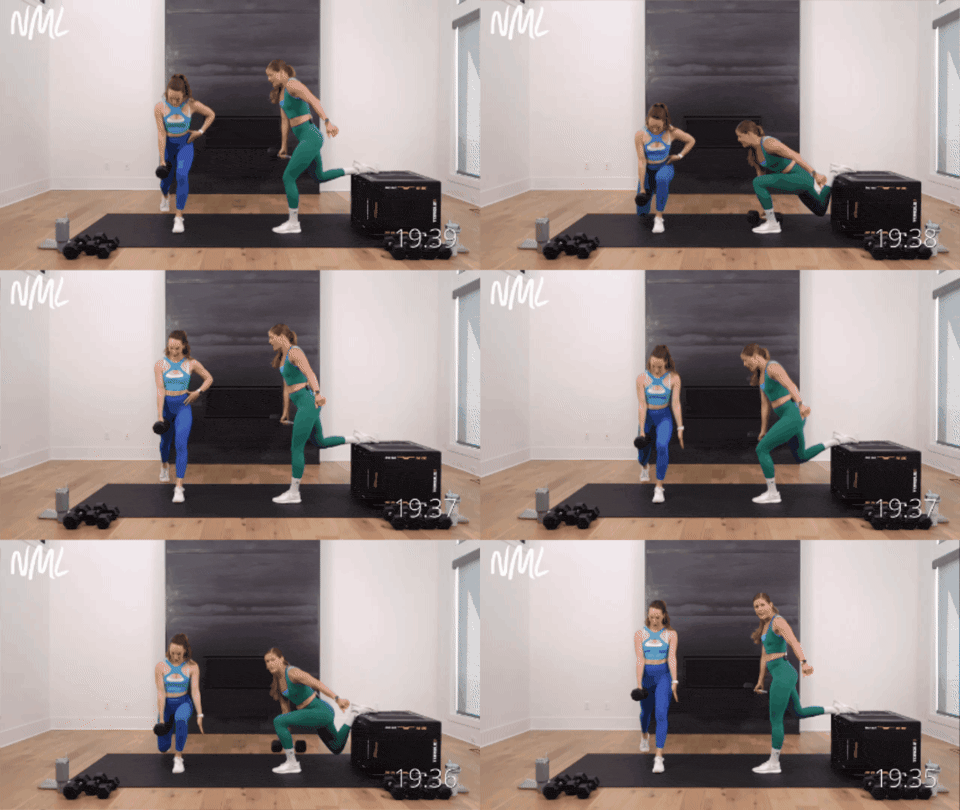
How to Do a Rear Foot Elevated Lunge (Bulgarian Split Squat)
- Kneel in front of your bench or chair, then place your left foot behind you on a chair or bench, shoelaces down. You can place a towel under your foot to provide additional support if needed. Hold a dumbbell in your left hand.
- Step your right foot forward (it will vary for everyone, but a little over a foot in front of your bench). Your front thigh will be parallel to the ground. This is the bottom of your movement.
- Drive through your front right heel, squeezing your right glute to return to standing. Feel your front glute engage to power the movement.
- With control, bend your knee to lower back down to the starting position, making your front thigh parallel with the ground.
Modification: Perform a standard reverse lunge or split squat, keeping your back foot on the ground rather than elevating it on a chair. If lunges hurt your knees, you can also try an alternative exercise.
5. Incline Plank and Single-Arm Back Row
Targets: Latissimus dorsi (or lats), upper back, chest, shoulders, arms and core.
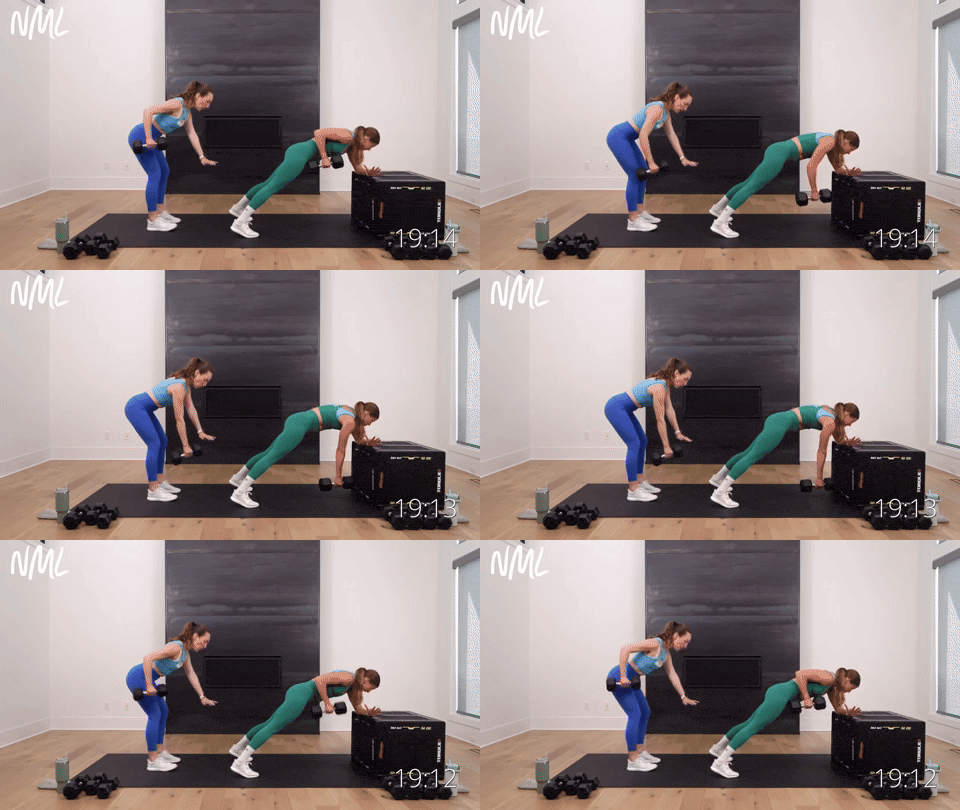
How to Do an Incline Plank and Single-Arm Back Row
- Stand in front of a bench, box or couch. Place 1 dumbbell on the ground below your right arm. Brace your left forearm horizontally on the bench, shoulder stacked over elbow. Step both feet back, finding an elevated high plank position.
- Gripping the dumbbell in your right hand, pull your right elbow to your right hip (performing a renegade row, or plank back row).
- Slowly and with control, extend your arm, lowering your dumbbell towards the ground and returning to the starting position.
Modification: Perform standing single-arm bent-over rows.
6. Staggered Row, Clean and Curtsy Lunge
Targets: Latissimus dorsi (lats), legs, quads (thighs), gluteus maximus (butt), hip flexors and core.
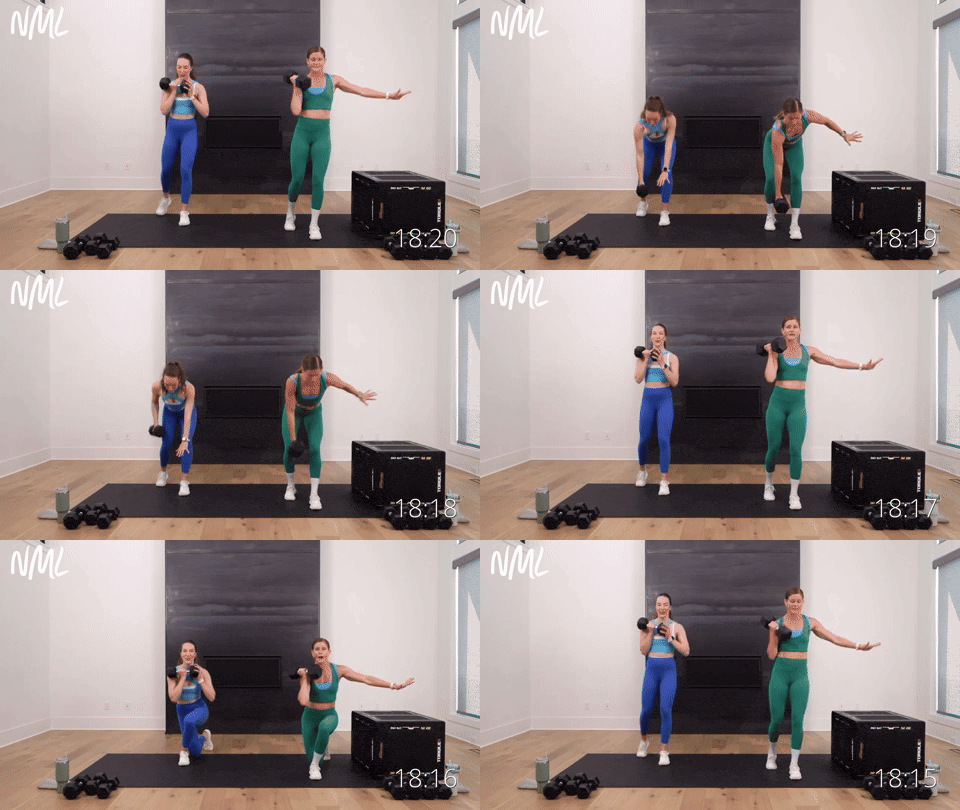
How to Do a Staggered Row, Clean and Curtsy Lunge
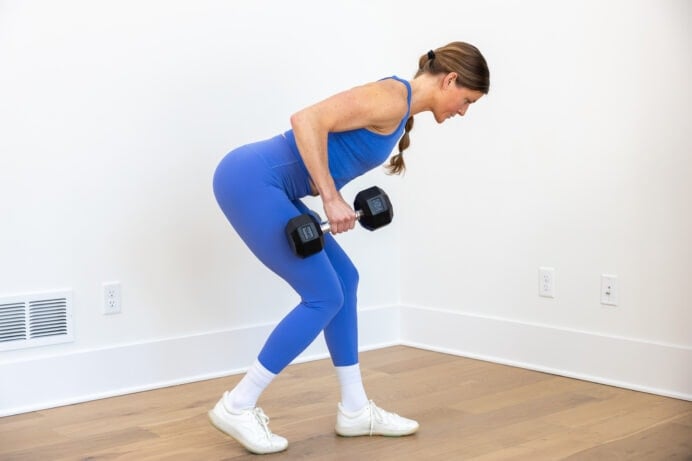
- Stand with your feet slightly wider than shoulder-width apart, knees slightly bent. Find a staggered stance by stepping your left leg slightly behind your right leg. Hold a dumbbell in your left hand, palm facing in (narrow grip).
- Bend forward at the hips, maintaining a flat back, as you pull the dumbbell back towards your left hip. Stop once your elbow is in line with your rib cage, making a straight line from shoulder to elbow. Hold the row at the top for a moment, squeezing your shoulder blade in.
- With control, lower the dumbbell back to the starting position and drive through the front right heel to stand tall. As you stand tall, clean the dumbbell in your left hand to your left shoulder.
- Keeping the dumbbell at your left shoulder, step your left leg back into a curtsy lunge (left knee should meet right calf), and left knee lowers towards the mat. Lower your hips until both knees reach a 90-degree angle, front thigh parallel to the floor.
- Drive through the right heel and glute to stand tall and repeat the sequence.
7. Staggered Squat
Targets: Legs, glutes, quads, hamstrings, hip flexors and core.
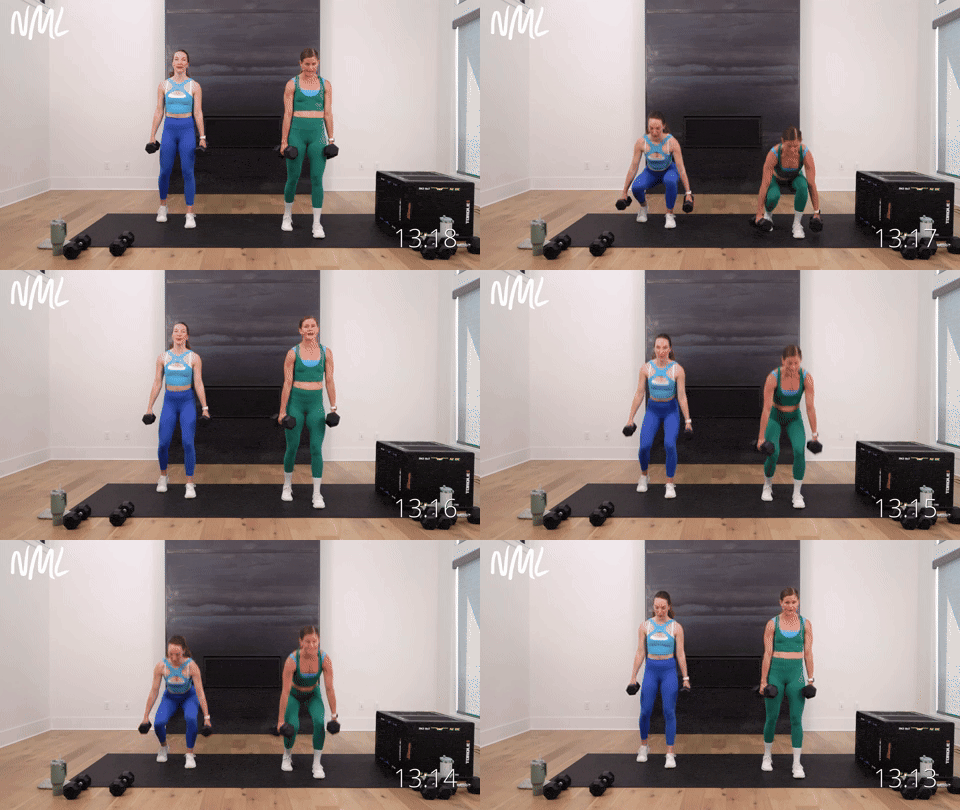
How to Do a Staggered Squat
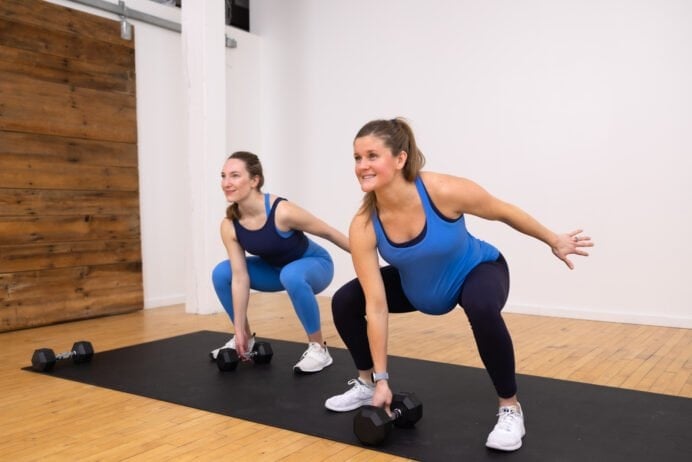
- Stand with your feet hip-width apart and your knees slightly bent. Hold a pair of dumbbells at your sides, palms facing in. Stagger your feet, so your right leg is slightly in front of your left foot.
- Maintain a staggered stance as you perform a squat, lowering down into a squat position until your hips are parallel with your knees. Drive your knees out toward your outer three toes.
- Drive through your front right heel to stand tall, squeezing your glutes, and repeat.
8. Single-Arm Bicep Curl
Targets: Biceps brachii (the front of your arms).
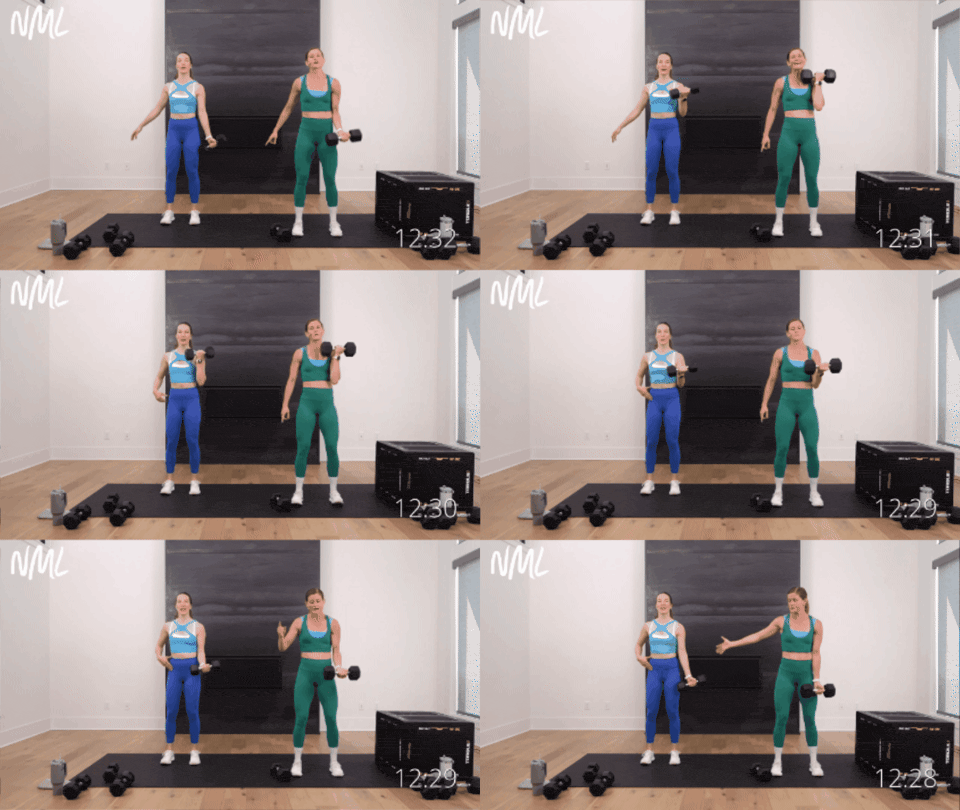
How to Do a Single-Arm Bicep Curl
- Stand with your feet slightly wider than shoulder-width apart, knees slightly bent.
- Hold a dumbbell in your right hand, palm facing away from your body.
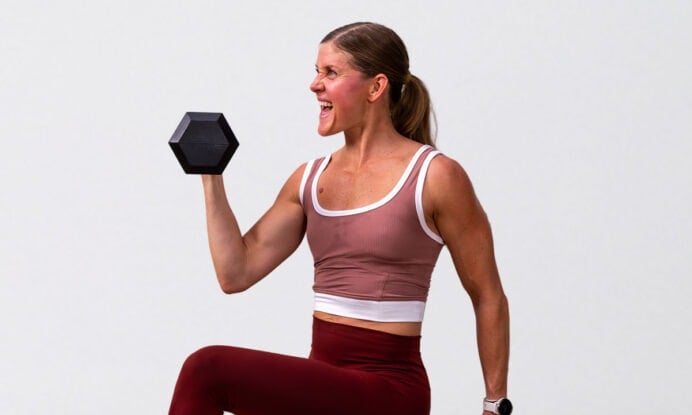
- Keeping your right elbow locked by your side, squeeze your right bicep muscle to curl the weight up toward your right shoulder.
- With control, lower the dumbbell back to the starting position. This is a slow deceleration of the weight through the full range of motion, lowering on a 3-count in a controlled movement.
9. Staggered Squat and Eccentric Bicep Curl
Targets: Legs, glutes, quads, hamstrings, hip flexors, biceps and core.
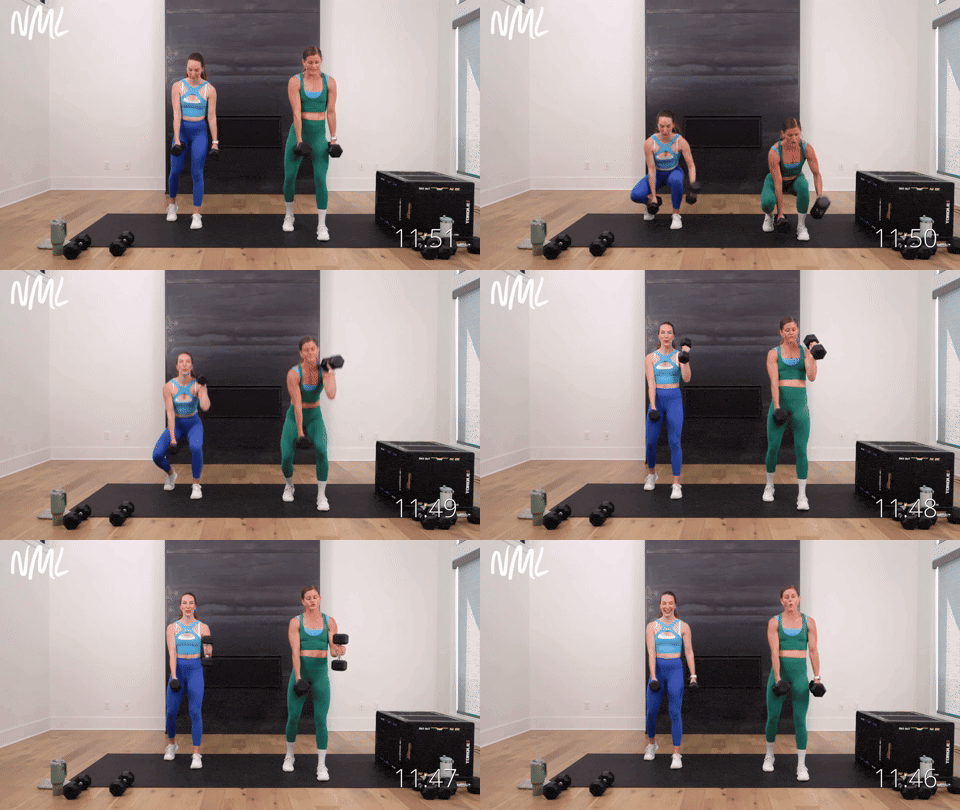
How to Do a Staggered Squat and Eccentric Bicep Curl
- Stand with feet hip-width apart, knees slightly bent. Hold a pair of dumbbells at your sides, palms facing in. Stagger your feet, so your right leg is slightly in front of your left foot.
- Maintain a staggered stance as you perform a squat, lowering down into a squat position until your hips are parallel with your knees. Drive your knees out toward your outer toes.
- At the bottom of the squat, perform a single-arm hammer curl on the right arm by curling the dumbbell up to shoulder height.
- Keep the dumbbell at shoulder height as you drive through your front right heel to stand tall. Slowly lower the dumbbell in your right hand down to your side on a 3-count.
10. Single-Leg Glute Bridge
Targets: Glutes, hamstrings, hips and pelvic floor.
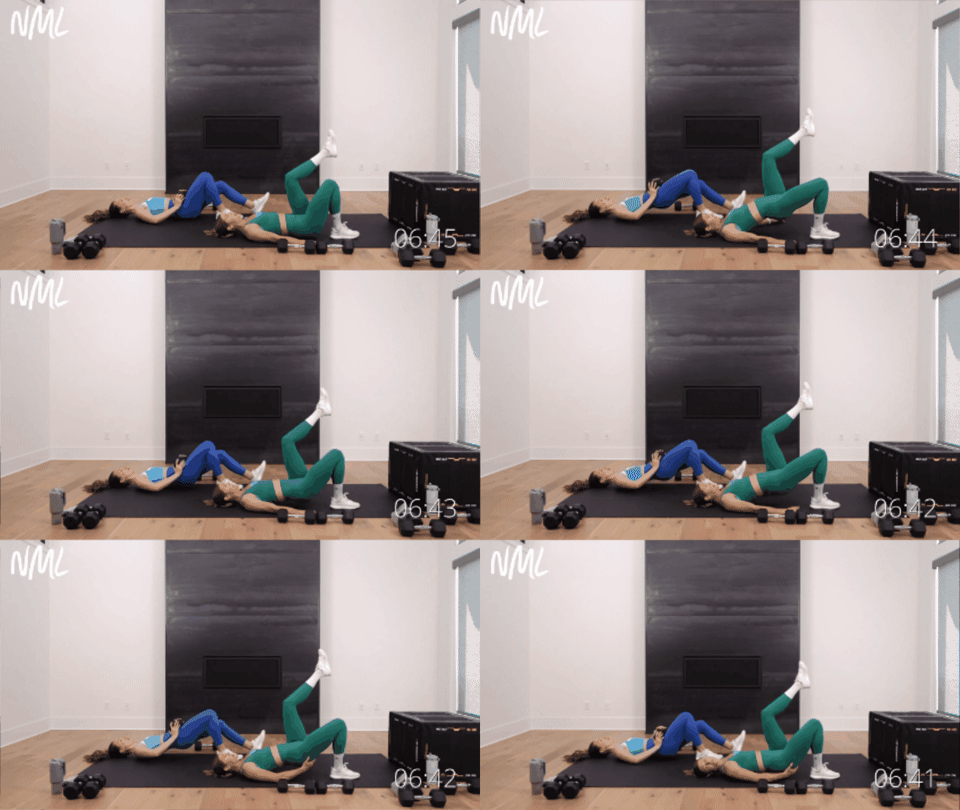
How to Do a Single-Leg Glute Bridge
- Start lying on your back, right foot planted on the ground, left foot extended straight overhead, ankle stacked over knee.
- Press through your heels to lift your glutes off the mat, squeezing your glutes as you lift. Think about keeping your core engaged and knees in line with your hips.
- Exhale, slowly lowering your hips to hover an inch above the mat, returning to the starting position.
Modification: Perform a staggered stance glute bridge by planting your left heel and stepping your right foot out slightly further away from your body. Keep most of your weight in your left heel, right toes popped off the ground.
11. Single-Leg Bridge Hold and Skull Crushers
Targets: Legs, glutes, hamstrings, inner thighs, triceps (back of the arm) and core.
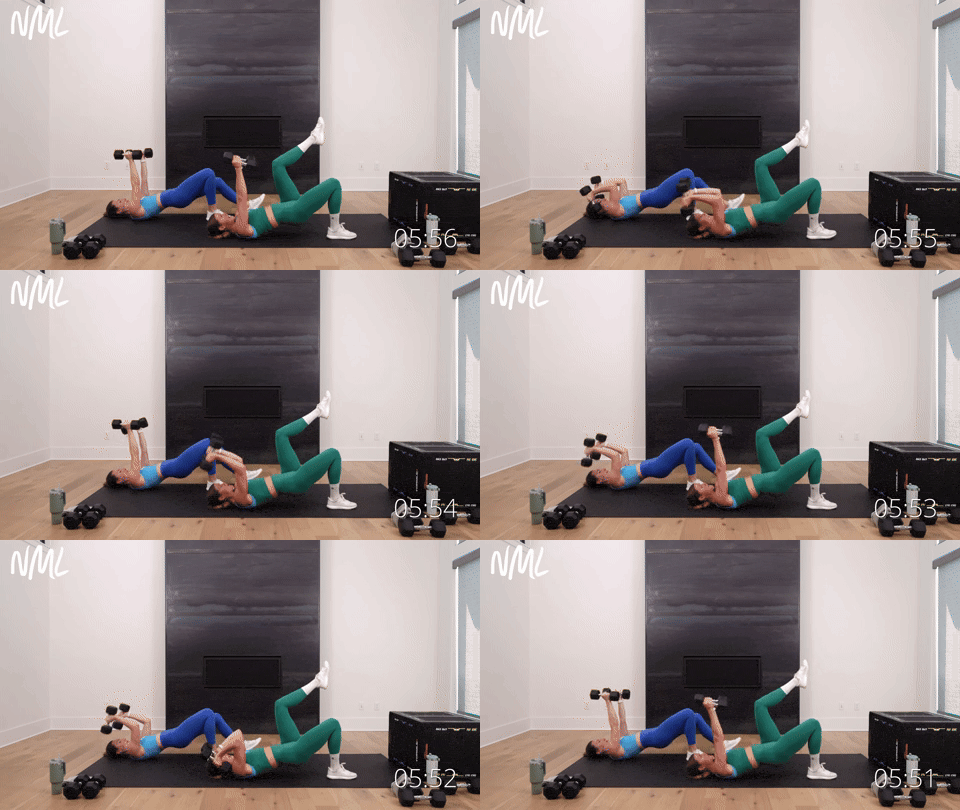
How to Do a Single-Leg Bridge Hold and Skull Crushers
- Start lying on your back, right foot planted flat on the ground, left foot extended straight overhead (ankle stacked over knee). Hold a dumbbell in each hand, fully extending your arms so the dumbbells are directly overhead, palms facing one another.
- Press through your heel to lift your glutes off the mat, squeezing your glutes as you lift. Think about keeping your core engaged and knees in line with your hips. Hold this single-leg glute bridge.
- Bend at the elbows to slowly lower the dumbbells towards your head (just bending at the elbows). This is a skull crusher.
- Push the dumbbells back overhead to return to the starting position. Repeat to perform as many skull crushers as possible in the timed interval, maintaining the single-leg glute bridge hold the entire time.
Modification: Option to perform skull crushers while holding a staggered or double leg glute bridge (keeping both feet on the ground).
12. Uneven Sit-Up and Single-Arm Press
Targets: Rectus abdominis (your “6-pack” ab muscles), deep transverse abdominals, upper abs, lower abs, obliques and shoulders.
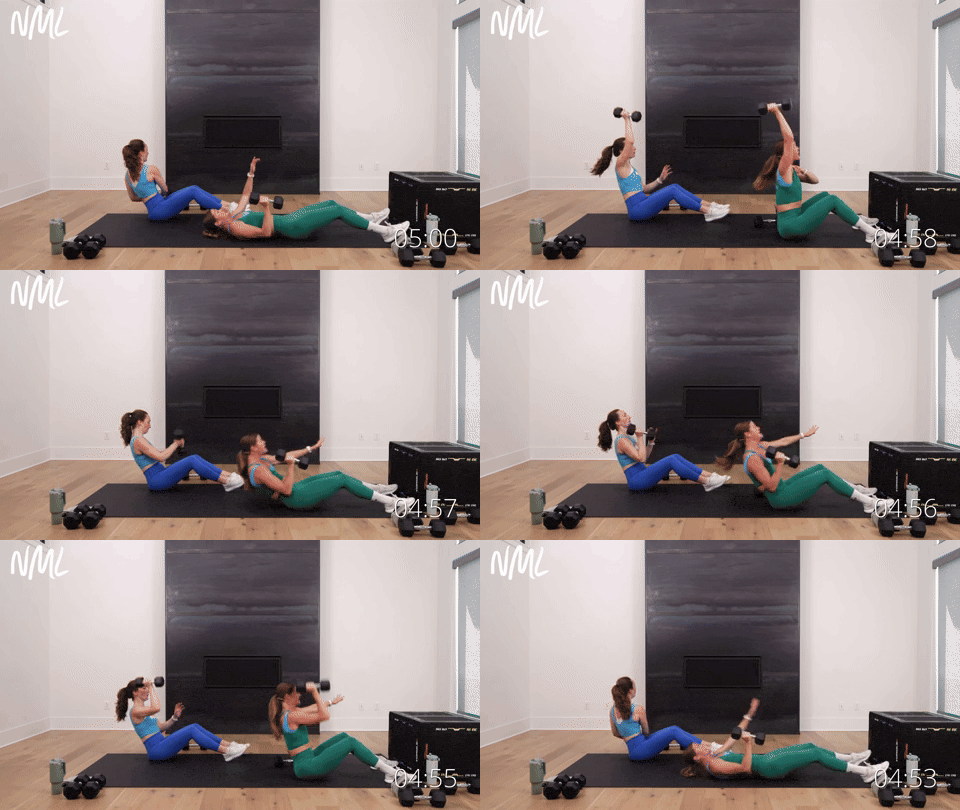
How to Do an Uneven Sit-Up and Single-Arm Press
- Start seated with your knees bent and your feet flat on the floor. Hold a dumbbell in your right hand at shoulder height.
- Keeping your core engaged, lean your torso back to lie flat on the ground, body forms a straight line.
- Pull your torso back to an upright position to perform a sit-up. At the top of the movement, perform a single-arm shoulder press by pressing the dumbbell in your right hand directly overhead, locking out the right bicep near your right ear.
- With control, lower the dumbbell back to your shoulder, then lower back down to the mat and repeat.
Modification: Option to omit the sit-up and perform seated cross-body chops and single-arm overhead presses.
Read A 5-Star Review ⭐⭐⭐⭐⭐
“I think this is my new favorite! The variety, sequencing, and 1-minute burnouts made for a challenging and fun workout. Thank you!”
Benefits of Unilateral Exercises
As a personal trainer with over a decade of experience, I believe unilateral training is one of the most overlooked keys to building functional strength. Unilateral exercises – movements performed with 1 arm or 1 leg at a time – challenge the body in ways bilateral lifts simply can’t. While traditional bilateral exercises, like squats or chest presses, allow you to lift heavier, single-sided training unlocks a different set of benefits that are essential for balanced, resilient strength.
For beginners, the best unilateral exercises, such as lunges, split squats, single-leg deadlifts, step-ups and single-arm rows, are great places to start. These movements build stability, control and body awareness.
One of the biggest advantages of unilateral movement is how effectively it targets and corrects muscle imbalances. Since each limb works independently, your stronger side can’t compensate for your weaker side. Over time, this creates more symmetrical strength, improves posture and reduces overuse patterns that often lead to injury.
Unilateral exercises are also beneficial for improving balance and stability. They engage the deep core, hips and smaller stabilizing muscles that keep the body aligned. This not only strengthens the core without traditional ab work but also enhances your ability to move efficiently in daily life.
When it comes to muscle growth, unilateral exercises are great. Because each limb handles the full load on its own, the muscles work harder. This makes unilateral training especially useful for progressive overload when equipment is limited.
From an injury-prevention standpoint, unilateral movements are unmatched. By strengthening stabilizers, evening out imbalances and reinforcing joint strength, these exercises help reduce the risk of common issues in the knees, hips, shoulders and lower back.
For athletes (or anyone who wants to move more powerfully), unilateral training directly translates to better performance. Running, jumping, cutting, carrying and most real-world movements happen 1 side at a time. Training unilaterally improves coordination, explosiveness and control, making your body more adaptable and resilient.
Whether your goal is muscle growth, injury prevention or better athletic performance, unilateral training is great to add to your routine.
FAQs
Who should do unilateral training?
Unilateral training is beneficial for everyone, from beginners building foundational strength to advanced athletes looking to optimize performance. It’s especially helpful if you want to correct muscle imbalances, improve stability, enhance coordination or reduce your risk of injury. Because each side works independently, unilateral exercises meet you exactly where your body is, and help you even out your dominant side.
Why do I struggle with single-leg exercises, and how can I improve my balance?
Struggling with single-leg movements is normal because they challenge your strength, stability and coordination at the same time. Weak glutes, limited ankle mobility or an underactive core often make balance harder. You can improve by practicing easier progressions (like supported single-leg work), strengthening your hips and core, and training barefoot or on stable surfaces to improve proprioception.
What is the best single-leg exercise?
In my opinion, there isn’t one “best” single-leg exercise, but the single-leg Romanian deadlift (RDL) is one of the most effective. It targets the hamstrings, glutes and core while demanding balance and control. Lunges, step-ups and split squats are also excellent options depending on your goals and comfort level.
What is a bilateral exercise?
A bilateral exercise is any movement where both sides of the body work together at the same time. Squats, deadlifts, bench presses or overhead presses are all examples of bilateral movements. Bilateral training allows you to lift heavier weights, build overall strength and train major muscle groups efficiently.
Free 2-Week Strength Program
More Workouts
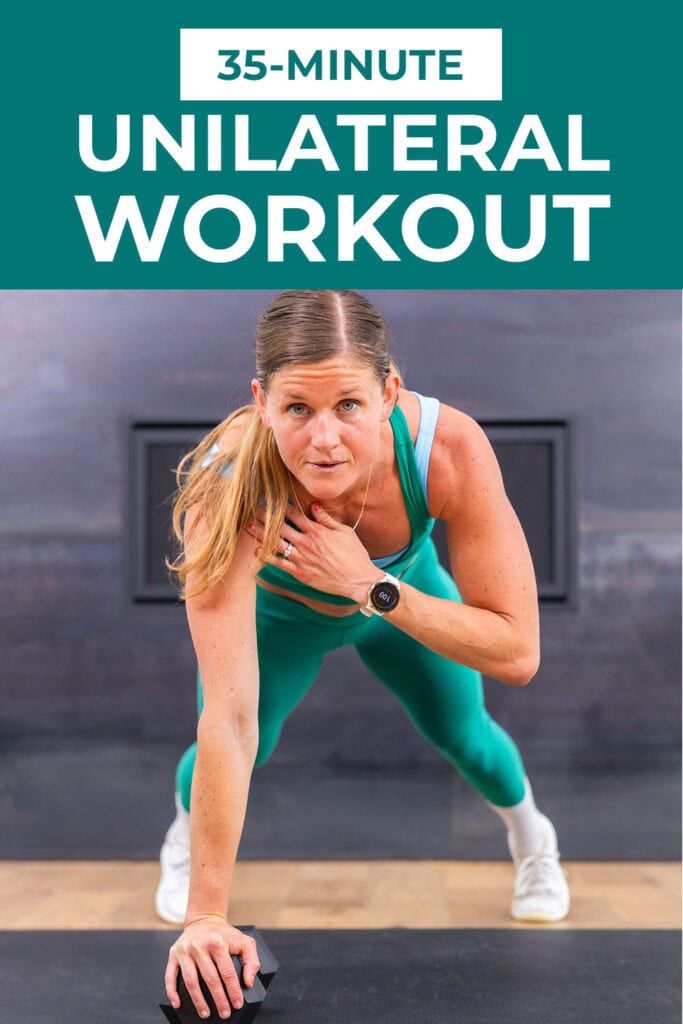
Full-BodyPin This: 12 Unilateral Exercises (Full-Body Strength Workout)
no comments