





35-Minute Boxing Workout at Home
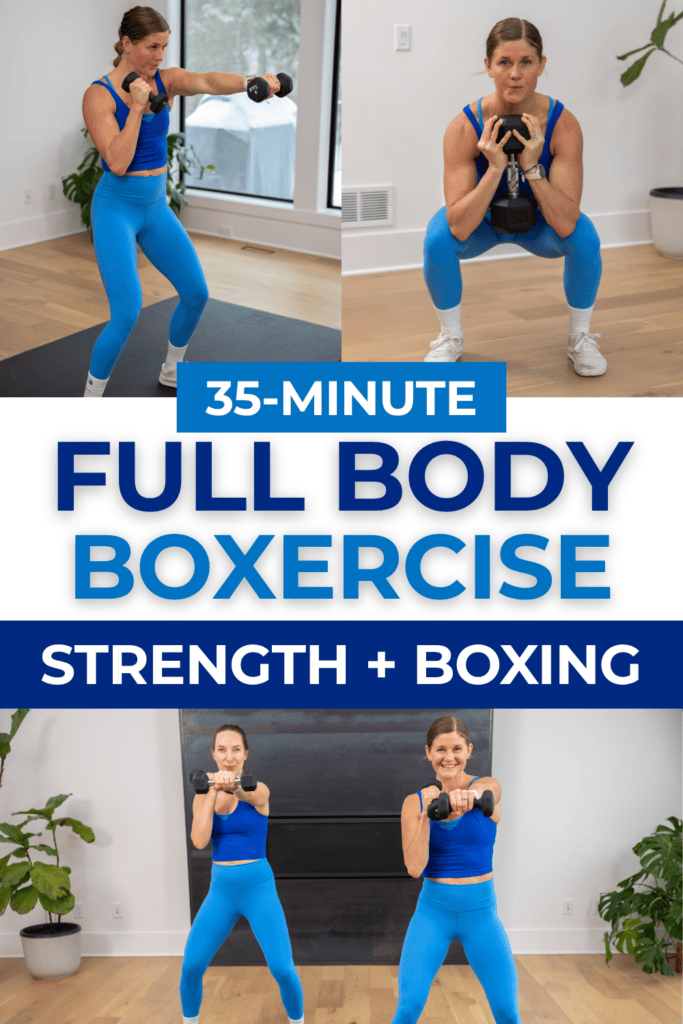
Punch and jab your way to strong, defined muscles with this fusion-style strength and boxing workout you can do at home. This full-body session targets the lower body, upper body and core while improving muscular strength, cardiovascular fitness, coordination and endurance. It’s ideal for anyone looking for an efficient, time-saving workout that blends strength training with high-energy boxing combinations, combining resistance-based exercises (like squats, presses and lunges) with dynamic boxing drills to keep your heart rate elevated and your muscles working throughout.
I’ve always found boxing workouts to be one of the most effective and enjoyable ways to train at home, especially when the goal is to build strength, improve conditioning and stay consistent without needing a gym. There’s something about the rhythm of boxing punches and the flow of combinations that makes the workout feel fast-paced and engaging, while still delivering a truly great workout with high-intensity intervals that challenge the entire body.
From my experience, boxing at home is a good workout and one of the most efficient ways to improve fitness. A structured HIIT workout that blends boxing stance work, conditioning drills and strength exercises can improve cardiovascular endurance, coordination, agility and core strength, while also supporting lean muscle development when resistance is added. I especially notice how quickly my heart rate climbs during boxing intervals, which is one of the key benefits of boxing for both fat loss and overall conditioning.
What makes boxing so effective is how functional it is. Every punch (whether it’s a jab, cross, hook or uppercut) relies on full-body coordination, engaging the shoulders, arms, back and core while footwork patterns build balance and lower-body stability. I focus heavily on boxing fundamentals like stance, guard position and controlled movement, because they directly impact how powerful punches feel and how efficiently energy is used. I often combine these boxing punches with push-ups, squats, lunges, deadlifts and presses to build a full-body boxing workout circuit that mirrors real athletic movement patterns. This style of training also transfers into everyday function, like lifting objects, rotating through the torso and reacting quickly under pressure.
A good at-home boxing workout routine doesn’t require much equipment, which is part of what makes boxing training from home so accessible. Most sessions only require a bit of space, a mat and optional equipment like light or heavy dumbbells. When available, a punching bag or heavy bag can add resistance and power development, allowing for more powerful punches and improved striking technique. Even without a bag, shadowboxing remains highly effective for building speed, control and endurance.
I’ve found that a boxing workout with weights is one of the most efficient ways to combine strength and conditioning in a single session. It typically includes shadowboxing rounds, strength-based movements like push-ups and lower-body lifts and core-focused exercises that enhance stability and control. This structure creates a HIIT-style training approach that improves both power and endurance while maintaining intensity throughout the session.
Beyond the physical benefits, boxing is also a great tool for stress relief. The act of throwing controlled boxing punches, especially at high intensity, helps release tension and reset the nervous system after a stressful day. It’s one of the most effective ways I’ve found to channel mental energy into movement, leaving me feeling focused and re-energized afterward.
Overall, boxing at home is an empowering, accessible training method that combines fundamentals, conditioning and strength into one efficient system, making it a highly effective approach for both fitness and mental well-being.
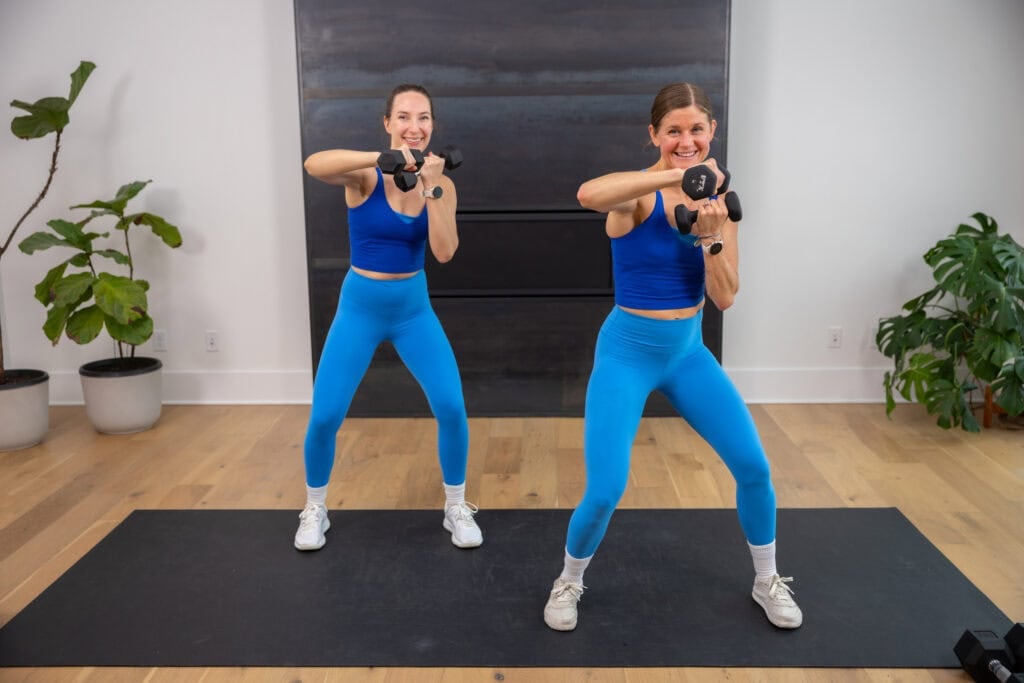
Read A 5-Star Review ⭐⭐⭐⭐⭐
“Absolutely LOVED this format! Perfect combination of strength and cardio, upper and lower body. Had so much fun sweating with you, as always!”
— Erin M.
Boxing Workout Details
Get your heart rate up and build strength at home with this efficient full-body workout. This fusion-style strength and shadowboxing session combines boxing-inspired movements with resistance training to challenge your entire body while improving coordination and endurance.
This workout targets every major muscle group, including the lower body (quads, hamstrings, glutes, calves and thighs), upper body (biceps, triceps, back, shoulders and chest), and core. The combination of dynamic punching patterns and strength-based movements also helps improve cardiovascular fitness, balance, and overall athletic conditioning.
For best results, include this type of full-body conditioning workout in your routine 1-2 times per week, alongside other forms of training such as strength sessions, mobility work or steady-state cardio. If you are new to exercise, start with 1 session per week and gradually build up as your fitness improves.
This workout may not be suitable for individuals with wrist, shoulder, knee or lower back injuries, or those who experience pain with high-impact or repetitive arm movements. If you are pregnant, managing a medical condition or returning from injury, consult a healthcare professional before participating or modify the movements to a lower-impact version.
Workout Equipment
Heavy dumbbells for the strength training blocks. I recommend between 15-25 lbs, depending on your fitness level.
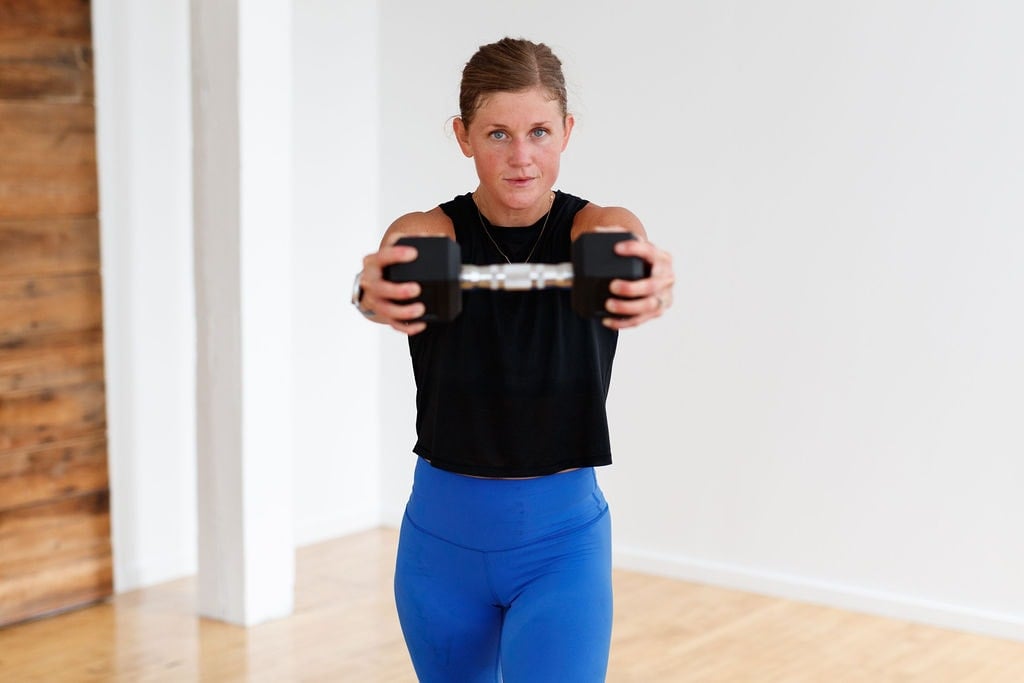
Optional light dumbbells for the boxing blocks. I recommend 3-5 lbs, but you could perform these with just your bodyweight as well.
Workout Instructions
Follow along with the guided Strength and Boxing Workout At-Home on YouTube, led by me — your certified personal trainer (CPT), Lindsey Bomgren.
Your Workout Looks Like This:
- Guided Warm-Up and Cool-Down
- 3 Circuits
- 3 Strength Exercises Per Circuit and 4-5 Boxing Exercises Per Circuit
- Timed Intervals of Work for Strength Exercises (40 seconds work, 20 seconds rest. Repeat x2 sets, performing as many reps as you can in the timed interval.)
- 3 Minutes of Boxing Combos (flowing directly from one move to the next; no repeats)
Note: I re-filmed this workout and changed up some of the exercises! You can find the original workout video here. If you try both, I’d love to know your favorite!
At-Home Boxing Workout Outline
Circuit 1:
Strength:
- Staggered Squat
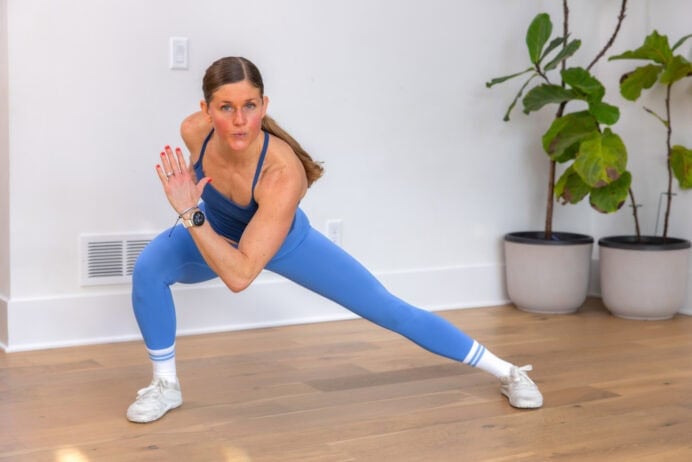
- Lateral Lunge
- Deadlift and Calf Raise
Boxing:
Circuit 2:
Strength:
- Side-to-Side Squat
- Reverse Lunge
- Staggered Deadlift
Boxing:
Circuit 3:
Strength:
- Goblet Squat
- Alternating Cleans
Boxing:
- 2 Jabs and Double Knee Block
- Shuffle and Crossbody Punches
- Jab, Hook and Uppercut
1. Jab and Cross
Targets: Arms, shoulders, back, chest, biceps, triceps, abs, core and calves.
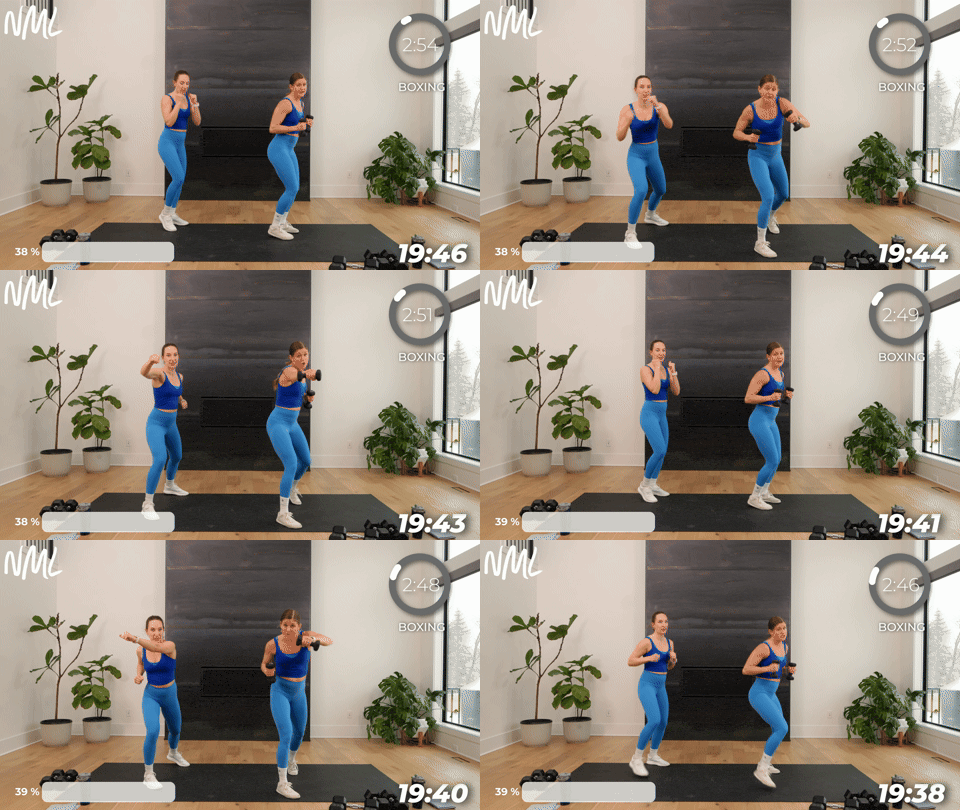
How to Do a Jab and Cross
- Start standing facing the right side of the room, feet hip-width apart, knees slightly bent and core engaged. Hold a light set of weights in each hand and bring your hands up into a guard position in front of your face.
- Perform a jab with your left arm by punching directly forward in front of you. As you extend the punch, step your left foot forward at the same time, keeping your shoulders relaxed and core tight. Quickly pull your left hand back to guard.
- Next, perform a cross-body cross punch with your right arm, rotating slightly through your torso as you punch across your body. As you punch, bring your right foot forward to meet your left foot, maintaining balance and control throughout the movement.
- Step both feet back to your starting position to reset, returning both hands to your guard position. Keep your stance strong and repeat the sequence in a controlled rhythm, focusing on power and coordination rather than speed.
Modification: Option to omit the light weights, and perform this exercise with just your bodyweight.
2. Front Jab and Press Jack
Targets: Arms, shoulders, back, chest, biceps, triceps, abs, core, glutes and calves.
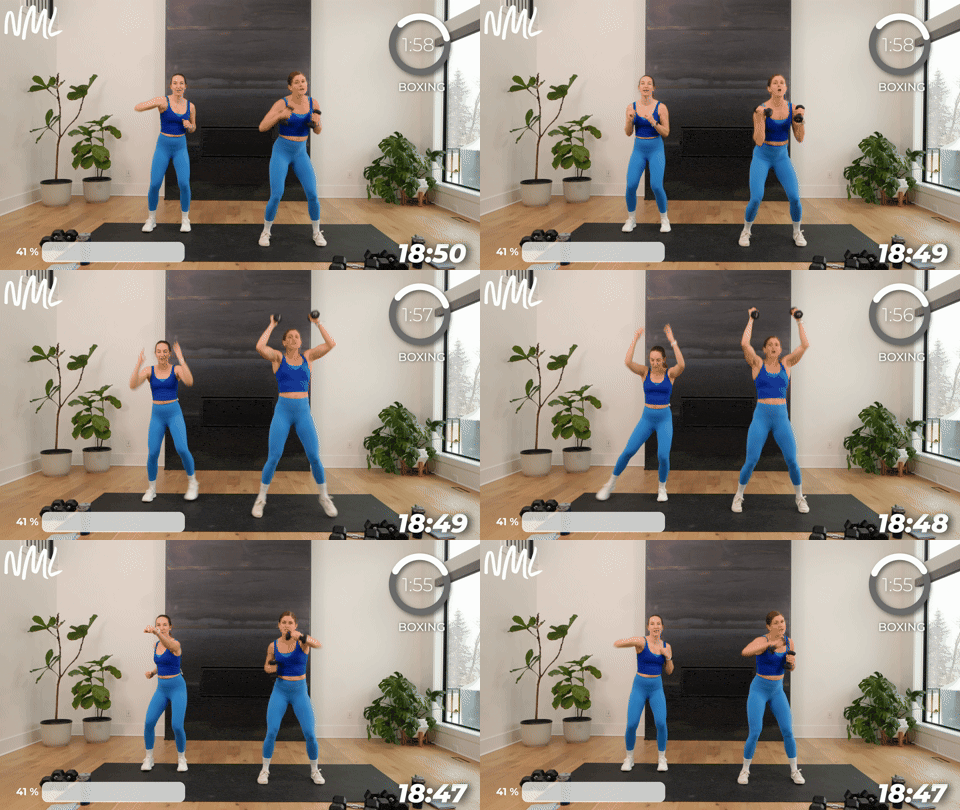
How to Do a Front Jab and Press Jack
- Start standing facing forward, feet hip-width apart, knees slightly bent and core engaged. Hold a light set of weights in each hand and bring your hands up to a guard position in front of your face, keeping your shoulders relaxed and spine tall.
- Perform a jab with the right arm, punching straight in front of you at shoulder height. Keep your wrist straight and core tight, then quickly pull the right hand back to your guard position.
- Immediately perform a jab with the left arm, punching straight forward with control. Engage your torso slightly for stability, then pull the left hand back to your guard position, maintaining balance and steady breathing.
- Perform 2 press jacks: Jump your feet out wide like a jumping jack while simultaneously pressing both weights straight overhead. Keep your core engaged and avoid arching your lower back as you press.
- Jump your feet back together to return to your starting stance, lowering the weights back to shoulder height or guard position. Reset your posture and repeat the full sequence with controlled rhythm and coordination.
Modification: Option to omit the light weights, and perform this exercise with just your bodyweight. Omit the impact by stepping the feet out rather than jumping them out during the jumping jacks.
3. Elbow Block and Press Jack
Targets: Shoulders, arms, back, chest, triceps, biceps, abs, core, glutes and calves.
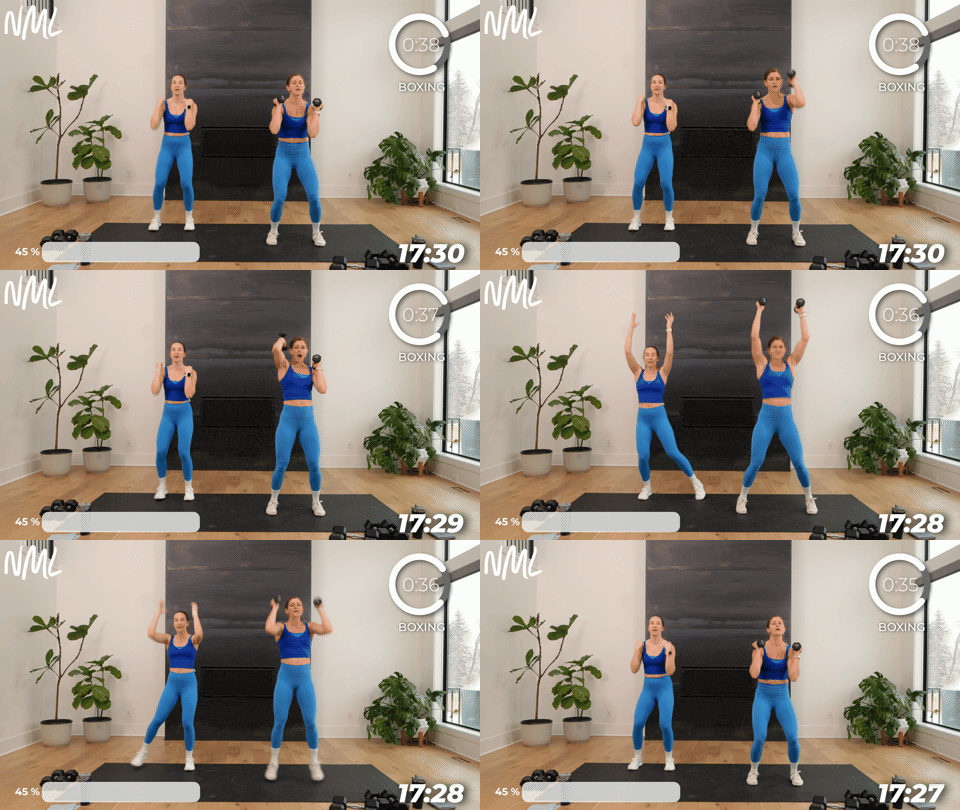
How to Do an Elbow Block and Press Jack
- Start standing facing forward, feet hip-width apart, knees slightly bent and core engaged. Hold a light set of weights in each hand in a front-racked position at your shoulders, with elbows bent and close to your body. Keep your chest lifted and spine neutral.
- Perform an elbow block with the right arm by lifting your right elbow up in front of your body, as if blocking an incoming strike. As you lift the elbow, allow the dumbbell in your right hand to shift slightly behind you, keeping control through the shoulder and upper back. Focus on stability through your core.
- Lower the right elbow back down to your starting racked position at your shoulder, maintaining tension in your arms and core.
- Perform an elbow block with the left arm, lifting the left elbow up in front of you in the same controlled motion while the dumbbell shifts slightly behind. Keep your torso steady and avoid leaning. Return the left elbow to the racked position.
- Perform 2 press jacks: Jump your feet out wide like a jumping jack while simultaneously pressing both weights straight overhead. Keep your core engaged and avoid arching your lower back as you reach full extension.
- Jump your feet back together and return the weights to the front-racked shoulder position. Reset your stance and repeat the sequence with control, maintaining strong posture and smooth transitions throughout.
Modification: Option to omit the light weights, and perform this exercise with just your bodyweight. Omit the impact by stepping the feet out rather than jumping them out during the jumping jacks.
4. Jab, Crossbody Punch, Hook and Uppercut
Targets: Arms, shoulders, back, chest, biceps, triceps, abs, core and calves.
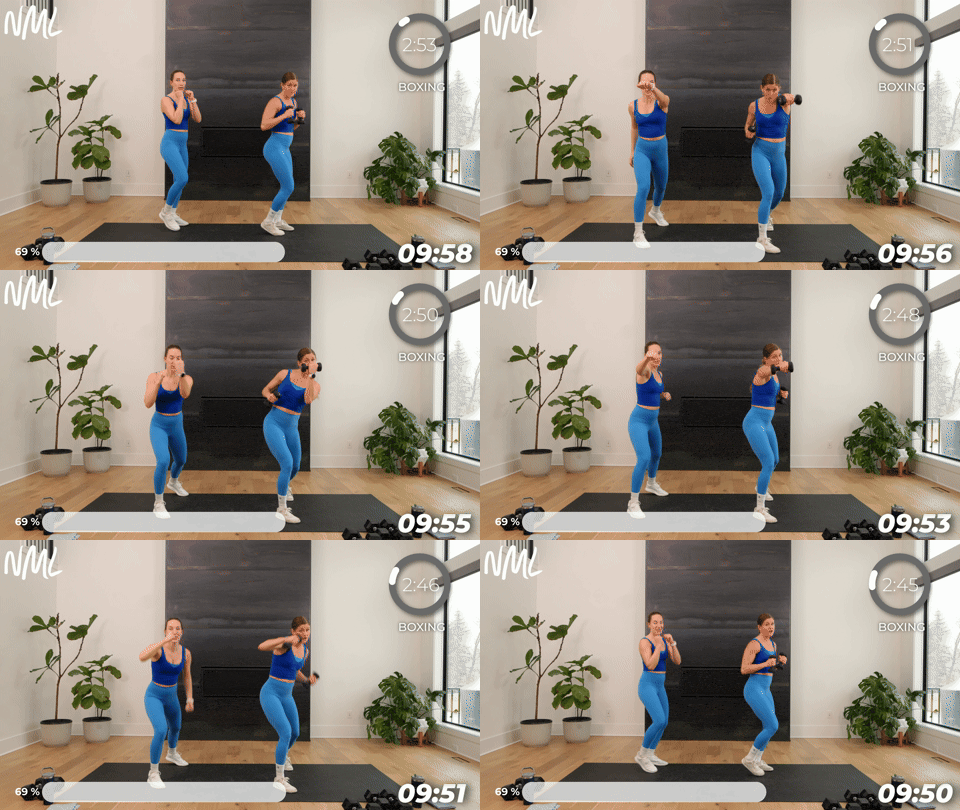
How to Do a Jab, Cross, Hook and Upper
- Start standing, feet hip-width apart, knees bent, core engaged. Hold a pair of light weights. Open your hips to the right, so your left foot is forward and your right leg is back. Bring your hands or knuckles up to defend your face in a guard position.
- With your right arm, jab forward towards the front of the room. Pull your right arm back to your defensive position.
- Punch across your body with your left hand (performing a cross-body punch). Pull both hands back to the defensive position.
- Then, perform a hook with your left arm, flexing your bicep as you curl your left arm in a half circle towards the front of the room. Pull your left arm back to your defensive position.
- Finally, perform an uppercut with your right arm. An uppercut is a hooking motion that starts low and comes up, with a flexed bicep. Think about landing your punch underneath someone’s chin. Pull your right arm back into your defensive position, returning to the starting position.
Modification: Option to omit the light weights and perform the exercise with just your bodyweight.
5. Beatdown and Jab
Targets: Arms, shoulders, back, chest, biceps, abs, core and calves.
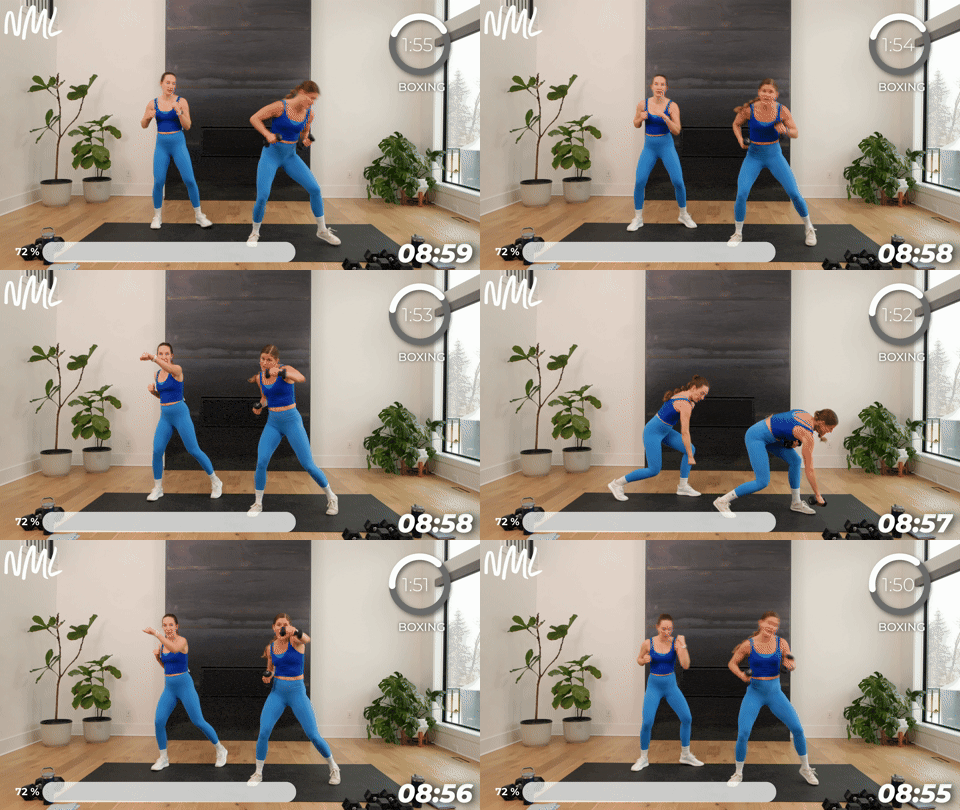
How to Do a Beatdown and Jab
- Start standing in an athletic stance, feet wider than hips, soft bends in both knees. Hold a pair of light weights at chest level.
- Pivot your hips, knees and toes towards the left. Drive the weight in your right hand across your body, punching towards the left. Think about using the momentum from your back right leg to power the punches. Repeat, performing 2 punches.
- Pivot your hips, knees and toes to the right. Bend your right knee as you use your left arm to punch down towards the ground. Repeat, performing 2 beatdowns.
Modification: Option to omit the light weights, and perform this exercise with just your bodyweight.
6. Jabs and Double Knee Block
Targets: Arms, shoulders, back, chest, biceps, triceps, abs, core, hip flexors, glutes and calves.
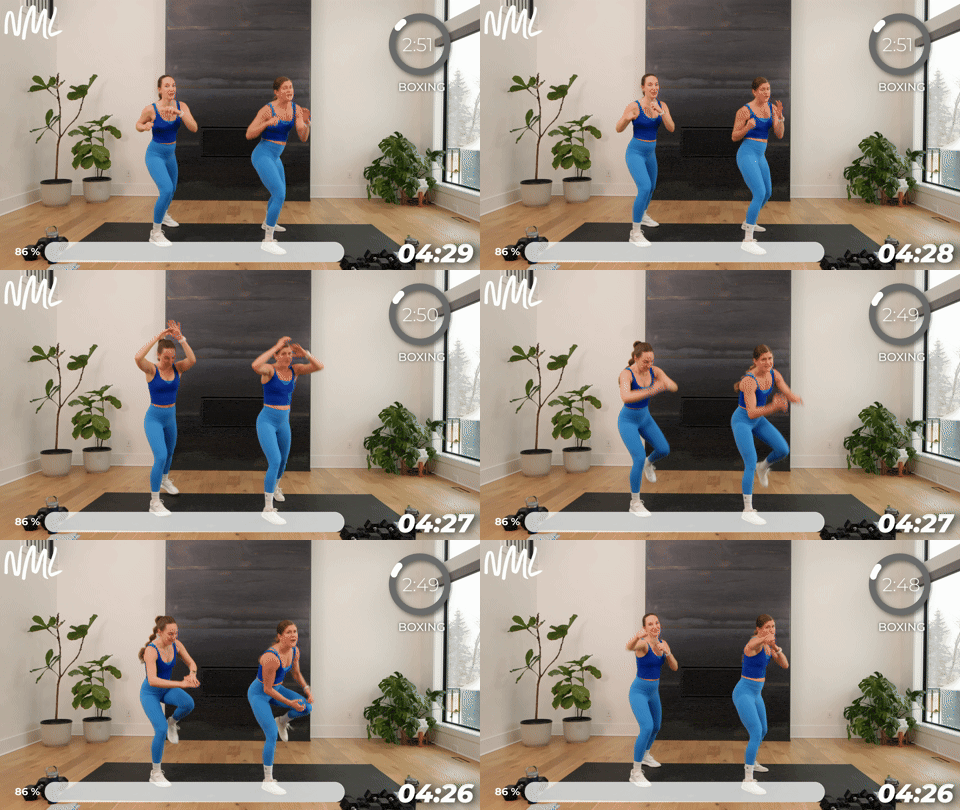
How to Do a Jab and Double Knee Block
- Start standing facing the right side of your space in a split stance, with your left foot forward and right leg back. Keep your knees slightly bent, core engaged and hands up in a guard position in front of your face as if defending.
- Perform 2 jabs with the left fist, punching directly forward at shoulder height. Each jab should be quick and controlled, with a full retraction back to your guard position after each punch. Keep your shoulders relaxed and torso stable.
- Shift your weight into your front left heel, maintaining balance and an upright posture.
- Perform 2 knee blocks by driving your right knee up toward your chest. As you lift the knee, pull both arms down powerfully to meet the knee, engaging your core as if blocking or compressing the movement.
- As the right foot returns to the ground after each knee drive, press both arms back up overhead, keeping the motion strong and controlled. Repeat for the second knee block, maintaining a steady rhythm and core engagement throughout.
- Reset in your split stance with hands back in guard position, then repeat the full sequence with control, focusing on coordination between upper and lower body movement.
7. Shuffle and Crossbody Punches
Targets: Arms, shoulders, back, chest, biceps, triceps, abs, core, obliques, glutes and calves.
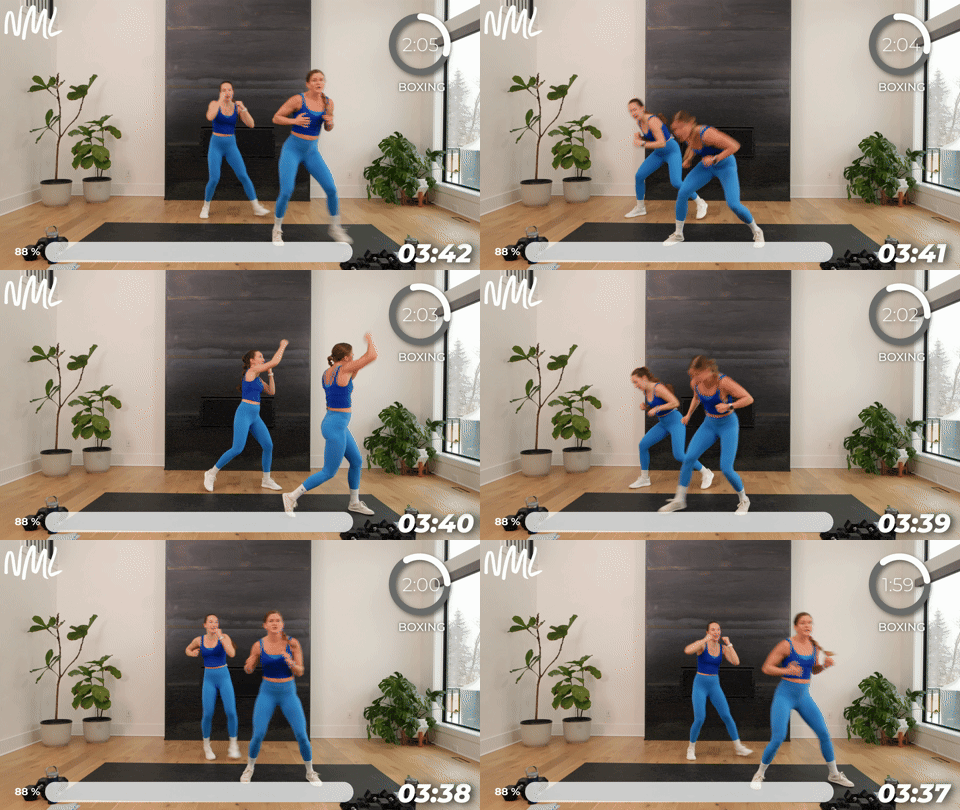
How to Do a Shuffle and Crossbody Punch
- Start standing at the far right side of your space, feet hip-width apart, knees slightly bent and core engaged. Keep your hands up in a guard position in front of your face, shoulders relaxed and posture tall.
- Perform a lateral shuffle to the left, taking 2 large controlled shuffle steps. Stay low in your stance as you move, keeping your chest lifted and core tight to maintain balance and stability.
- Once you reach the far left side of your space, perform a low crossbody punch with the right arm, punching diagonally across your body toward your left foot. Rotate slightly through your torso as you reach the punch, then pull the arm back to guard.
- Perform a lateral shuffle back to the right side of your space, maintaining a low athletic stance and steady rhythm as you travel.
- When you reach the right side, perform a high crossbody punch with the left arm, punching up and across your body over your right shoulder. Engage your obliques as you rotate and extend, then return the arm back to guard.
- Continue repeating the full sequence, alternating travel and punch directions with control, keeping your movement smooth, grounded and coordinated between upper and lower body.
FAQs
What are the basic boxing movements?
The basic boxing movements include jabs, crosses, hooks and uppercuts. A jab is a quick, straight punch with your lead hand. A cross is a powerful straight punch with your rear hand, usually following a jab. A hook is a semi-circular punch aimed at the side of the opponent, often delivered with the lead hand. An uppercut is a rising punch that comes from a bent arm position, targeting the opponent’s chin or torso. In addition to punches, basic movements include footwork (shuffling, pivoting and stepping), defensive actions (blocks, slips and ducks), and core engagement to maintain balance and power.
What do the numbers 1-6 mean in boxing combinations?
In boxing, numbers are shorthand for specific punches to make calling combinations easier. Typically, 1 is a jab, 2 is a cross, 3 is a lead hook, 4 is a rear hook, 5 is a lead uppercut and 6 is a rear uppercut. Lead refers to punching with your lead hand and rear refers to punching with your rear hand. Trainers often call out sequences like “1-2-3” to indicate jab, cross, lead hook, allowing boxers to perform combinations smoothly.
How often should you do boxing workouts at home?
For general fitness and skill-building, 2-4 boxing workouts per week is ideal. Beginners can start with shorter sessions of 20-30 minutes, focusing on technique, footwork and conditioning. More advanced athletes can train 4-6 times per week, mixing skill practice, strength work and cardio conditioning. It’s important to allow rest or active recovery days to prevent overuse injuries, especially in the shoulders, wrists and knees.
Free 2-Week Strength + HIIT Program
More Workouts
30 MinutesPin This: At-Home Boxing Workout (35 Minutes)
4 comments


I would love a full playlist of boxing related workouts. I loved this combination of strength and boxing intervals. So motivating, so fun, not at all boring. I’m sore in all the best ways the day after. Thank you for all your thoughtful, highly motivational workouts. We appreciate them!
That is great feedback, Katie! I’m glad to hear you enjoyed this combo – it’s a fun one. Thanks for following along! -Lindsey
You had me at boxing and to add strength?! This quickly moved into my top NML faves! Kickboxing has been one of my favorite ways to work out for years (I found NML when I googled kickboxing/barre workouts and have never looked back), and now that I’m over 50 I’ve been prioritizing strength training. To find a workout that combines them both isn’t just holy bananas, it’s top bananas! My son is getting married later this year, and this one will definitely be on my wedding slim/trim/tone playlist. I have a bone spur in my neck that can result in painful pinched nerves sometimes in my upper back/shoulder area, along with sciatica, so right now 8 lbs. is my new 25 lbs., but thank you, thank you, thank you for providing encouraging and achievable workouts that don’t make ya feel like a loser if you can’t do it all! Blessings to you ladies!
Hi Stacey! Thank you so much for this kind comment! I love that you’re combining kickboxing and strength in a way that works for you, and major kudos for listening to your body and adjusting as needed – that’s real strength. Honored to be part of your wedding prep (congrats to your son!) and so glad the workouts feel encouraging and doable. Keep up the great work! -Lindsey