





2-Week Hybrid Strength Training Plan
This free 2-week hybrid program is designed to build total-body strength, increase muscle mass and boost cardiovascular endurance while improving speed and reducing your risk of injury. It’s ideal for anyone looking to improve overall fitness and build muscle at home with minimal equipment. The plan combines resistance training, bodyweight exercises and cross-training workouts for a well-rounded, effective routine that supports both strength gains and functionality.
Quick Links:
If you’ve been around here a while, you know how much I value functional fitness. Resistance training will always be a priority for me. Still, I care just as much about building endurance, supporting bone density and improving mobility so my body can move well for the long run.
That’s where hybrid training comes in. To me, it’s the intentional combination of weightlifting and endurance work, training in a way that builds muscle mass while also improving how efficiently your heart and lungs perform. The hybrid athlete isn’t focused on just lifting heavy or just going the distance; they’re working toward doing both well, creating a body that’s strong, capable and built for real-life functionality. You’ll see this style in training formats like HYROX, where strength and endurance are equally prioritized.
I’ve found this approach to be effective, even at home, because it doesn’t require a ton of equipment – just smart, intentional programming. I like to balance my week with a mix of resistance training sessions and conditioning workouts, sometimes blending the 2 in a single session. That might look like dumbbell or bodyweight strength work paired with sprints or short cardio intervals, or alternating days dedicated to endurance and full-body strength training. I also make sure to include active recovery so my body can adapt and continue progressing.
One of the biggest benefits I’ve seen is improved overall strength, better performance and a reduced risk of injury. When I only focus on one style of training, I start to feel the gaps. Running alone can lead to overuse of certain muscle groups, and weightlifting alone can leave my endurance behind. Combining both helps me feel more balanced, improves my energy and supports strength gains in a way that translates to everyday life.
Most weeks, I aim for around 4-6 training sessions, alternating between strength and endurance to allow for recovery while still applying progressive overload where it matters. It’s not about doing everything at once; it’s about being intentional with how I train so I can continue building strength, endurance and overall fitness over time.
LET’S GET STARTED
Download Your FREE Workout Plan Here
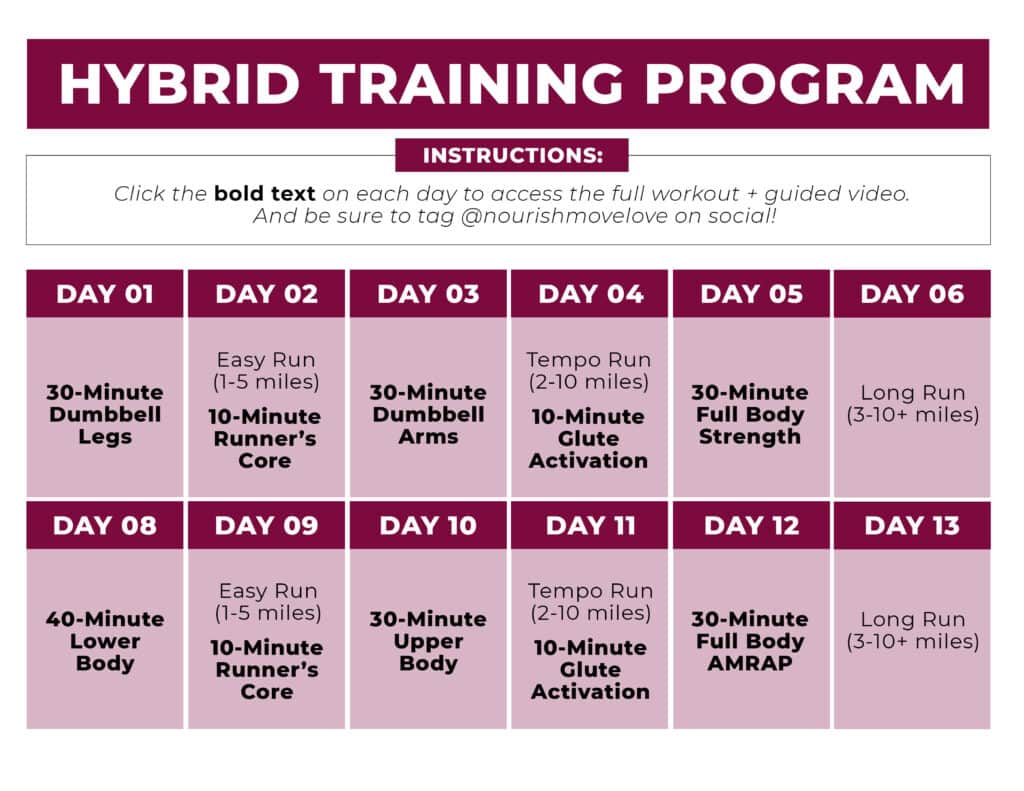
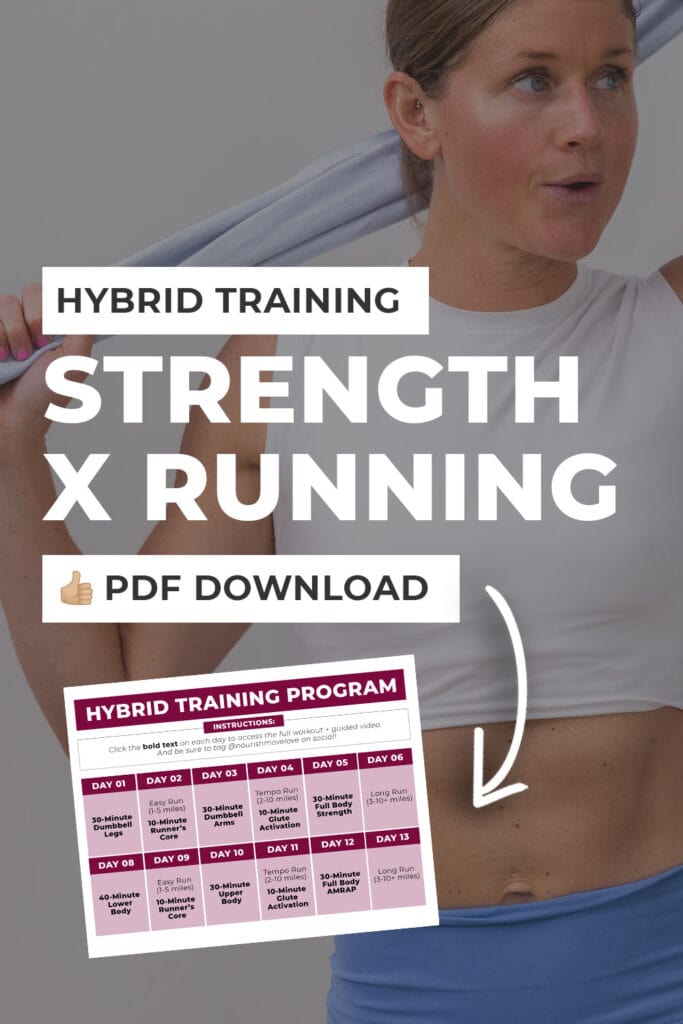
Download the PDF calendar for this 2-week workout program so you can easily access your daily workouts.
Download Plan
Benefits of Hybrid Training and How It Works
Hybrid training combines resistance training with endurance work (like running, cycling or sprints) to improve overall fitness and performance. By training multiple muscle groups through both strength and cardio, this approach builds muscle mass, increases aerobic capacity and enhances overall strength and functionality.
Blending these training styles throughout the week allows you to build strength and power while improving cardiovascular efficiency. It’s an effective way to supplement traditional weightlifting with endurance training, leading to better body composition, increased strength gains and a lower risk of injury by strengthening supporting muscles and reducing repetitive strain.
This plan is designed with runners in mind, targeting key lower-body muscle groups like the glutes, hamstrings, quads, calves and core, while also improving upper-body strength for better posture and performance. That said, you don’t have to be a runner to follow it. You can tailor the cardio to your goals – whether that includes sprints, steady-state runs or lower-impact options like walking or cycling. The goal is to meet you where you are while helping you build strength, endurance and long-term resilience.
Who Should Complete This 2-Week Challenge
- This free hybrid training program is for anyone looking to:
- Create a consistent, sustainable fitness routine you can stick to in just 2 weeks.
- Build strength in key power-generating muscles that support running performance.
- Improve upper-body strength (an area I see a lot of runners overlook).
- Strengthen connective tissues to support better flexibility and range of motion.
- Combine weight training with HIIT-style cardio for a balanced, efficient routine.
- Boost cardiovascular endurance while building core strength, mobility and stability.
- Burn calories and support fat loss with effective at-home workouts.
Week 1
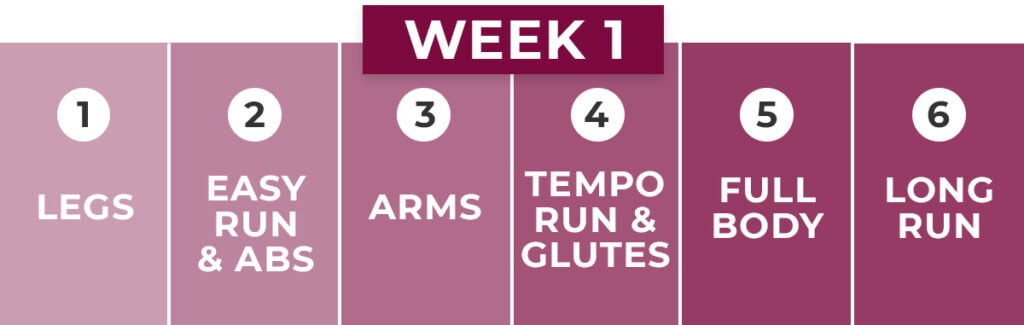
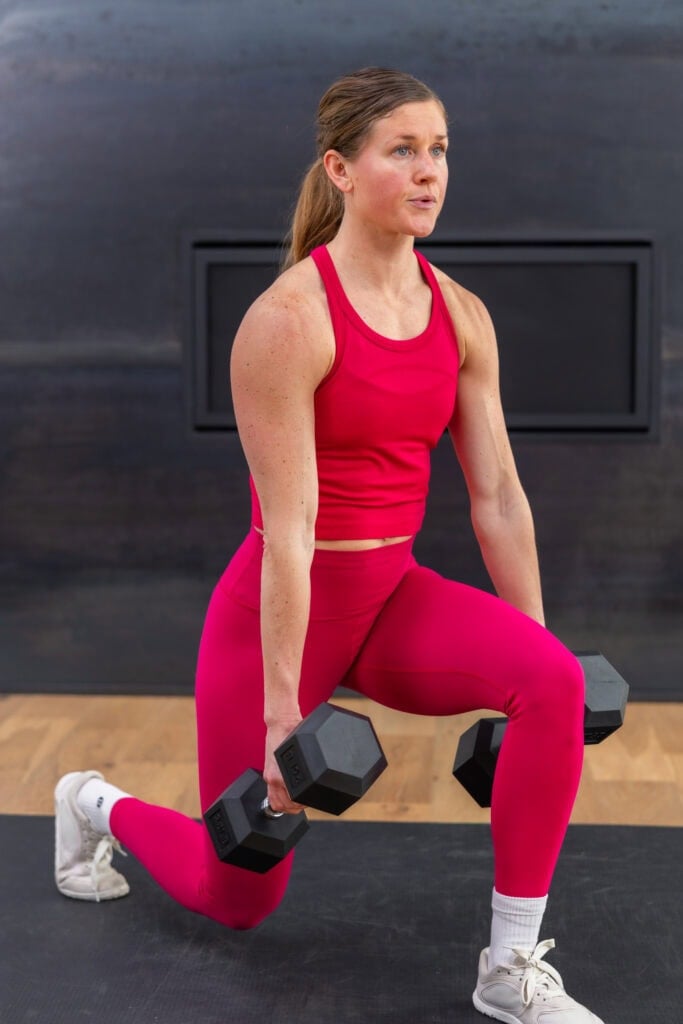
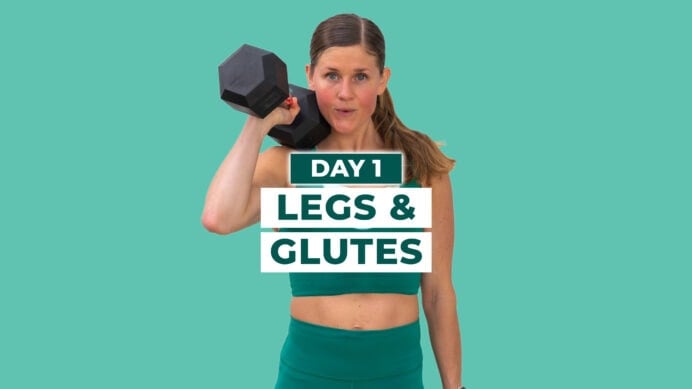
Day 1: 30-Minute Dumbbell Leg Workout
- Workout Time: 30 Minutes
- Equipment: Dumbbells. Optional mini loop resistance band and bench/box.
- YouTube Link: 30-Minute Dumbbell Leg Workout
- Running Distance: None
Day 2: Easy Run and 10-Minute Core Workout for Runners
- Workout Time: 10 Minutes (plus running time)
- Equipment: None
- YouTube Link: 10-Minute Core Workout for Runners
- Running Distance: 1-5 Miles (Think of this as a leg shakeout. Beginners should aim for 1 mile, and more advanced runners should aim for 2-5 miles.)
- Running Alternative: 15-Minute Zone 2 Cardio Workout
Day 3: 30-Minute Dumbbell Arm Workout
- Workout Time: 30 Minutes
- Equipment: Dumbbells
- YouTube Link: 30-Minute Dumbbell Arm Workout
- Running Distance: None
Day 4: 10-Minute Glute Activation Warm-Up and Tempo Run
- Workout Time: 10 Minutes (plus running time)
- Equipment: Mini loop resistance band
- YouTube Link: 10-Minute Glute Activation
- Running Distance: 2-10 Miles (Tempo runs should be between 20-40 minutes total. If you’re an advanced runner, you can aim for 60 minutes. Aim for 80-85% of your max heart rate for 20-30 minutes of the run. The pace should feel hard but sustainable — it would be hard for you to carry on a conversation. Beginners aim for 2 miles, intermediates aim for 4-5 miles and advanced aim for 5-10 miles. You can also structure your tempo runs as intervals. For example, run 4-5 minutes at your tempo pace with a 90-second walking recovery.)
- Running Alternative: 30-Minute LISS Cardio with Weights
Day 5: 35-Minute Strength Workout for Runners
- Workout Time: 35 Minutes
- Equipment: Dumbbells
- YouTube Link: 35-Minute Strength Workout for Runners
- Running Distance: None
Day 6: Long Distance Run
- Workout Time: To be determined by your running time
- Equipment: None
- Running Distance: 3-10+ Miles (The distance of your long run will ultimately depend on your personal fitness level and goals. Aim for 3-10+ miles at a pace you can sustain.)
- Running Alternative:35-Minute Low-Impact Cardio and Mobility Workout
Day 7: Rest Day 7-Minute Hip Mobility
- Workout Time: 7 Minutes
- Equipment: None
- YouTube Link: 7-Minute Hip Mobility
- Running Distance: None
Week 2
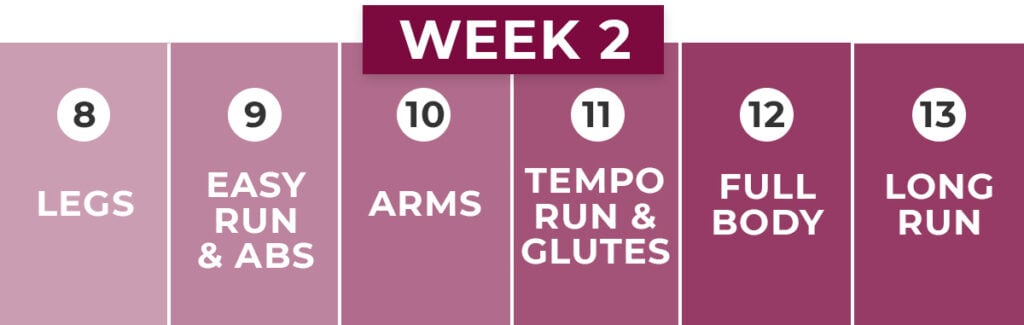
Day 8: 40-Minute Leg and Glute Workout
- Workout Time: 40 Minutes
- Equipment: Dumbbells. Optional mini loop resistance band and bench/box.
- YouTube Link: 40-Minute Glute Workout
- Running Distance: None
Day 9: Easy Run and 10-Minute Core Workout for Runners
- Workout Time: 10 Minutes (plus running time)
- Equipment: None
- YouTube Link: 10-Minute Core Workout for Runners
- Running Distance: 1-5 Miles (Think of this as a leg shakeout. Beginners should aim for 1 mile, and more advanced runners should aim for 2-5 miles.)
- Running Alternative: 20-Minute Strength and Walking Workout
Day 10: 25-Minute Toned Arms
- Workout Time: 25 Minutes
- Equipment: Dumbbells
- YouTube Link: 25-Minute Toned Arms
- Running Distance: None
Day 11: 10-Minute Glute Activation Warm-Up and Tempo Run
- Workout Time: 10 Minutes (plus running time)
- Equipment: Mini loop resistance band
- YouTube Link: 10-Minute Glute Activation
- Running Distance: 2-10 Miles (Tempo runs should be between 20-40 minutes total. If you’re an advanced runner, you can aim for 60 minutes. Aim for 80-85% of your max heart rate for 20-30 minutes of the run. The pace should feel hard but sustainable — it would be hard for you to carry on a conversation. Beginners aim for 2 miles, intermediates aim for 4-5 miles and advanced aim for 5-10 miles. You can also structure your tempo runs as intervals. For example, run 4-5 minutes at your tempo pace with a 90-second walking recovery.)
- Running Alternative: 30-Minute Strength and Steps Workout
Day 12: 30-Minute Full Body Dumbbell AMRAP Workout
- Workout Time: 30 Minutes
- Equipment: Dumbbells. Optional bench/box.
- YouTube Link: 30-Minute Full Body Dumbbell AMRAP Workout
- Running Distance: None
Day 13: Long Distance Run
- Workout Time: None
- Equipment: None
- Running Distance: 3-10+ Miles (The distance of your long run will ultimately depend on your personal fitness level and goals. Aim for 3-10+ miles at a pace you can sustain.)
- Running Alternative: 35-Minute Low-Impact Cardio Workout
Day 14: Rest Day 7-Minute Hip Mobility
- Workout Time: 7 Minutes
- Equipment: None
- YouTube Link: 7-Minute Hip Mobility
- Running Distance: None
Find This Workout Plan On YouTube
 YouTube Playlist
2-Week Hybrid Athlete Program Details
1. Gym Equipment Needed:
A Set of Dumbbells. Most daily workouts require a set of dumbbells. Each weight training workout has a recommended dumbbell weight, usually between 8 and 20 pounds. You want a weight heavy enough that your last few reps are a struggle, but you are still able to complete the workout with good form. Shop my dumbbells here (Discount Code: NML5).
Optional Exercise Equipment: Mini Loop Resistance Band (Discount Code: NML)
2. Time Requirement:
Workouts are 10-35 minutes a day, 6 days per week. You can always take more rest days as needed.
Note: the amount of time it will take to complete each workout depends on your run distance and running pace.
You can always take more rest days as needed. If you don’t enjoy running, sub power walks, or I have a “running alternative” workout video linked.
3. Fitness Level:
Intermediate to advanced, with modifications offered for all fitness levels in the daily workout videos.
If you’re looking for a full-body workout plan for beginners, follow my Beginner Workout Plan.
4. Cost:
FREE! No sign-up needed, this is a FREE Workout Plan.
FAQs
What are common mistakes in hybrid training?
One of the biggest mistakes I see is trying to do too much at once. For example, stacking intense strength sessions on top of long or high-intensity cardio without allowing for proper recovery. It’s also common to neglect one side of the equation, either undertraining strength or treating cardio as an afterthought. Another issue is not having a clear structure or progression, which can lead to burnout or stalled results. I always focus on being intentional with programming, balancing intensity and giving my body time to recover so I can actually make progress.
Can beginners try hybrid training?
Yes, a hybrid training schedule can work for beginners. I recommend starting simple and building gradually. Focus on a few strength workouts each week paired with low-impact or shorter-duration cardio sessions (or simply getting your steps in), then increase intensity and volume over time. It’s important to prioritize good form, listen to your body and not feel like you have to do everything at once. A well-structured hybrid plan can actually be a great way to build a solid, well-rounded fitness foundation from the start.
How do you tailor a hybrid athlete training program to your goals?
I start by identifying my primary goal (whether that’s building strength, improving endurance or training for a specific event) and then structure my week to support that focus. From there, I adjust the balance between strength and cardio, along with the intensity and volume of each. For example, if endurance is the priority, I’ll scale back slightly on lifting volume, and if strength is the goal, I’ll keep cardio shorter or lower intensity. The key is being intentional with how everything fits together so each workout supports, rather than competes with, your overall goal.
How to Download and Use This Hybrid Training Plan
- Download the 2-Week Hybrid Training Plan PDF by clicking here, or bookmark this webpage for reference.
- Save this workout calendar to your mobile device home screen for easy access.
- Open this workout calendar pdf in the safari browser on your phone.
- Tap the bottom arrow in the center of your screen.
- Select ‘Add to Home Screen’.
- Hover over and then click on the bold text each day to access the full video on nourishmovelove.com. Or find the daily workouts on YouTube.
- You can also access all of the home workout videos on this workout challenge calendar on YouTube via this YouTube Playlist: 2-Week Hybrid Strength Training Plan.
- Share your daily workouts with me by tagging @nourishmovelove on social and ‘Pin’ the daily workouts on Pinterest so you can do them again.
Get My Full Program Guide!
New to Nourish Move Love and wondering which workout plan is best for you? Check out more of my free workout plans, and find the program that’s best for you!
Start Here!
Pin This 2-Week Training Plan for Hybrid Athletes
Note: Before beginning any new exercise program you should consult with your physician or midwife. The information provided with this workout challenge is intended for general information and use; it does not include specific, individualized recommendations and is not intended as medical advice. Before you begin any new exercise program Nourish Move Love, LLC recommends that you consult with your physician. Nourish Move Love, LLC primarily educates clients to assume more personal responsibility for their health by adopting a healthy and active lifestyle.
This post may include affiliate links and I earn a small commission on products purchased using these links. All words and opinions are my own. Thank you for supporting Nourish Move Love.
no comments

Leave a Comment