





Standing Ab Workout
Build a stronger, more defined core with this standing ab workout that targets the entire midsection, including the abs, obliques and stabilizing muscles. This workout is perfect for those who prefer low-impact, no-floor routines. It helps improve core strength, balance and posture. This quick and effective home workout includes 5 standing core exercises using weights.
I’ve always loved incorporating standing core work into my routine because it trains the midsection in a way that feels much more natural and practical than traditional floor exercises.
A while back, I shared a standing ab circuit that used just bodyweight, and it quickly became a favorite. This version adds a dumbbell, which makes the workout even more effective by forcing the core to work harder to stabilize the torso while you move.
In my experience, standing core exercises really work because they challenge the abs, obliques and deep stabilizing muscles the same way they’re used in everyday life. When you’re resisting rotation, balancing on one leg, or controlling a weighted movement, the core has to fire up to keep the body steady. Over time, that kind of training can improve balance, coordination, posture and overall stability.
I also love that this workout completely skips crunches and planks. Instead of lying on the floor repeating the same movements, these standing exercises keep both the body and mind engaged. Movements like weighted knee drives, rotational presses and standing oblique work help sculpt and strengthen the entire midsection while also building control and body awareness.
If you’re newer to core training, standing exercises can be a great place to start. They’re approachable, easy to modify and help you learn proper core engagement. And if you’re looking to increase the challenge, simply adding dumbbells turns these simple movements into a seriously effective core workout.
Read A 5-Star Review ⭐⭐⭐⭐⭐
“This was the perfect add-on to my run. Loved the balance and functional challenges!”
— Susan A.
Workout Specifics
This standing ab workout includes 5 weighted exercises designed to strengthen the entire core while helping build definition through the midsection. Each movement challenges your abs, obliques and stabilizing muscles while keeping you on your feet, which also helps improve balance, posture and overall core control.
I like adding this workout to a routine about 1-2 times per week to build core strength and muscular endurance. It works well on its own as a quick core session or added to the end of a strength workout. To keep your routine balanced and interesting, I recommend rotating it with other styles of core training (like a Pilates-inspired ab workout or exercises such as the dead bug) so you’re challenging the core in different ways.
If you’re new to weighted ab exercises, start with lighter dumbbells and focus on controlled movement and good posture throughout each exercise. Anyone dealing with current low back pain, a core injury or who has been advised to limit rotational movements should check with a healthcare professional before attempting weighted standing ab work.
Workout Equipment:
Beginner: No equipment, just your bodyweight.
Intermediate/Advanced: Add a single medium dumbbell or kettlebell to make this a weighted ab workout. I’m using 10-15 lb dumbbells.
Workout Instructions:
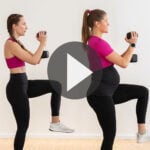
Follow along with the guided 10-Min Standing Abs Workout Video on YouTube, led by me — your certified personal trainer (CPT), Lindsey Bomgren.
Your Workout Looks Like This:
- 5 Standing Ab Exercises
- Timed Intervals (40 seconds of work, 20 seconds of rest. Perform as many reps as you can in the timed interval.)
- Repeat All 5 Standing Ab Exercises x2 Sets
Workout Outline
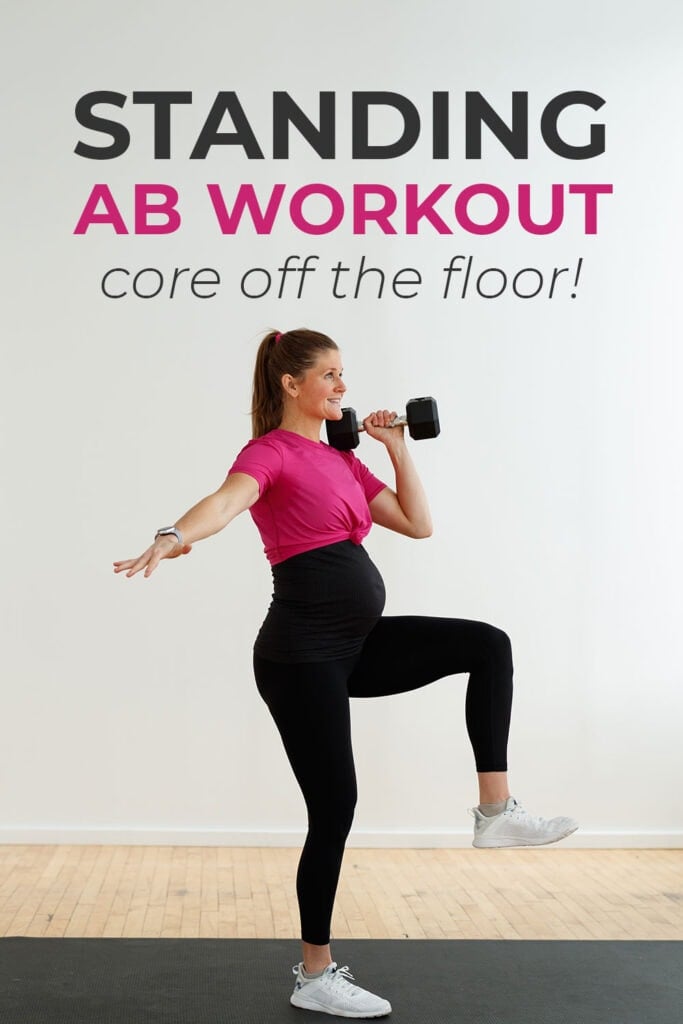
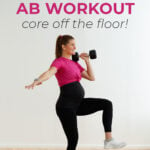
1. Goblet Hold and March (High Knee Lift)
Targets: Low abs, obliques, glutes, hip flexors, chest and shoulders.
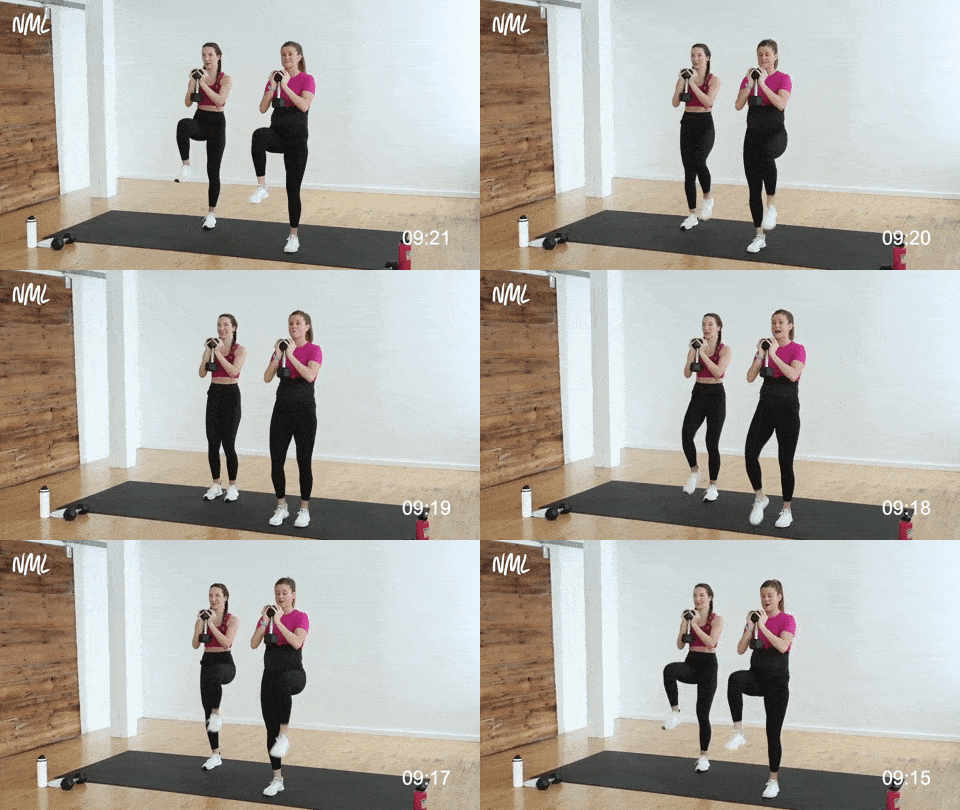
How to Do a Goblet Hold and March (High Knee Lift)
- Start in a standing position, feet hip-width apart, holding a dumbbell vertically at your chest, elbows tucked in.
- Engage your core, then drive your right knee up in line with your right hip. Right knee bent at a 90-degree angle.
- Ground through your standing leg to remain stable, then return your right foot to the ground.
- Switch sides, driving your left knee up in line with your left hip. Return to the starting position and repeat these alternating high knee lifts.
2. Uneven Front Squat and Pivot Press
Targets: Glutes, quadriceps, hamstrings, shoulders, transverse abdominis (six-pack ab muscles), abs, obliques and erector spinae.
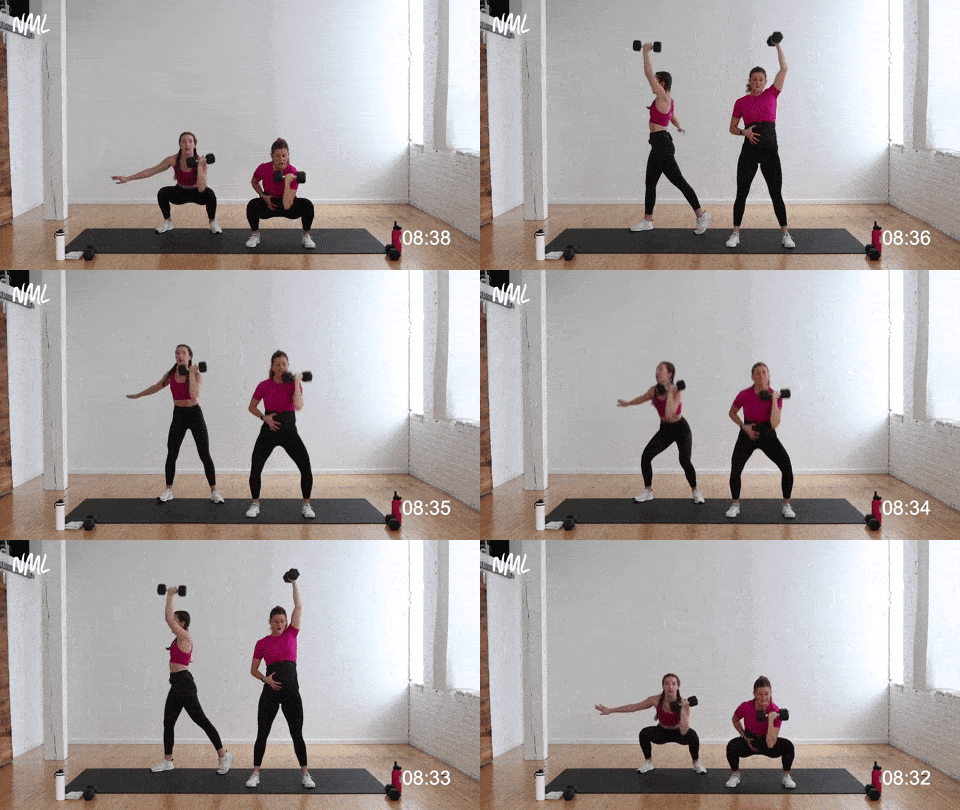
How to Do an Uneven Front Squat and Pivot Press
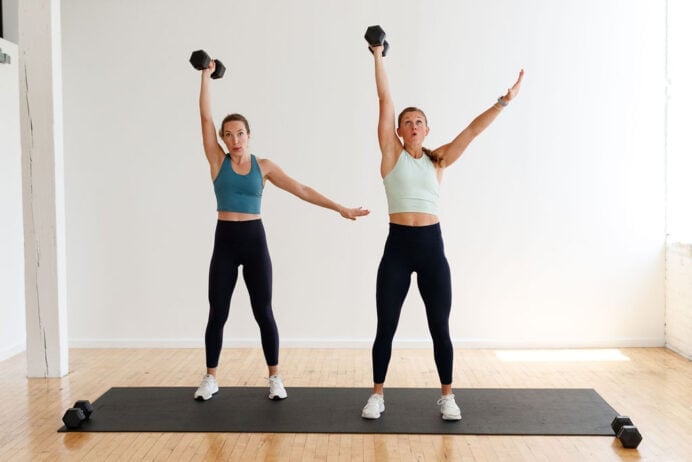
- Start in an athletic position, feet shoulder-width apart, holding a dumbbell in your right hand at shoulder height, palm facing in.
- Sit your hips back as you lower into a squat, aiming to get your thighs parallel to the ground (both knees bent at 90 degrees).
- Press through your heels to stand tall, legs straight. As you stand, you’re rotating your torso and hips to the left. Toes pointing to the left as your left heel pops off the mat. Use the power from your hips and glutes to drive the dumbbell in your right hand overhead.
- Return the dumbbell to shoulder height as you reverse the rotation, both toes pointing forward, returning to the starting position. Repeat on the opposite side during the next set.
Modification: Omit the pivot press, performing a standing squat and overhead press.
3. Single-Leg Balance Weight Pass
Targets: Low abs, obliques, transversus abdominis, glutes, hip flexors, arms and core.
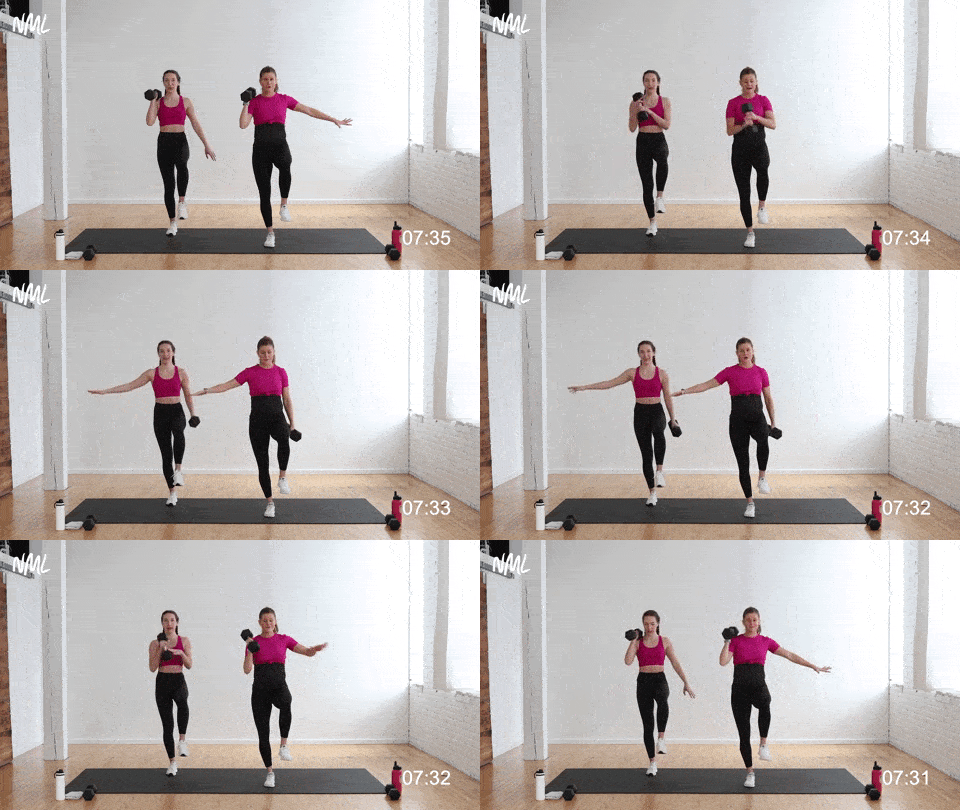
How to Do a Single-Leg Balance Weight Pass
- Start standing feet shoulder-width apart, holding a dumbbell in your right hand at the side of your body.
- Brace your core as you lift your right leg off the ground, aiming to get your right thigh parallel to the mat (bend your knee at a 90-degree angle). Ground through your left foot for balance.
- Curl the dumbbell up and across your body, transferring it from your right hand at your side to your left hand at your left shoulder. Focus on keeping your torso and hips stable as you transfer weight to the opposite side of your body.
- Return the dumbbell across your body, transferring the weight back to your right hand, and end at your side, in the starting position.
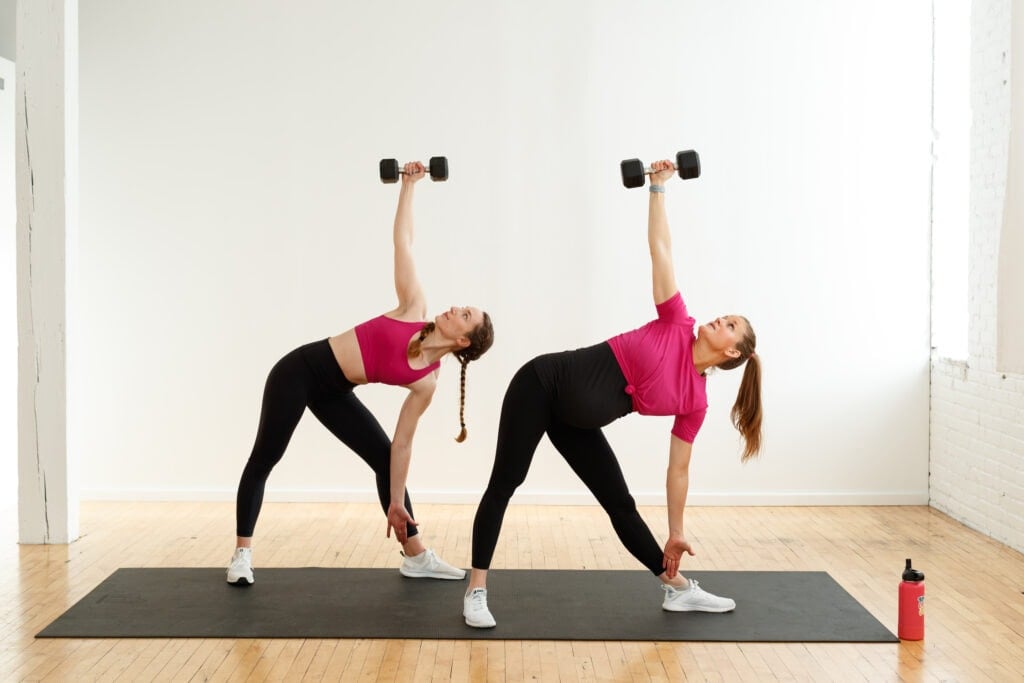
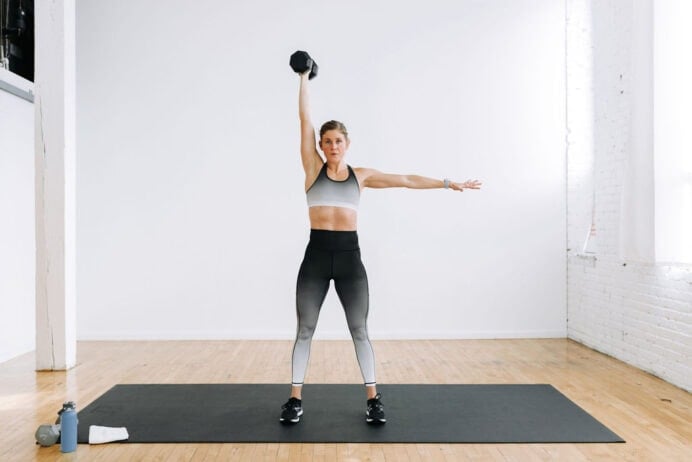
4. Windmills
Targets: Obliques, abs, upper back, outer glutes, inner thighs, hamstrings, upper body and shoulders.
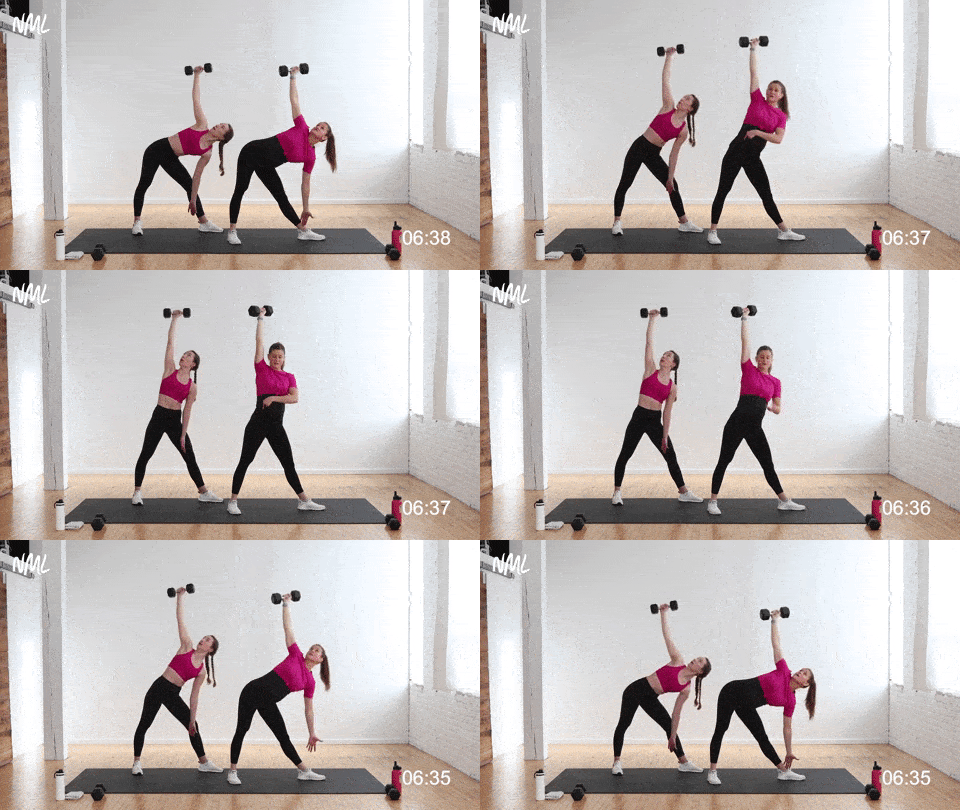
How to Do Windmills
- Start in a wide stance, holding a dumbbell (or kettlebell) in your left hand, directly above your shoulder.
- Rotate your right foot out 90 degrees so your right toes are pointing towards the top of your mat, then pivot your left foot slightly inwards (about 45 degrees). Think the right heel aligns with the left arch.
- Focus on creating and maintaining length through your waist as you hinge at the hips, sliding your right arm down your right leg. Keep your left hand directly above your left shoulder.
- Squeeze through your obliques to pull your torso back to an upright position.
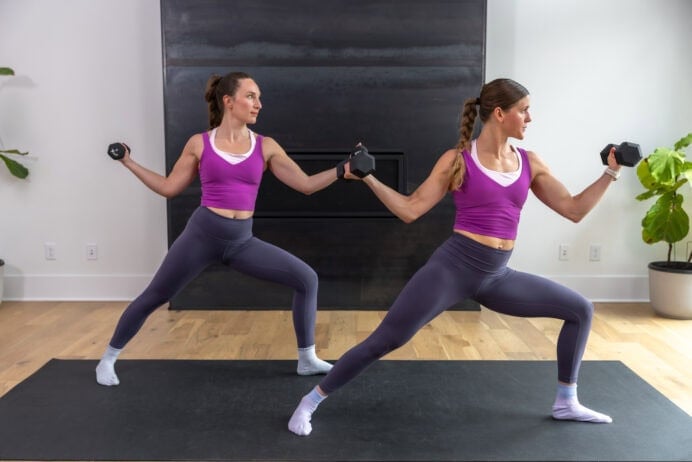
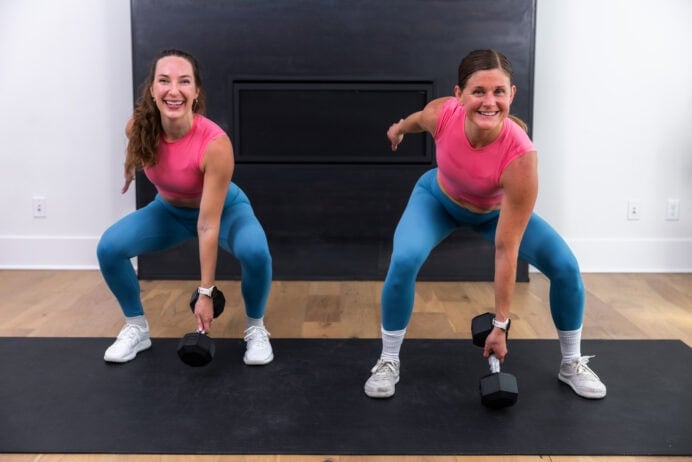
5. Lateral Squat and Front Raise
Targets: Gluteus medius (part of your butt used for side-to-side movements), quads, hips, inner thighs, shoulders, abs and core muscles.
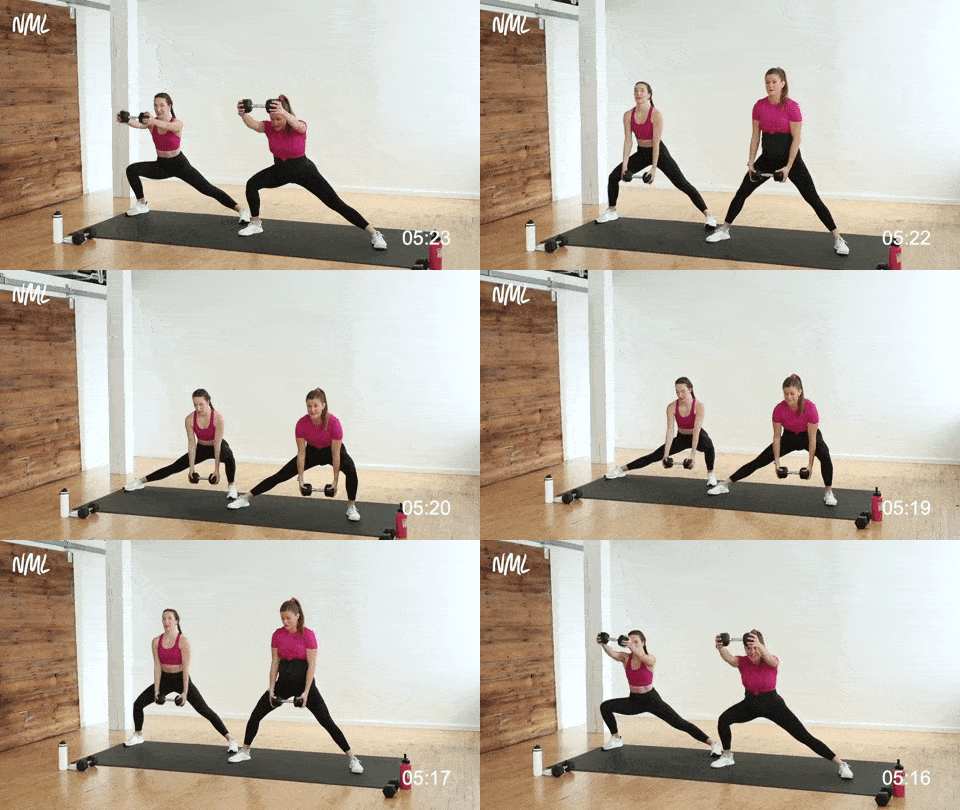
How to Do a Lateral Squat and Front Raise
- Start in a wide stance, feet wider than shoulder width apart. Hold a dumbbell horizontally between your hands, toes facing forward or slightly out.
- Sit your hips back, bending your right knee while leaving your left leg straight. Think of performing a single-leg squat on your right side.
- At the bottom of your squat, brace your core and exhale as you extend your arms, lifting the dumbbell up to shoulder height, arms straight in front of you. With control, lower the dumbbell back down to your thighs.
- Then, push off your right foot to reverse the movement, returning to the center.
- Then, repeat the movement on your left: sitting your hips back and bending your left knee while leaving your right leg straight.
- Raise your arms as you lift the dumbbell to shoulder height, then control it back down to the starting position.
- Push off your left leg to return to the center.
FAQs
Can you build a strong core using only standing exercises?
Yes, you can absolutely build a strong core using standing exercises. When you perform core work while standing, your abs, obliques and deeper stabilizing muscles have to engage to support your spine and control movement. Movements that include rotation, anti-rotation and single-leg balance can be especially effective because they challenge the core in a way that closely mimics everyday movement patterns.
Are standing core exercises safe to do during pregnancy?
Many standing core exercises can be a safe and comfortable option during pregnancy because they avoid prolonged time on your back and often place less pressure on the abdomen. However, exercises that involve heavy weights, intense twisting or strong abdominal bracing may need to be modified or avoided depending on the stage of pregnancy. It’s always best to check with a healthcare provider and focus on controlled, pregnancy-safe core movements that support core stability and posture.
How often should you do standing core exercises for best results?
For most people, adding standing core exercises to a workout routine 1-2 times per week is a great way to build strength and endurance. This allows the core muscles enough stimulus to get stronger while still giving them time to recover. Standing core work can be done as a short, standalone workout or added to the end of a strength or cardio session for an extra core challenge.
Free 7-Day Ab Challenge
More Workouts
Core-StrengtheningPin This: 10-Minute Standing Ab Workout (5 Exercises)
no comments
Leave a Comment