





How to Deadlift With Proper Form (Step-by-Step Guide)
To deadlift with proper form, hinge at your hips, keep the weight close to your body and keep your back flat, then push the floor away with your feet and stand up tall.
The traditional deadlift is the “pick it up off the floor” move that is behind doing things like lifting your kids, carrying laundry baskets and hauling your groceries. It trains your glutes, hamstrings and back (your posterior chain) for everyday life. Rather than starting while standing as you would for a Romanian deadlift, this move simply starts from the floor.
In this deadlift tutorial, I’ll walk you through the dumbbell version step by step, then show you how it carries over to a barbell.
Quick Links:
- What Is a Deadlift?
- How to Deadlift With Dumbbells
- Form Cues
- Common Mistakes
- How to Deadlift With a Barbell
- Deadlift Variations
- How to Add Deadlifts to Your Routine
- FAQs
What Is a Deadlift?
A deadlift is a hip hinge that involves you lifting a weight from the ground into a standing position. This move works your glutes, hamstrings, quads, lower back, lats, upper back, core and your grip. Along with the squat and bench press, it’s one of the three main lifts in powerlifting.
Here are some of the biggest benefits of deadlifts:
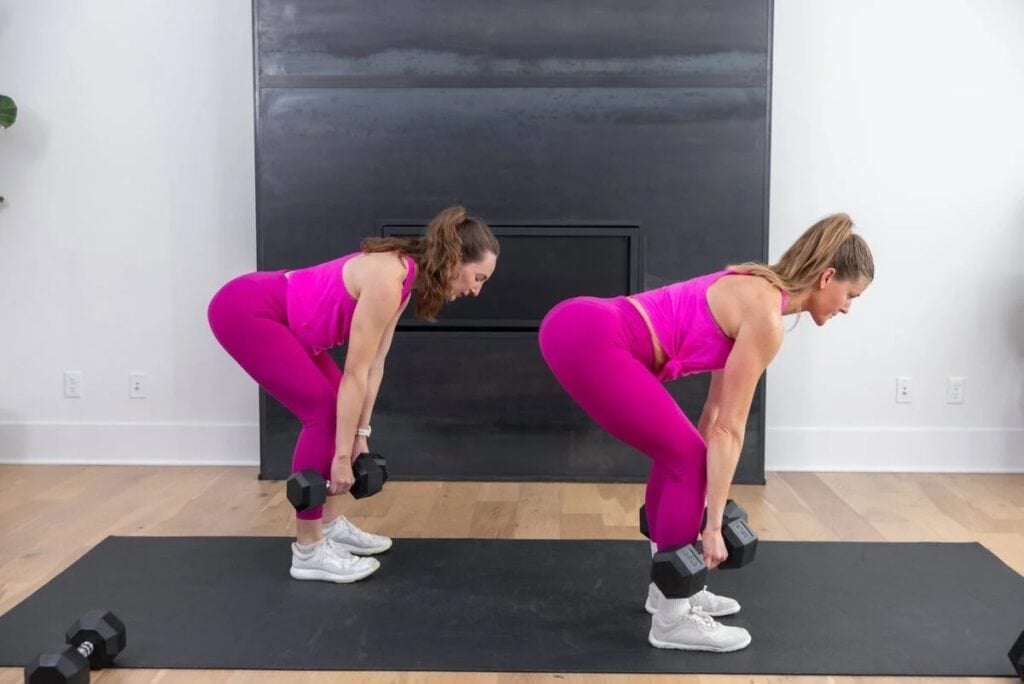
How to Deadlift With Dumbbells
Targets: Glutes, hamstrings, quads, abs, lower back, lats, core and grip.

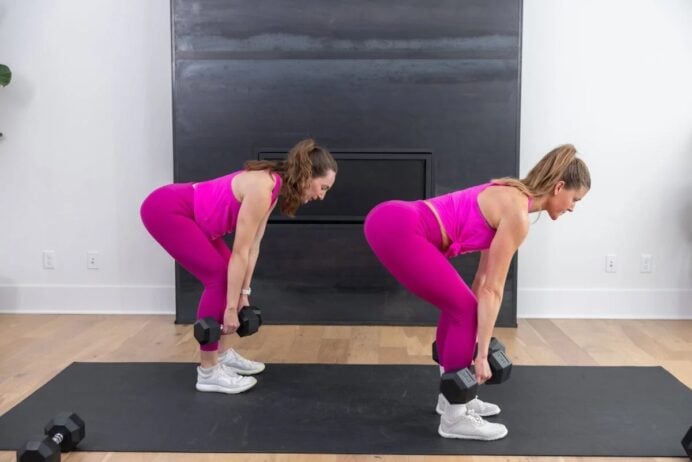
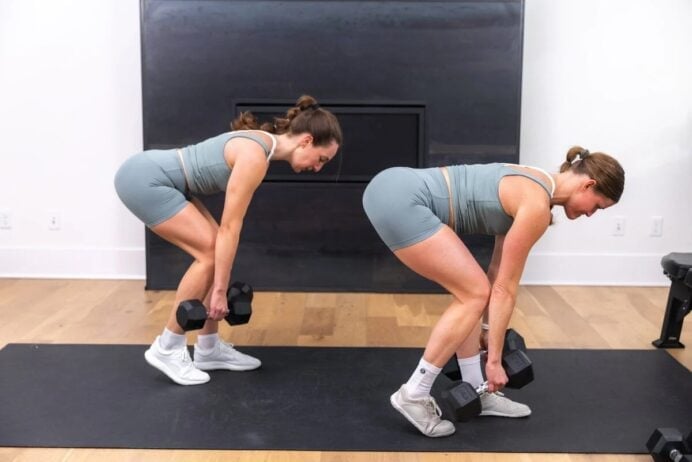
- Stand with your feet hip-width apart and set the dumbbells on the floor in front of your shins.
- Push your hips back and bend your knees to grab the dumbbells, keeping your back flat and your chest proud.
- Brace your core and pull your shoulders down and back to engage your lats.
- Press your feet into the floor, drive your hips forward and squeeze your glutes as you stand up straight, keeping the dumbbells close to your legs. Pause for about 1 second at the top; there’s no need to hold it longer.
- Push your hips back and bend your knees to lower the dumbbells to the floor with control.
Modification: Use a lighter weight or a single dumbbell or kettlebell held between your feet.
Deadlift Form Cues to Remember
If you can hit every one of these cues on every rep, you’re doing deadlifts correctly. To check, film a set from the side: your back should stay flat, and the weights should stay close to your legs the whole time. Repeat these cues to yourself mid-rep:
- “I’m keeping a neutral spine.”
- “The weights are staying glued to my legs.”
- “My chest is proud and my lats are engaged.”
- “I am bracing before I lift.”
- “Push the floor away.”
- “I am raising my hips and shoulders together.”
- “I finish with my glutes instead of leaning back.”
Common Deadlift Mistakes (and How to Fix Them)
- Rounding your back: Don’t drop your hips so low during setup, engage your lats and core before pulling and ensure the movement is a hip hinge rather than a squat.
- Hips shooting up first: Raise your starting hip height, keep your shoulders aligned and keep the weights close to your legs as you lift.
- Letting the weights drift forward: Make sure you’re starting with the weights over the middle of your feet; avoid rocking forward or dropping your hips too low when bending.
- Leaning back at the top: Stand tall and don’t let yourself lean; squeeze your glutes rather than your lower back to emphasize hip extension. If you still lean back, lower the weight.
- Jerking the weight off the floor: Pull the slack out of your arms, build tension progressively and treat it like a leg press rather than a pull.
How to Deadlift With a Barbell
If you feel that you’re able to keep a neutral spine and comfortably lift the dumbbells, it might be time to progress to a barbell.
When making this change, it’s important to start with your feet hip-width apart, with your barbell hovering over the middle of your feet and your shins about an inch from the bar. Hinge at your hips and bend your knees slightly as you grab the bar just outside the knees (use an overhand grip, a hook grip or a mixed grip for this move; lifting straps can also help once your grip gives out before your legs do).
Be sure to create tension before you lift by pulling the slack out of your barbell, then brace your core and engage your lats as you push away from the floor with your feet. Keep the bar glued to your thighs as you stand up straight, locking your hips and knees at the top.
Finish by squeezing your glutes and not by leaning backward. If a straight bar feels awkward, a hex bar (also called a trap bar deadlift) lets you stand inside the frame with the handles at your sides, which many beginners find easier on the lower back.
Once you’re comfortable, rack pulls (starting the bar from a raised position) and deficit deadlifts (standing on a low platform to lengthen the range of motion) are two more barbell variations to try.

Deadlift Variations to Try
- Romanian Deadlift: Starts from a standing position and helps unlock the full range of motion for your hips.
- Sumo Deadlift: Starts with your feet farther apart and your hands closer together, causing less stress to be applied to the lower back.
- Single-Leg Deadlift: Lifts on one leg at a time to build balance and even out strength differences between sides.
- Staggered Deadlift: This is a halfway point between a traditional deadlift and the single-leg deadlift, as one foot is used for the lift and the other is used as a kickstand.
- Kettlebell Deadlift: Uses a kettlebell rather than a barbell, which causes more focus on core engagement.
- Stiff-Leg Deadlift: Keeps your legs nearly straight to put more of the work on your hamstrings.
How to Add Deadlifts to Your Routine
When you feel ready to add deadlifts to your routine, here are the sets and reps that I recommend for each level:
Beginner: 2 to 3 sets of 8 to 10 reps
Intermediate: 3 to 4 sets of 10 to 12 reps
Advanced: 4 to 6 sets of 12 to 15 reps
How to Choose Your Starting Weight
Start with a pair of dumbbells that feel heavy by your last rep but let you keep your back straight and your hip hinge smooth. If you feel your form getting worse as you go, lower your weight. Once you are able to finish every set with proper form, try practicing progressive overload by adding a little more weight to your next workout to gradually ask your muscles to do more so they get stronger. Before your working sets, warm up with 1 or 2 light sets so your hips and hamstrings are ready to hinge.
FAQs
How do I deadlift correctly as a beginner?
To deadlift correctly as a beginner, you should be sure to start out with your feet hip-width apart, with your toes pointing out and the barbell positioned over the middle of your feet. Then hinge at your hips and bend your knees slightly until your shins lightly touch the bar. Make sure your spine is straight and squeeze your armpits as you pull the slack out of your barbell and push the floor away with your feet. Stand completely tall and lock out your knees and hips when you reach the top. If you’re brand new, start light with a pair of dumbbells before you move to a barbell.
Are deadlifts worth doing?
As long as you are using proper form, deadlifts are worth doing for full-body strength building, improving your posture and training your posterior chain (glutes, hamstrings and lower back).
What muscles do deadlifts work?
Deadlifts mostly target your posterior chain—the muscle groups that run down the back of your body. Your primary movers are your glutes, hamstrings, quads and adductors. Deadlifts also work your upper and lower back, as well as your stabilizers (abs, obliques, forearms, hands and calves).
Should you feel deadlifts in your lower back?
It is normal to feel a slight muscular pump or some soreness in your lower back during and after a deadlift. However, if you feel a sharp or burning feeling or excessive pain, stop right away, reset your spine to a neutral position and check your form or consider dropping the weight that you are lifting. Working muscles feel like a dull, even fatigue that fades within 1 or 2 days. Pain is sharp, pinpointed or gets worse the more you lift. If that sounds familiar, read my guide to lower back pain from lifting.
How heavy should I deadlift as a beginner?
When deadlifting as a beginner, you should choose a weight that allows you to feel comfortable doing 8 to 10 reps with control while still feeling like you’re safely able to continue for a few more reps. When trying to find the weight that works for you, a good place to start is at 40-60% of your body weight.
What is the difference between a deadlift and a Romanian deadlift?
Conventionally, a deadlift starts on the ground and focuses on full-body strength, whereas a Romanian deadlift starts from a standing position and focuses more on your hamstrings and glutes.
Start Deadlifting With Confidence
Deadlifts feel a lot less intimidating once you practice the movements and get the hang of them. Start light with a pair of dumbbells that you can lift with a flat back, focus on proper form and practice the hip hinge until it feels smooth. Add weight only when every rep looks like your first.
Ready to try this move in a full workout? Try starting with my Beginner Kettlebell Workout.
More Workouts
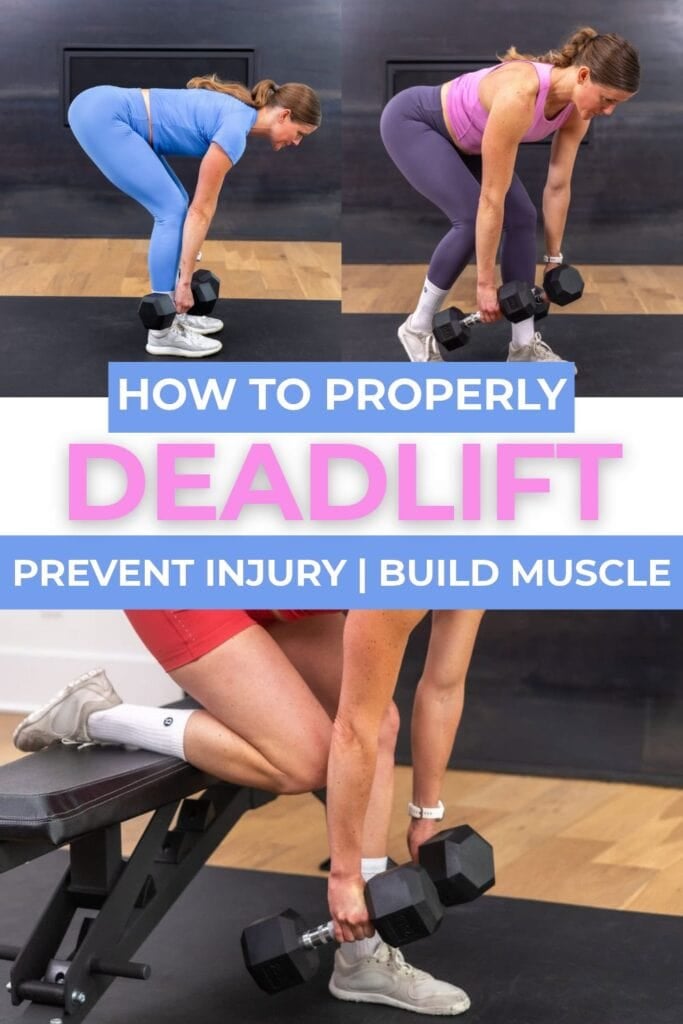
Strength TrainingPin This: How to Deadlift With Proper Form
This post includes affiliate links. I do earn a commission for products purchased using these links (at no additional cost to you). Thank you for supporting Nourish Move Love, making the content you see on this blog possible.
no comments


Leave a Comment