






9 Best Pilates Ball Exercises
In this roundup, I’m sharing 9 of my favorite Pilates ball exercises to help improve posture, stability, balance and body awareness, making this workout ideal for beginners and experienced exercisers alike. These exercises include glute-focused movements, core exercises, upper-body strength exercises and full-body stability work that can easily be added to your existing fitness routine as a standalone workout or in a 2-a-day session paired with steady-state cardio.
Rep and Set Details
Choose between 5-6 exercises from the list below and follow these rep and set ranges:
- Beginner: 8-10 reps, 2 sets, 30-45 seconds rest
- Intermediate: 10-12 reps, 3 sets, 30-45 seconds rest
- Advanced: 12-15 reps, 3-4 sets, 30-60 seconds rest
- Isometric exercises: 15-20 second holds for beginners, 20-30 seconds for intermediate, and 30-45 seconds for advanced; complete 2-4 sets based on fitness level
For an added challenge, give yourself a buy-in and cash-out exercise of a single set.
Pilates Ball Exercises Outline
1. Clamshell Squeezes
Targets: Inner thighs, hips and core

How to Do a Clamshell Squeeze
- Lie on your back. Roll onto 1 side and place your elbow on the ground, propping your head in the palm of your hand.
- Bend your knees to a 90-degree angle and place the Pilates ball between your thighs.
- Squeeze the ball with your inner thighs, then release the squeeze with control.
- Repeat for the desired number of repetitions, maintaining a controlled squeeze and release throughout the movement.
2. Glute Bridge With Ball Squeeze
Targets: Glutes, hamstrings, hips and pelvic floor
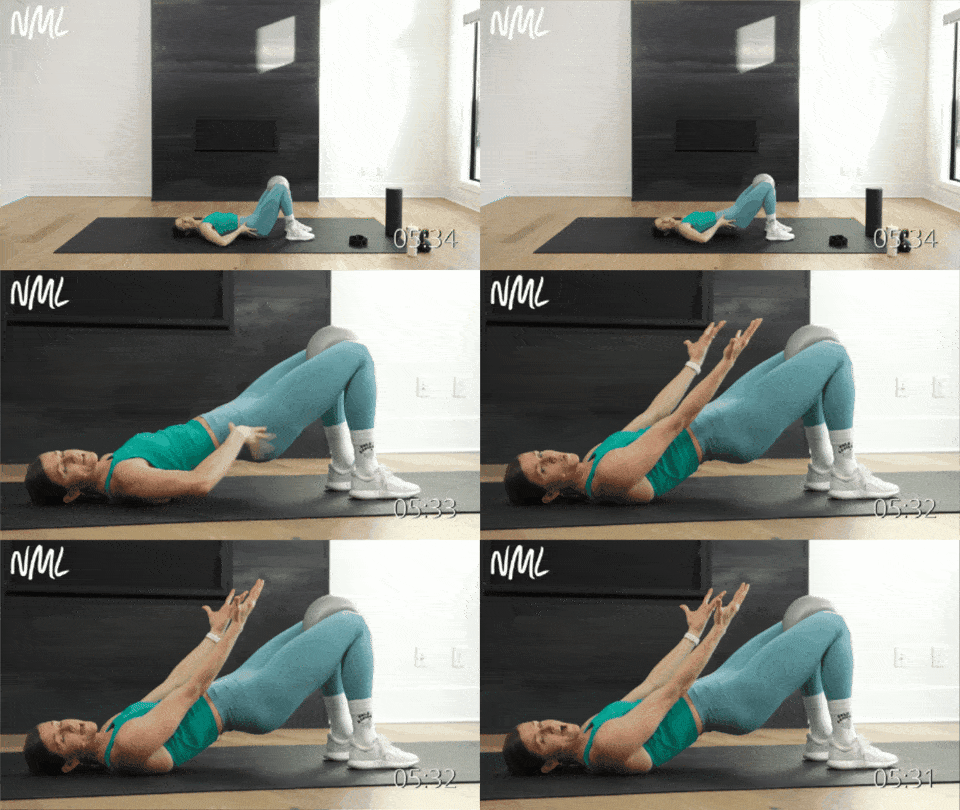
How to Do a Glute Bridge With Ball Squeeze
- Start lying on your back with your feet planted under your knees. Place a Pilates ball between your knees.
- Press through your heels to lift your glutes off the mat, squeezing your glutes as you lift. As you lift upward, squeeze your inner thighs together, pressing into the Pilates ball. Keep the ball controlled between your knees throughout the movement.
- Exhale as you slowly lower your hips to hover an inch above the mat, maintaining some tension on the Pilates ball.
Modification(s): Remove the Pilates ball and perform a standard glute bridge, focusing on controlled movement and squeezing your glutes at the top. If needed, reduce your range of motion by lifting your hips only as high as you can while maintaining proper form.
3. Hamstring Curl Heel Stamp
Targets: The gluteus maximus, the largest of your three glute muscles, hamstrings, core and shoulder muscles

How to Do a Hamstring Curl Heel Stamp
- Start in a table top position, quadruped on all fours, shoulders stacked over wrists and hips stacked over knees. Place a pilates ball behind your left knee.
- With the left foot flexed, kick the heel of your left leg up towards the ceiling, squeezing the ball as you keep a 90-degree angle in your knee.
- Perform a hamstring curl with the ball by squeezing the ball to engage the hamstring. This is a small, controlled movement.
- Then, perform a heel stamp by raising the left leg towards the ceiling an inch. The sole of your left foot should “stamp” the ceiling.
- With control, slowly lower your left knee down an inch. Again, this is a small, controlled movement.
4. Wall Sit Ball Squeeze
Targets: Inner thighs, quadriceps, glutes and core

How to Do a Wall Sit Ball Squeeze
- Stand with your back against a wall and your feet about hip-width apart, positioned slightly in front of your body. Place a Pilates ball between your knees.
- Slowly bend your knees and slide your back down the wall until your thighs are parallel to the floor, or as low as is comfortable. Keep your knees aligned over your ankles.
- Squeeze the Pilates ball between your knees to engage your inner thighs while maintaining the wall sit position.
- Hold the position, continuing to squeeze the ball and keeping your core engaged and back supported against the wall.
- Slowly press through your feet to return to standing.
Modification(s): Perform a higher wall sit by keeping your knees less deeply bent. You can also reduce the amount of pressure on the Pilates ball and focus on maintaining the wall sit with proper form.
5. Side-to-Side Leg Lowers
Targets: Obliques (muscles along the sides of your torso), lower abs and hip flexors

How to Do a Side-to-Side Leg Lower
- Start lying on your back, core activated to press your lower back into the mat.
- Lift your legs, knees bent at 90 degrees (knees stacked on top of hips) and squeeze a pilates ball between your knees.
- Keeping your shoulder blades flat on the mat, slowly lower your knees to the right side of your body, knees stacked and tapping the mat with your right knee.
- Squeeze your abs as you pull your knees back up to starting position.
- Repeat on the left, lowering your knees so your left knee taps the mat on the left side of your body.
Modification(s): Reduce range of motion of your legs to reduce the intensity of this exercise.
6. Bear Crawl Hold With Ball Squeeze
Targets: Deep transverse abdomen muscles, rectus abdominis (six-pack ab muscles), oblique muscles, shoulders, back, legs, glutes and quads

How to Do a Bear Crawl Hold With Ball Squeeze
- Start in a tabletop position, quadruped on all fours, with your shoulders stacked over your wrists and hips stacked over your knees. Place a Pilates ball between your knees, keeping your pelvis even.
- Inhale as you let your belly slightly drop, raising your gaze as you breathe into your belly.
- Exhale, drawing your belly button toward your spine. Tuck your toes under and lift your knees 1 inch off the mat, finding a bear crawl position.
- Gently squeeze the Pilates ball between your knees while maintaining the bear crawl position.
- Hold this position, continuing to squeeze the ball while keeping your core engaged and your back flat.
- Continue holding for the prescribed amount of time, maintaining steady breathing and controlled tension throughout the movement.
Modification(s): Hold a bear crawl for the timed interval without the Pilates ball. For an added challenge, alternate extending 1 hand straight overhead at a time while maintaining the bear crawl and ball squeeze.
7. Bird Dog With Ball Press
Targets: Core, glutes, shoulders and back
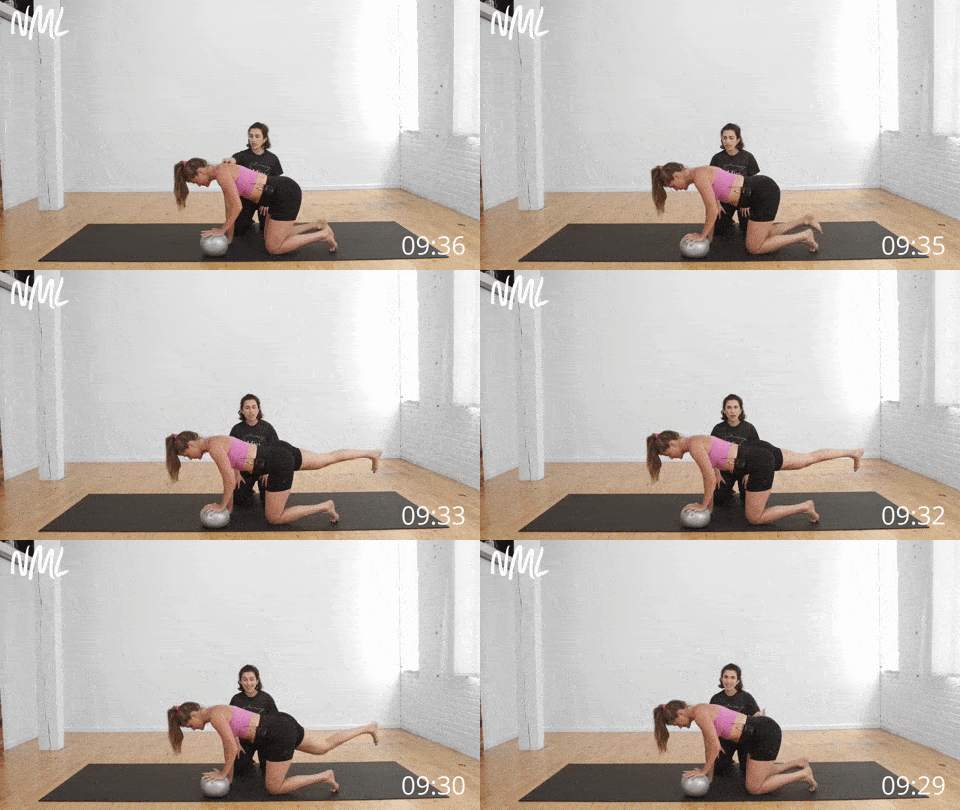
How to Do a Bird Dog With Ball Press
- Find a quadruped position with your knees hip-width apart and hands firmly on the ground, about shoulder-width apart. Place a Pilates ball under your left hand and engage your core.
- Find a bird dog position by extending your right leg back, floating it off the ground. As you extend the right leg back, extend the opposite arm, the left arm, straight out in front of you while pressing into the Pilates ball.
- Hold the right leg back and left arm out for a moment, maintaining pressure into the ball, then return to the starting position on all fours.
- Then repeat this movement on the other side of the body, moving the Pilates ball under your right hand, extending the left leg long and the right arm straight out in front of you.
8. Modified Plank With Ball Roll
Targets: Core, shoulders, chest and triceps

How to Do a Modified Plank With Ball Roll
- Start in a modified plank position with your knees on the mat and hands firmly planted on the ground, slightly wider than shoulder-width apart. Place the Pilates ball under one hand.
- Engage your core and keep your body in a straight line from your head to your knees.
- Slowly roll the Pilates ball from one hand to the other, transferring your weight as you move the ball across the mat.
- Place the ball under your opposite hand and stabilize your body before repeating the movement in the other direction.
- Continue alternating sides, rolling the ball between your hands with control while keeping your hips as stable as possible.
Modification(s): Remove the Pilates ball and hold a modified plank with both hands on the mat. You can also widen your knees for additional stability and reduce the amount of weight placed through your upper body.
9. Superman Ball Press
Targets: Lower back, glutes, shoulders, upper back and core

How to Do a Superman Ball Press
- Start lying face down on a mat with your legs extended straight behind you and your arms extended overhead. Hold the Pilates ball between your hands.
- Engage your core and squeeze your glutes as you simultaneously lift your arms, chest and legs slightly off the mat.
- Press into the Pilates ball with both hands as you hold the Superman position, keeping your arms extended overhead.
- Hold briefly, then slowly lower your arms, chest and legs back to the mat with control.
- Repeat for the desired number of repetitions, maintaining steady pressure on the ball throughout the movement.
Modification(s): Keep your legs on the mat and perform the upper-body portion of the Superman, pressing into the Pilates ball with both hands. You can also reduce the range of motion by lifting your chest and arms only as high as is comfortable.
FAQs
What are the benefits of using a Pilates ball?
As a personal trainer, I love using a Pilates ball to add resistance, instability and an additional balance challenge to exercises, helping engage the core and supporting core strength and stability.
A Pilates ball can also be useful for targeting muscles such as the glutes, hamstrings and inner thighs while adding variety to a mat Pilates workout. This also means I’m not stuck doing hundreds of crunches and hours of side planks just to target my core!
How often should you do Pilates ball exercises?
How often you use Pilates ball exercises depends on your fitness level, goals and overall workout routine. For most people, incorporating Pilates ball exercises 2-3 times per week can provide a good balance between training and recovery. You can also use these exercises as part of a larger Pilates ball workout or combine them with other forms of strength and mobility training.
What is the difference between a Pilates ball and a stability ball?
A Pilates ball, sometimes called a Pilates small ball, is typically much smaller than a stability ball and is designed to be used for targeted exercises, positioning and added resistance. A stability ball is much larger and is commonly used to challenge balance, stability and core strength. While both are inflatable balls, they serve different purposes depending on the exercise.
How do I choose the right size Pilates ball for my workout?
The right Pilates ball size depends on the exercise and how you plan to use it. A small Pilates ball should be easy to control and comfortable to hold or place between the legs, while a larger stability ball should allow you to maintain proper spinal alignment and positioning during exercises. When in doubt, choose a size that allows you to perform the movement comfortably without compromising your form.
What are common mistakes when doing Pilates ball exercises?
Common mistakes include using a ball that is too large or too small, rushing through the movement, sacrificing form for balance, and failing to maintain proper core stability. Allowing the ball to move unpredictably or losing proper spinal alignment can also reduce an exercise’s effectiveness. Focus on controlled movements, proper positioning and maintaining core strength throughout each exercise.
More Roundups
Fitness EducationPin This: 9 Pilates Ball Exercises

This post includes affiliate links. I do earn a commission for products purchased using these links (at no additional cost to you). Thank you for supporting Nourish Move Love, making the content you see on this blog possible.
no comments

Leave a Comment