



The Murph Workout: What It Is and How to Do It
The “Murph” is a Memorial Day weekend hero workout honoring Navy Lieutenant Michael Murphy, who was killed in action in Afghanistan, and has become one of the most well-known CrossFit WODs (workout of the day), attempted by thousands each year. It consists of a 1-mile run, 100 pull-ups, 200 push-ups and 300 air squats, followed by a final 1-mile run (often performed wearing a weighted vest). While it’s famously associated with CrossFit gyms and even unofficial CrossFit Games-style leaderboard comparisons, it’s ultimately a personal test of strength, endurance and grit. Many people modify or scale it to better match their fitness level using a variety of scaling options. I personally committed to completing a Murph this year; here’s everything you need to know about training for your first one.
Before You Begin
If you’ve ever felt uninspired to do the Murph, watch Lone Survivor and you’ll be inspired to do one – that’s what did it for me. I’ve been a personal trainer for over a decade, run multiple marathons (and dozens of half-marathons) and birthed 3 humans, and I was still nervous to commit to this workout.
The Murph is a CrossFit Hero WOD created in honor of Navy Lieutenant Michael P. Murphy, a U.S. Navy SEAL killed in action in 2005 during a mission in Afghanistan. It’s a simple but brutal format: a 1-mile run, 100 pull-ups, 200 push-ups, 300 squats, then another 1-mile run (often with a weighted vest), designed to push both physical capacity and mental resilience.
While it’s typically completed “for time,” a good finish depends on your fitness level, and most people scale it by breaking up reps or modifying movements. Even so, it’s a high-intensity challenge that can be completed surprisingly fast. Elite CrossFit Games-level times land around 36-46 minutes as prescribed.
The Murph isn’t for beginners, and it’s not appropriate during pregnancy or early postpartum. Anyone new to high-volume strength workouts or with underlying health conditions should skip it or choose a scaled version instead. The risk of overexertion, rhabdomyolysis and heat-related illness – and elevated heart rate stress if you push too far too soon – is real.
The Murph Challenge
There are 2 common ways to approach the Murph today. The original version, once called “Body Armor,” was one of Lt. Murphy’s favorite workouts and is performed wearing a 20 lb weighted vest if you have one.
The Murph Workout Challenge is also an annual fundraiser supporting the Lt. Michael P. Murphy Memorial Scholarship Foundation, with participants around the world completing the workout in his honor. Many CrossFit gyms also program it as their Memorial Day workout of the day as a way to honor those who have served and died in the line of duty.
Standard Murph Workout (Unpartitioned)
To perform the Murph “strictly,” you complete all reps of each movement before moving on:
- 1-Mile Run
- 100 Pull-Ups (strict pull-ups if possible)
- 200 Push-Ups
- 300 Air-Squats
- 1-Mile Run
Partitioned Murph Workout
A common strategy is to partition the reps to manage fatigue and heart rate. Start and end with a 1-mile run, and break the strength work into 20 rounds of:
- 15 Air-Squats
- 5 Pull-Ups
- 10 Push-Ups
1. One-Mile Run
Targets: Cardiovascular endurance, quadriceps, hamstrings, glutes and calves.
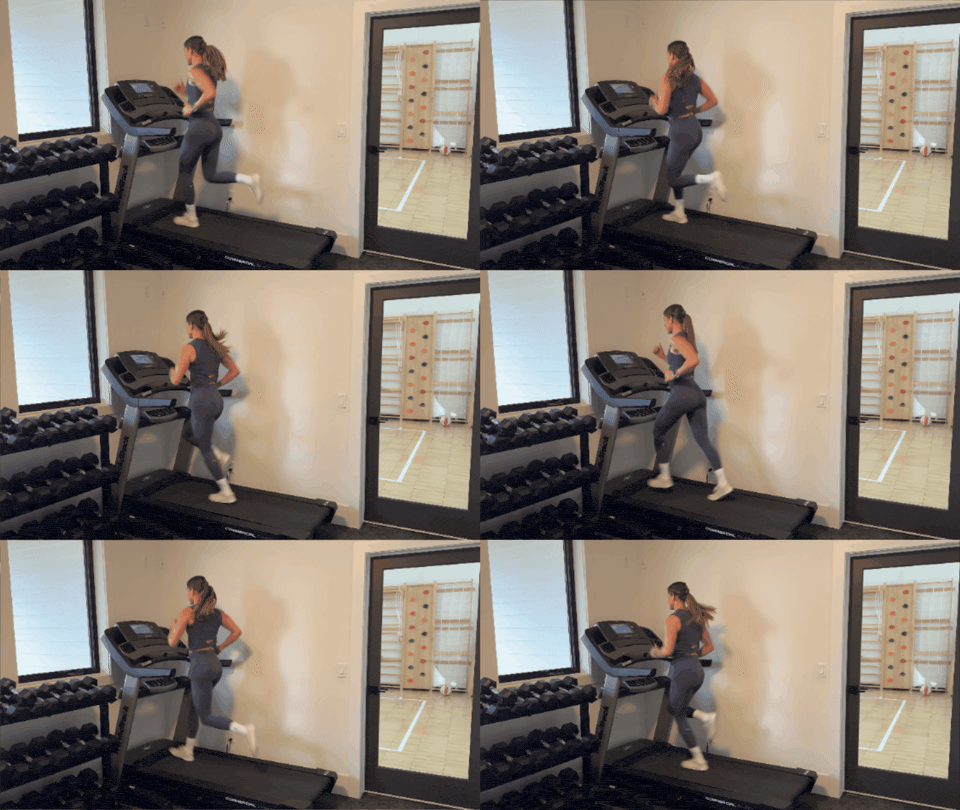
How to Train for a Mile Run
- Start with run-walk intervals. For example, you may start by running/jogging for 30 seconds, then walking for 30 seconds. Repeat this pattern until you run a mile. As you build cardiovascular endurance, gradually increase your running time while decreasing walking time. Continue increasing your running time until you are able to run for the entirety of the mile.
- Focus on cross-training. In addition to adding short and medium-distance runs to your training routine, I recommend following a strength training for runners workout plan that incorporates core, upper body and lower body exercises.
Common Mistakes: One of the most common mistakes made during the Murph is starting off the run portion too fast. You need to pace yourself to maintain energy for the rest of the workout, so don’t try to PR on your first mile.
Modification(s): If running hurts your knees, you can substitute jump rope, rowing or cycling.
2. 100 Pull-Ups
Targets: Latissimus dorsi (lats), biceps, rhomboids, trapezius (traps), deltoids (shoulders), forearms and core.

How to Do a Pull-Up
- Reach up and grip the pull-up bar with your palms facing away from your body (overhand grip), hands slightly wider than shoulder-width distance apart.
- Hang from the bar: Allow your body to hang freely with your arms fully extended.
- Perform the pull-up: Initiate the pull-up by squeezing your shoulder blades together and pulling your chest towards the bar. Keep your elbows pointed downward throughout the movement.
- Complete the pull-up: Continue to pull your body, pulling your chest up until your chin is above the bar, or as high as you can comfortably go. Keep your core engaged and your body straight throughout the movement.
- Lower yourself down: Slowly lower yourself back down to the starting position, extending your arms fully to return to the starting position.
Common Mistakes: Instead of thinking “chin over bar,” think “elbows to hips.” This encourages proper muscle engagement and prevents excess straining or swinging.
Modification(s): If you can’t do a pull-up, start by performing assisted pull-ups with a resistance band. Then, increase max pull-up reps by following a pull-up progression program. You could also substitute ring rows for pull-ups.
3. 200 Push-Ups
Targets: Chest, shoulders, triceps, back, abs and core muscles.

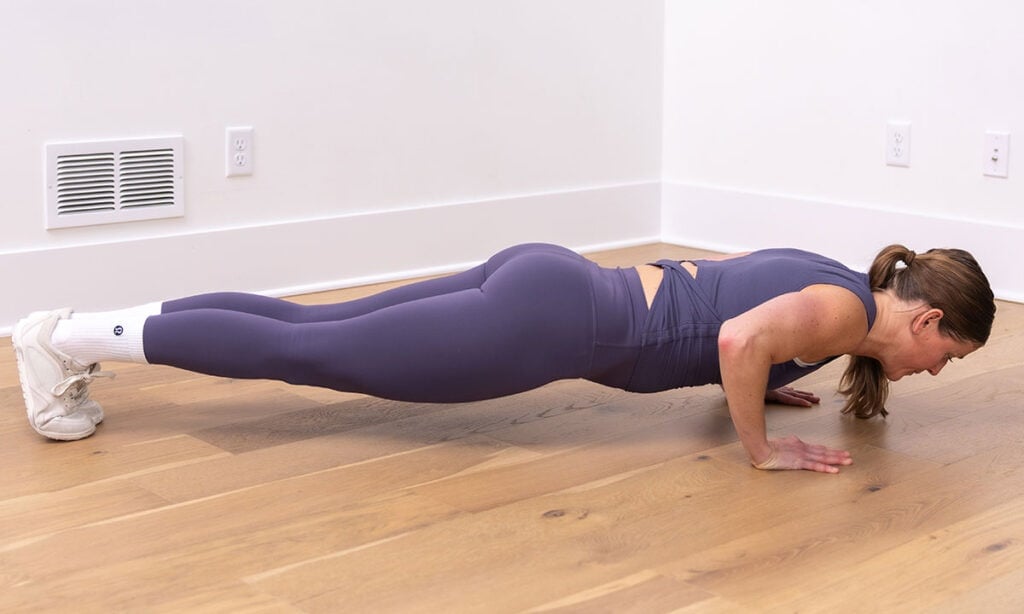
How to Do a Push-Up
- Start in a high plank position with your shoulders stacked over your wrists, weight evenly distributed amongst all 10 fingers. Pull your kneecaps up towards your belly, feet hip-width apart. Option to place your hands on weights if you have wrist pain.
- Hold this plank position, maintaining a straight line with your body, gaze slightly in front of you.
- Slowly lower your chest down towards the ground as your elbows fall back towards your hips (not out to the sides).
- Once at the bottom of your push-up, exhale as you push back up into a high plank position.
Common Mistakes: Try tucking your elbows in slightly (about a 45-degree angle) rather than straight out (90-degree angle) to protect your shoulder joint. If you look at your body from above, your elbows should form an “A” shape, not a “T” shape.
Modification(s): If you can’t do a push-up on your toes, start by placing your hands on an incline, or choose one of these push-up modifications. Then, increase max push-up reps by following a push-up progression program.
4. 300 Air-Squats
Targets: Legs, glutes, quads, hamstrings, hip flexors and core.

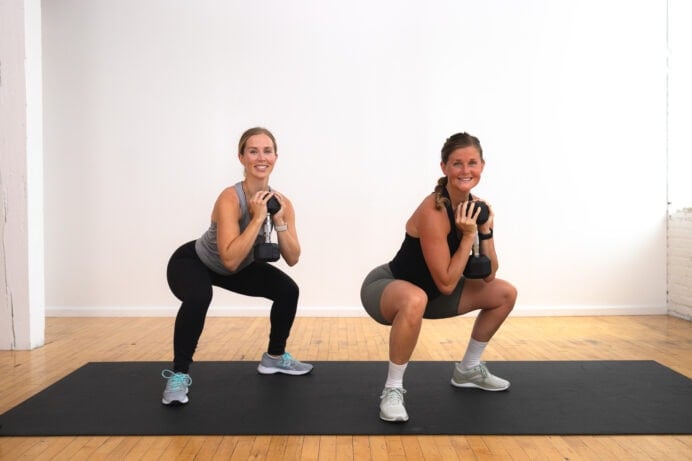
How to Do an Air-Squat
- Stand with your feet shoulder-width apart, shoulders stacked over hips, and knees slightly bent. Think about engaging your core and keeping your spine neutral.
- Lower into a squat by sitting your hips back (as if sitting in a chair). Lower until your thighs are parallel to the floor, 90-degree bends in both knees.
- Drive through your heels to stand tall, completing 1 rep.
Common Mistakes: Don’t allow your knees to collapse in – instead, focus on pressing your knees out towards your pinky toes.
Modification(s): Consider doing box squats or shallower squats to reduce intensity. Alternatively, if squats don’t feel good, substitute these lunge and squat alternatives.
FAQs
How long does it take for a beginner to complete the Murph workout?
For beginners, a scaled Murph can take anywhere from 45 to 90+ minutes depending on fitness level, pacing and how the movements are broken up. Even experienced athletes often take 45-60 minutes as prescribed, so slower finishes are completely normal. The goal is consistency, not speed or leaderboard positioning.
What is a good Murph workout time?
A “good” Murph time depends on experience and whether you’re doing it Rx or scaled. For the standard version, competitive CrossFit athletes may finish in 35-45 minutes, while most fit recreational athletes finish in 45-70 minutes. Anything under an hour is generally strong for non-competitive athletes.
What are some tips for improving your Murph workout time?
The biggest factor is pacing and avoiding early burnout. Partitioning reps (like 5-10-15 or Cindy-style rounds) helps maintain steady output. Building strict pull-ups and push-up endurance ahead of time, and controlling your run pace so your heart rate doesn’t spike early, are key performance drivers.
Is there a modified or mini Murph workout?
Yes, and it’s very common. Scaling options include reducing total reps (50-100-150), using assisted pull-ups or ring rows, doing incline push-ups or shortening the runs. A mini Murph is often used as a progression for beginners working toward the full version.
Should you wear a weighted vest for the Murph workout?
A weighted vest is optional, not required. The traditional Rx version includes a 20 lb vest for men and a 14 lb vest for women, but many people complete the workout without one. If you’re newer or still building strength and movement efficiency, it’s best to skip the vest until your body is ready.
Keep Going, You’ve Got This
The Murph is a demanding full-body hero workout that challenges both physical endurance and mental toughness, combining a 1-mile run, high-volume bodyweight movements and a final mile run (often with the option to add a weighted vest). Throughout this guide, I’ve broken down how to approach it, how to scale it and what to expect so you can train and complete Murph safely and confidently.
This isn’t a workout meant to be done regularly. Most people reserve it for Memorial Day as a yearly benchmark – a way to honor those who served in Afghanistan and lost their lives in the line of duty, while also measuring personal progress year over year.
There’s no need to chase CrossFit Games-level times, leaderboard rankings or unbroken sets to “do it right.” Whether you complete the full version, scale the reps or modify movements, success is about showing up and working with intention.
At its core, the Murph is about remembrance, respect and effort. If you show up and complete Murph in a way that meets your current ability, you’ve already done it right.
Free 2-Week Strength Program
More Workouts
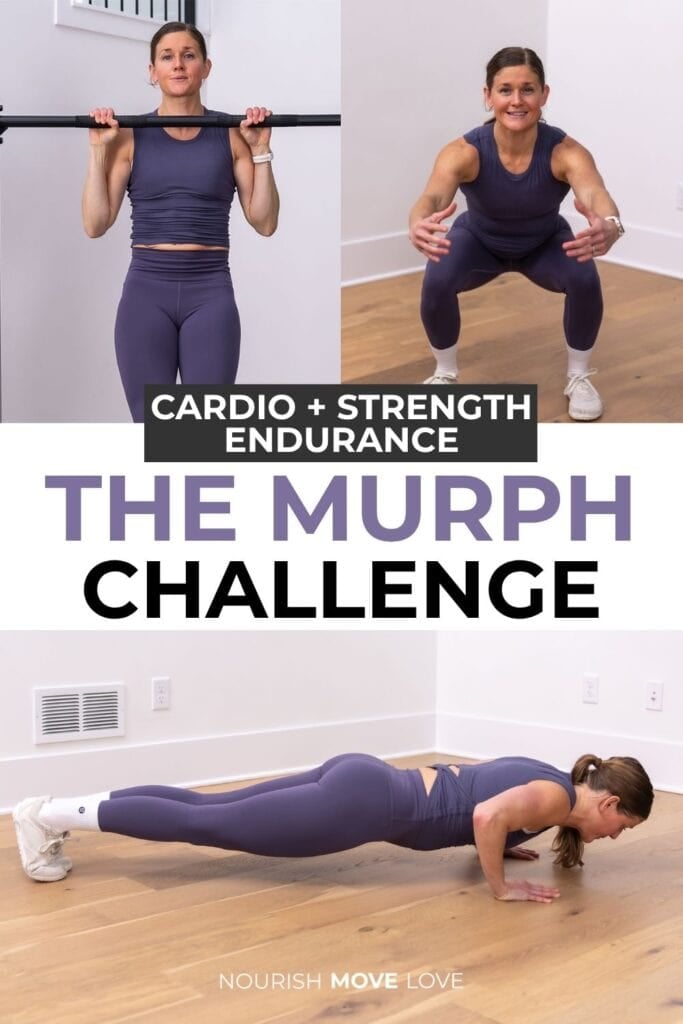
Strength and EndurancePin This: The Murph (What It Is and How to Train for It)
no comments